

So many of today’s best-selling Christian books claim to present the Bible clearly. So many of our growing churches are popular for the way in which discipleship is understood simply. It seems we live such confused lives that complexity and ambiguity are out. Perhaps, then, Pentecost too? It demands so much patience and uncertainty -- when (sigh) Babel was so straightforward!
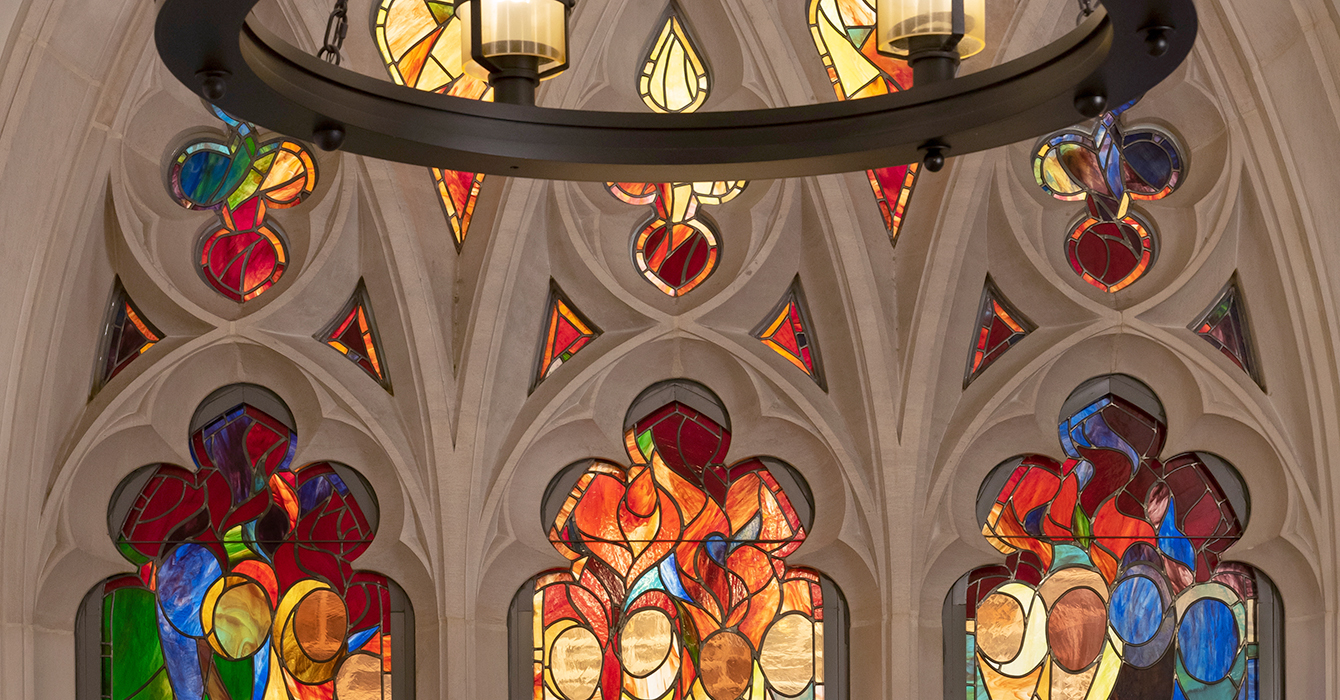
It was the early church fathers who first saw divine reversal in the events of Pentecost in Jerusalem (Acts 2) compared with the primeval portrayal of Babel (Genesis 11). At Babel the one language was confused; in Jerusalem the many languages become comprehensible. At Babel the people were scattered; in Jerusalem “every nation” comes together. At Babel earth tried building its way to heaven; in Jerusalem heaven reaches down to earth. At Babel the human ego was condemned; in Jerusalem the human spirit is renewed. At Babel we saw divine frustration; in Jerusalem we witness divine delight. At Babel we look into a mirror; at Pentecost we gaze through a window -- a window that reveals a glimpse of heaven on earth.
The harmony of heaven depicted in the book of Revelation -- of every tribe and tongue gathered around the throne -- is foreshadowed on the day of Pentecost in Jerusalem. “All nations” are gathered: their various colors, cultures and languages retained. At Pentecost these differences no longer serve as barriers; rather, the very diversity and variety is part of the excitement and awe with which God is lauded in multidimensional harmony. A decisive blow is paid to any tidy family line or unitary culture: first the descendents of Noah must be dispersed; that way there’s a chance they may grow into God’s “rainbow people.”
The church was born at Pentecost, and we celebrate its birthday once a year. But, I wonder, are we formed by Pentecost, shaped by its implications for the ways (nature or nurture) the church is raised and organized?
I find the parallel with Babel especially instructive. Babel represents a dazzling logistical accomplishment. Though the mythological language does not lend itself to organizational detail, a strong central administration is suggested. Imagine hiring the prominent architect, engineer and main contractor, who harness armies of brickmakers, bricklayers and other skilled laborers in teams that apparently pull together seamlessly. Here is the show-home skyscraper: the first among many promised landmarks, to furnish the city fit for heaven. It would have made a strong MBA case study, impressive for the clarity of vision, unity of purpose and efficiency of its workforce. (And I bet that building opened on time!)
But the pattern of Babel is decisively rejected. Previously God had worked order out of chaos, but here chaos is preferred over order. High procedural order. The focused bureaucracy is destroyed. As with a toddler’s toy tower, the bricks are toppled from a great height across the surface of the earth. And the people are scattered with them -- to work out new ways of building community and administering their common lives: in small breakout groups rather than plenary.
At Pentecost, we might suggest the central administration was less impressive. The apostles were never obviously noted for their discipleship skills in any case, but at this point in Jerusalem they lack for vision and direction as well. Their membership has encountered some flux, and there is no clear unity of purpose except to follow the instruction from Jesus to wait (Acts 1:4 and 8).
When the promised Spirit descends, it gets even messier. There is an immediate level of chaos -- Is the wind blowing up a hurricane? Is the house burning? Are they drunk? -- until bewilderment moves to amazement and the confused throng start hearing languages they are surprised to comprehend. Peter’s spontaneous sermon situates him in a new position of leadership. Yet Luke stresses the democracy of Pentecost: “all of them [the 12] were filled with the Holy Spirit” (Acts 2:4), and before the end of the chapter another 3,000 are baptized and filled with the Spirit.
What follows from Pentecost is a fast-moving narrative of collaboration, opposition and growth. The church does not simply begin; it explodes. We may note how Jerusalem bears historic significance for the church -- as the place of its birth -- yet hardly functions as administrative base or even spiritual home (unless you count the time spent by apostles in its prisons). Appropriately, it hosts the first church council (Acts 15), after which the heady mix of proselytizing and persecution shapes a new diaspora. If there is any common thread, it is the constant surprise. The apostles, like God’s Spirit, are on the move. Partnerships and affiliations are all characterized by ongoing transition.
The contrast between Babel and Pentecost is not a playoff between maintenance and mission. No, at both Babel and Pentecost we are witness to the lively pursuit of mission. Rather, the difference has to do with how and why mission is embraced. At Babel the mission is human, the goal is measured in bricks, and success means efficiency in a strategy of design and delivery. At Pentecost the mission is not ours, the goal (the throng worshipping at God’s throne) is immeasurable, and success continually demands shunning efficiency for the sake of seeking the least and the lost. Pentecost undermines all blueprints, all formulae, all reduction to principles. Note that Peter did not preach in sound bites -- even to a nonliterate crowd.
A business school recommendation might be “change management.” I’m sure such skills are helpful, but the whole point of Pentecost is that there is no neatnik set of answers. The answers include living with uncertainty, holding in tension ambiguities, being patient in confusion, questioning our tendency to streamline for efficiency. They suggest breaking out instead of reining in, reaching for ever more uncomfortable, costly diversity and, more generally, tolerating broad margins of messiness. At bottom, perhaps it is about who is in control. Which is something both Babel and Pentecost make absolutely clear.