

In the heart of Manhattan, just a few blocks south of Times Square, two dozen young executives gathered in a conference room one evening last fall for an important meeting. Investment bankers, stock analysts, accountants and other Wall Streeters, they weren’t discussing the latest IPO, the day’s Dow Jones close, year-end bonuses or the state of the economy.
They were there to talk about Jesus. To talk about faith and work and how to integrate the two. Meeting at the administrative offices of Redeemer Presbyterian Church at 36th and Broadway, they read Scripture and discussed how to set boundaries on their ambition and keep work from taking over their lives.
Questions to consider
Questions to consider:
- Where have you seen or experienced a disjunction between work and faith? Where have you seen Christians view their work as a calling from God?
- Does Redeemer's ministry suggest that Protestants have lost their gift for seeing all Christian labor as priestly? If so, how do we regain it?
- What would it mean to see work as a form of gardening, as tilling the ground to create something fruitful?
- If work has become an idol, how can it be turned instead into an icon -- a place transparent to the loving gaze of Christ?
- Are other fields besides the arts susceptible to the "vortex of arrogance and despair?" If so, what does liberation from it look like? What role could small groups play in your ministry to help other professions break free?
“Listen to God, be open to God,” Linda Lin, the class leader, said as they talked about God’s call to Moses from the burning bush. “God is who he says he is: ‘I am who I am.’”
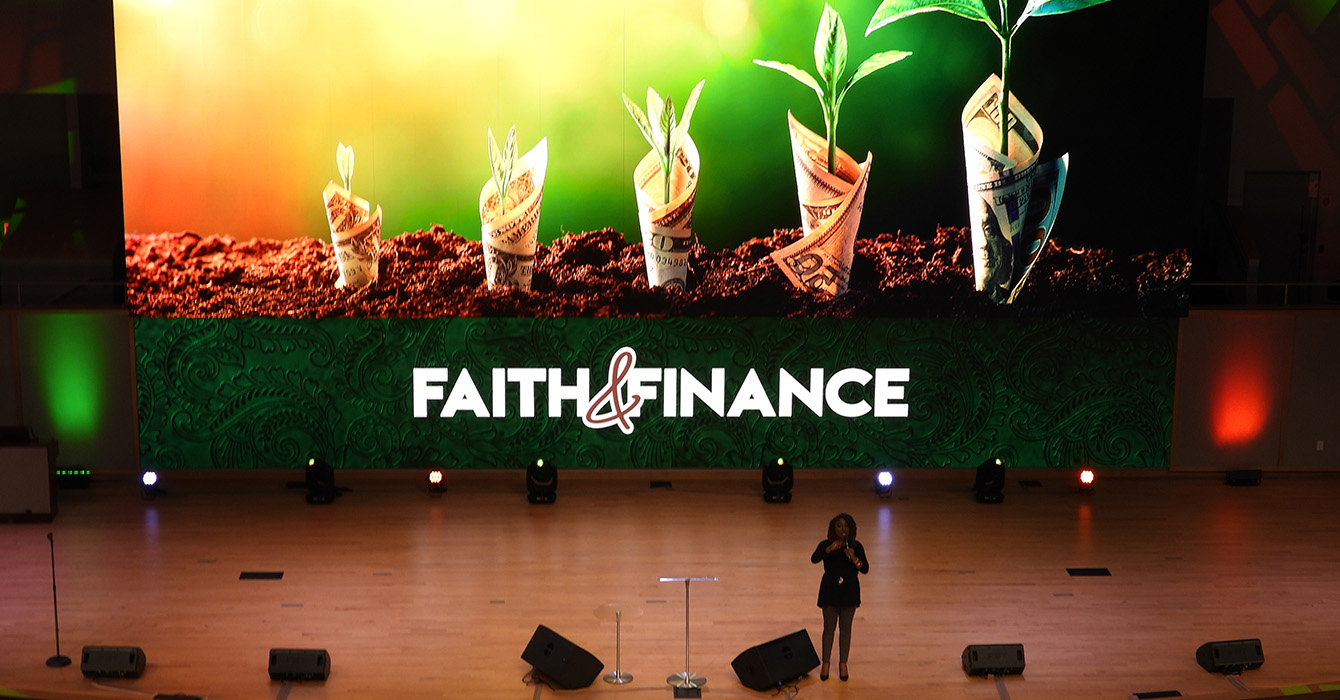
It was the monthly fellowship meeting of Redeemer’s Financial Services Ministry, one of hundreds of meetings, classes and other events held each year by the church’s Center for Faith & Work. One of Redeemer’s core ministries, the center is an ambitious and innovative program that helps members bring their religious beliefs to every aspect of their lives, personal and professional. Redeemer calls the center its “cultural renewal arm.” Its function: to “equip, connect and mobilize” members to transform the workplace, their professions and the broader community and culture.
“We’re trying to break down the dualism of people who don’t think their faith and their work have anything to do with each other,” says Katherine Leary, the center’s director. “God wants our whole lives to matter.”
'We bring the gospel with us'
A former CEO in the high-tech industry in California, Leary became a Christian at Redeemer while living in New York in the 1990s. In 2002, Redeemer’s senior pastor, the Rev. Tim Keller, asked her to return to New York to create the center. She was given a seat on Redeemer’s executive team and free rein to design the center.
Launched in January 2003, the center operates in four broad, overlapping areas:
• educational programs, including classes on the theology of work, vocational decision-making and cultural renewal, and the Gotham Fellowship, an intensive leadership development program;
• vocation-based fellowship groups for people in the financial sector as well as for artists, writers, lawyers, health care professionals and others;
• an arts ministry to create community for artists and opportunities for artistic expression within the church, and engage the Redeemer congregation in supporting the arts; and
• the Entrepreneurial Initiative to encourage and support entrepreneurs in new ventures -- profit and non-profit -- that help bring about gospel-centered change.
Undergirding the center’s work, Leary said, is a theological vision that permeates all ministry at Redeemer, one that comes straight from Keller: The gospel transforms and renews. It transforms individuals’ hearts, then their communities and then the world.
“One way the gospel changes the world is that we’re out there working in it,” Leary said. “Whatever our sphere of influence, we bring the gospel with us and it changes the world we’re in.”
Work, like all creation, is broken, Leary said. But it does not have to be that way. Work is not just a means to an end, but was created and ordained by God for good. Despite that run-in with the serpent and God’s curse on humanity to earn bread by the sweat of one’s brow, Keller and Redeemer espouse a pre-Fall account of work. It’s like Adam and Eve tilling the ground in the garden. All work is, or should be, a form of gardening: digging, rearranging resources and creating something new that contributes to human flourishing.
“Our job as Christians is to resurrect and provide hope in a workplace that is broken,” Leary said. “And that is really hard.”
Core idols
Redeemer members know well the struggles of work and faith, Leary said. Like the congregation overall, the center’s participants are young, with an average age of 30. Most --70 percent -- are single. And they are almost all in New York for one reason: work. Whether they are lawyers, stock traders, actors or advertising copywriters, they’ve come to seek their fortune in one of the most competitive cities on earth. About 20 percent of Redeemer’s congregation works in business or finance and another 20 percent in the arts or related fields.
“In some ways, we have the most work-identity-driven segment of the population,” Leary said. “We get them right out of college or grad school, coming to New York to make it. Work is what they’re thinking about when they get up in the morning and when they go to bed at night.”
Leary compares the center to a college ministry. She and her staff engage young people at a critical stage in their personal, professional and spiritual development. Most will be in New York a few years before moving away, so the center tries to use that interval to push and challenge them.
The participants come from a variety of faith backgrounds, Leary said. Some are lifelong Christians. Others are seekers, perhaps liking some aspects of Christianity but liking work even more. Others live a dualistic life, going to church on Sunday and doing what they want the rest of the week.
“We’ve got the whole range,” Leary said. “But people are ready to be changed at different points in their life and with different things. What we try to do is push them to examine where their worldview is blocking their ability to let God into their life.”
For many people today -- in New York or elsewhere -- work has become the primary barrier to God, Leary said. Job and career have become the real “American Idol,” one where the traditional idols of money, sex and power converge. Idolatry is the focus of Keller’s latest book, “Counterfeit Gods: The Empty Promises of Money, Sex, and Power, and the Only Hope that Matters.”
“We talk about idolatry a lot,” Leary said. “It’s one of the reasons why people come to Redeemer and to the center. It’s hitting some chord of truth that they know they have to wrestle with. The center gives people a great chance to wrestle through their core idols.”
That wrestling was palpable at the Financial Services meeting in October. Elmer Huh, a financial analyst with Duff & Phelps, opened the meeting with his personal testimony.
“Working on Wall Street can seem glamorous and sexy and appealing,” he said. But Huh saw the other side when he lost two jobs in two and a half years, each time spending months out of work. The latest was with Lehman Brothers, which collapsed in the largest bankruptcy in U.S. history.
“Sometimes God gives us thorns in the side again and again until finally we get it,” he told the group. “When I lost my job, I felt like my entire life was taken from me. But I heard another voice, Isaiah 43: ‘I am about to do a new thing.’”
Employed at Duff & Phelps for the past year, Huh is thriving now. But looking back, he realizes that he failed to make God a priority previously. Yet God never abandoned him.
“The lowest points of my life were the highest points in my relationship with God,” he said.
Arrogance and despair
As at most megachurches, small groups play a critical role at Redeemer. The church has an extensive network of small six-to-12-person fellowship groups that meet throughout the city for prayer and Bible study. The vocational groups supplement those groups, and many church members are in both.
When the center began, participants wanted to organize by vocation, Leary said. Some issues are common: What do you do if you’re the only Christian at your workplace? Is it okay to talk about my faith at work or evangelize co-workers? How do I discern my vocational call? Am I in the right work? But the issues can play out differently in different fields, and every field has its own challenges.
“The idea is that you need to talk about these issues in the context of a community of people who live in and understand your world,” she said.
Tim Keller on faith, work and cultural renewal:
- Keller’s article “Work and cultural renewal” appeared in the January 2010 Redeemer Report.
- Listen to “For such a time as this,” a Jan. 25, 2009, talk on faith and work in the economic crisis.
Artists who come to New York, for example, are often susceptible to a “vortex of arrogance and despair,” said LuAnn Jennings, the center’s coordinator of arts ministries. The former director of a theater company in Atlanta, Jennings came to New York seven years ago to study acting. While supporting herself in a staff job at Redeemer, she was recruited by Leary in 2004 to launch the arts ministry program.
“For an artist, if you make it here, you really have made it,” she said. “So the city attracts artists who believe they have the ability to make it to the top. And they believe this is the only place in the world where they can get what they want.”
When that doesn’t happen, life gets hard.
“You have to borrow money from mom and dad to pay your rent,” she said. “You’re living in a 500-square-foot apartment and if you’re married, you can’t afford kids. Despair sets in and starts to intersect with the arrogance in a way that makes it difficult to break free.”
The arts ministry program helps them break out of the vortex. The fellowship groups connect them with other artists, where they discover that others face the same challenges. It helps them think through core issues of identity and realize they are more than “actor” or “dancer” or “writer.” They begin to understand who and whose they really are as children of God.
But the arts ministry, like all the center’s programs, is also about mobilizing participants to change culture and the world. The program provides creative outlets including art exhibitions, a literary magazine and a dance project, Perichoresis. Through its Entrepreneurial Initiative, the center has helped fund a theater company.
Whatever their field, the center encourages participants to dig beneath the superficial. Sometimes, the issues of work today can be so complex that it’s easy to stay with safe conversations, Leary said.
Ethics discussions, for example, can easily become dead-end conversations about “what I do right and what others do wrong because they’re not Christian,” she said. Business executives might talk about how it is wrong to fudge expense reports. Or an actor might pledge to never take a role where they “take the Lord’s name in vain.”
“And so, we check off the box and, unfortunately, we miss the chance for a much deeper relationship with Christ,” she said. “Christianity is about more than personal piety. You have to be a thinker as a Christian. You have to be able to think more deeply and reflexively about God. Unfortunately most people aren’t very equipped to do that. They need theology to help.”
To give people a chance to explore issues of work and faith more deeply, the center launched the Gotham Fellowship two years ago. Over nine months, from Labor Day weekend to Memorial Day weekend, 24 young professionals meet weekly for in-depth theological study and reflection, work with spiritual and professional mentors and form a supportive community of peers. They read about 100 pages of theology a week from writers such as Augustine, Athanasius, Luther, Calvin, Lesslie Newbigin and N. T. Wright.
Amilee Watkins, 28, has worshipped at Redeemer since moving to New York from Colorado five years ago. She was in the first class of Gotham Fellows and now works on staff. Before that she spent seven years with Starbucks, including five years as a store manager in Manhattan.
Watkins said the Gotham Fellowship helped her realize how she could put her faith to work in her job at Starbucks and, in fact, already was.
“It was a great laboratory in which to work out issues of faith and work,” she said.
Changing culture, she discovered, doesn’t have to be as grand as commissioning a new painting or a play. Sometimes, especially in a city of 8 million people, it can be as simple as how you serve coffee.
If Watkins’ store was a lab, apparently the experiment was a success. At least one customer was impressed, even blogging about Watkins in August 2008 :
“Amilee Watkins is arguably the best employee I have ever seen. She is an enthusiastic leader, fearsomely cheerful, and sometimes frighteningly efficient. I remember the first time she went down the line of waiting customers and started rattling off each of their orders from memory, smiling at them for confirmation, calling out the order to the barristas, wishing everyone good morning...we were flabbergasted. Customer service? With a smile? And remembering your order??? In MANHATTAN?”
It’s called cultural change. One decaf, double, tall, non-fat cappuccino at a time.