
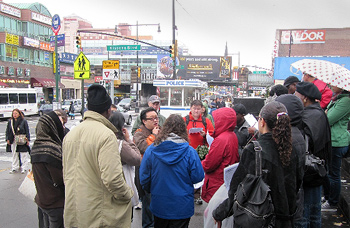
Mid-morning on a rainy fall Saturday, four people clustered near the subway entrance in Flushing, Queens, the last stop on the 7 line that stretches back to Times Square. Twenty yards away, hundreds of people hurried about their business, streaming through crosswalks and dodging traffic at Main and Roosevelt.
Their destinations: a jarring mix of stores and offices that line the two streets. Old Navy, McDonald’s, Dunkin Donuts and Starbucks. A grocery with caramel-colored roast ducks, hanging by their necks. A podiatrist with “before” and “after” photos attesting to the treatment of foot fungus. Jewelers, lawyers, travel agents and optometrists, advertised by signs in Chinese, Korean and English.
Near the subway stop, three of the small group stood with bowed heads. The fourth, Peter Ong, 39, looked about, eyes wide open, taking everything in and praying softly.
“Lord, we ask that you bless all the people here, all the commuters on the 7 line, the shoppers, and all the people of Flushing,” Ong said.
High above, atop a building across the street, a billboard proclaimed, “The Wonder of It All.” It was an ad for a casino. But that didn’t matter. That morning, it was a blessing, a benediction, a statement of fact.
Because this was all the classroom of City Seminary of New York. Teams of City students, faculty and alums -- African, Indian, Chinese and Puerto Rican, Pentecostals, Presbyterians, Baptist and more -- were on the move, walking, learning about and praying for Flushing and its people.
Among them was the Rev. Mark Gornik, a pastor and scholar who came to New York about 10 years ago to start a church in Harlem and wound up launching City Seminary as well. Opened in 2003, the school is a small, independent seminary that provides theological education to men and women in ministry in the rapidly changing religious landscape of New York. More accurately, Gornik insists, it is an intercultural learning community that brings together pastors and others in Christian ministry in New York to learn from one another.
Rooted in the changing demographics of global Christianity, City Seminary is a school for a particular time and place, Gornik said. Its sole focus is leadership development for urban ministry in New York, primarily in the city’s ethnic and immigrant communities where Christianity is thriving.
At a time when many denominations and seminaries are trying to determine how best to prepare ministers for a changing world, City Seminary is using innovative theological education to narrow the gap between the academy and church, theology and the world. It is exploring questions all seminaries face, questions of how to provide contextual education and how to prepare leaders for ministry in a globalized, multicultural world.
City Seminary is answering those questions in a way that is specific to New York and the needs of its urban pastors, said Christian Scharen, an assistant professor of worship and theology at Luther Seminary and a member of City Seminary’s board of directors. Still, other schools have much to gain from City Seminary’s re-imagining of theological education.
“There is a real richness in being in conversation with others about how they are answering similar questions in their context,” Scharen said. “What we’re doing here at Luther Seminary is trying to learn from how they are answering the questions, in order to spark creative ideas about how we can answer the questions here.”
The city is the seminary
The first clue to City Seminary’s identity is its name, especially the city part, says Emmanuel Katongole, a Ugandan-born theologian, authority on world Christianity and co-director of the Center for Reconciliation at Duke Divinity School. It’s not a generic descriptor like City Plumbing or City Hardware or City Auto Sales.
“The city is the seminary,” said Katongole, who has taught at the school. “All roads lead to New York. The whole world is there. A vision of world Christianity is already being lived out, right there in New York City.”
What Gornik and City Seminary have done, Katongole said, is value and embrace that vision and the people -- the pastors and others -- who are bringing it about in congregations all over New York.
“This is not the usual seminary, where you come, sit down and learn from above,” Katongole said. “Rather than top down, it is bottom up. Many of these pastors may not have formal theological education, but they have valuable experience. What the seminary does is to help them build upon that experience.”
To understand City Seminary, set aside all preconceptions of the academy, Gornik said.
“We’re a community,” he said. “That’s who we are and how we operate.”
The school does not offer degrees and is not accredited, though both items are on its list of long-term goals. Until recently, students could earn credit toward a master’s degree at Westminster Theological Seminary in Philadelphia, but that program ends next spring as Westminster phases out the New York branch of its urban ministry program. About 150 students take part in various sessions or events each year, including a core group of about 50 in ongoing programs. Tuition is low -- $295 for its eight-month-long Ministry Fellows program -- and the school is funded primarily by donations and grants, including one from Lilly Endowment Inc.
The school has no traditional courses, no Intro Old Testament or History of Christianity 101. Several stand-alone seminars and workshops on urban ministry, world Christianity and other subjects are held each year and have featured an impressive lineup of speakers, including Katongole, Miroslav Volf, Christine Pohl and Luke Timothy Johnson. But the heart of the school’s educational offerings -- programs such as Ministry Fellows, a leadership training program in urban ministry -- weave together the study of Scripture, the changing church, missions and theology.
Even then, the focus is on community, with the school working on a cohort model, Gornik said “You can’t just come in, take a class and be gone,” he said. “You enter with a particular cohort of students. You learn together. You’re building relationships and everyone’s knowledge increases because it is shared.”
It’s a participatory approach to education, rather than a “banking” approach in which knowledge is received, deposited and later withdrawn. It is also an approach that is highly academic, Gornik said.
“Our question is ‘How do we do ministry in New York City?’” Gornik said. “If you really focus on that question, it’s going to produce a profoundly theological and scholarly enterprise.”
To find the answers, the students read theology, learn about New York and its history, and study global Christianity. Together, they read and study Scripture extensively, looking at Acts, for example, as a model of how the gospel advances across different cultures. This year, Gornik said, they’ve been reading John deeply, drawing on Jean Vanier’s commentary “Drawn into the Mystery of Jesus through the Gospel of John.”
Questions to consider
Questions to consider:
- How can your community engage more deeply the particularities of life at street level in your city?
- If the Bible “starts in a garden and ends in a city,” what can we learn about God’s intentions by studying cities as multi-layered as New York?
- Many seminaries were founded when this country was largely rural. As we become increasingly urban, how will those institutions adjust?
- With mass immigration, Christians from Africa, Asia or Latin America are often our neighbors now. How can we become a more multi-ethnic, multi-national church by being better neighbors to them?
- In what ways, if any, do you or your church or other institution unknowingly fall into the provincialism that Peter Ong speaks of? What changes might be going on around you that you’re not even aware of and how do you open your eyes to those changes?
The typical student doesn’t have formal theological education but is already active in ministry. Highly skilled and motivated, they come to the school to dig more deeply in the Christian tradition, explore questions about ministry with others and gain a greater theological grounding.
Because most work full-time, the sessions are held in the evenings or on weekends, at the seminary’s office in Harlem or in churches around the city. Leavened throughout it all are experiences that get the students out in the city.
Because the students are from many different cultures and traditions, they have to be willing to listen, to hear how others understand the Christian faith, Gornik said. That way, everyone contributes.
“That’s how the body of Christ is supposed to work, actually,” Gornik said. “That’s the image in Ephesians, we reach the full stature of Christ together.”
The Rev. Adebisi Oyesile, pastor of Chapel of Hope Redeemed Christian Church of God in Brooklyn, a Pentecostal denomination founded in Nigeria, said City Seminary helped him understand and appreciate other faith traditions. Before, he was reluctant to speak with nonbelievers and sometimes those from other traditions.
“But this school points you to Christ,” he said. “You may be Catholic, Pentecostal, Protestant. What affects you affects everybody. It’s all pointing to Christ, and you can see that it all works together.”
Pray and break bread
The Saturday event in Flushing was a “Pray and Break Bread” event, essentially a series of small pilgrimages held over the past three years in every borough. The events bring together students and others to pray for the peace in the city and learn more about New York. After reading and meditating on Scripture together, participants walk around the selected neighborhood in small groups, pray as they feel called and afterward reflect together over a community meal.
“I can’t explain who we are any better than the Pray and Break Bread events,” Gornik said. “It’s people grounded in community who are coming together for an intercultural learning experience. We’re on the streets, learning from one another, having a great time together and sharing food. That is the seminary in a nutshell. It’s as good a picture of the seminary as you can get.”
The October event began at the Flushing branch of the Queens Library, where Ong gave colleagues an overview of his neighborhood. He’d chosen to meet at the library because it represents much of what Flushing is about, Ong said. Serving a constantly changing immigrant community, it’s the busiest branch of the busiest public library system in the nation, with books and movies in about 50 languages. Chiseled into the front stairs are book titles in Russian, Arabic, Chinese and English.
The borough of Queens is the most ethnically diverse county in the United States, Ong explained, with a mix of white, Hispanic, Asian and African-American residents. In Flushing, most residents are foreign-born, and almost 80 percent speak a language other than English at home.
With the ethnic diversity comes religious diversity. On one nearby street, Ong said, a Hindu temple, synagogue, mosque, Protestant church and Catholic church all stand within blocks of each other.
But beneath this bustling and vibrant cityscape, all is not well, Ong said.
“There are some tensions in the community, some antagonisms over race and ethnicity,” he told the group. “There are immigration issues. Issues of access to health care. It’s not uncommon for people to have to work seven days a week to make ends meet. So, pray for the people of Flushing.”
Before they fan out in teams of three and four, the group reads Scripture together, including Psalm 146, with its reminder that the “The LORD watches over the alien…”
For the next 45 minutes, Ong’s team moved through the neighborhood, praying at the subway stop, a struggling Protestant church, a retirement home and Flushing High School. Then they rejoined the others at Jade Asian Restaurant, discussing over lunch what they’d seen and learned.
Based on people’s cars and clothes, they’d noticed what seemed to be a surprising range of incomes in the area. Amid the overwhelming Asian presence, one person noticed a group of Hispanic day laborers, waiting for work.
The school’s dean, Maria Liu Wong, pushed the students to continue reflecting on the day’s events after they returned home. A former City student recruited by Gornik to the dean’s post, Wong has played a leading role in designing the Pray and Break Bread events and other programs.
“What is God telling you in walking with others and praying in community?” she asked.
As the gathering ended, Ong offered parting words.
“My hope is as you walk away, remember the people of Flushing,” he said. “Get out of the provincialism we all fall into. Continue to pray for us.”
An incarnational experience
Even in New York, it’s easy for people to stay in their own neighborhoods. It’s hard to realize you’re part of sweeping demographic and religious change when you’re in the middle of it.
Ong, who works developing lay leaders for Asian-American churches, said he wanted to go to City Seminary to study theology, to think and reflect. Once, Gornik assigned Ong’s cohort of students to attend a worship service at a church from a different faith tradition and ethnicity. A Presbyterian, Ong went to a service for the deaf at a Pentecostal Church on the Lower East Side of Manhattan.
“I’ve met Kenyan pastors and Puerto Rican pastors, East Africans living in Hunter Point, people in the Bronx and in Harlem,” he said. “The seminary challenged and stretched us.”
As the students learn from and support one another in community, they also help each other in the practice of ministry. It’s an incarnational approach to theological education
“We’re physically engaged in the city,” Gornik said. “Our bodies are in the city. We’re listening, seeing, talking, and praying. We’re making connections between our faith and every area of life. It’s a very comprehensive understanding of Christian faith. It’s a faith that walks, a faith that talks, a faith that listens and a faith that sees.”
That intimate, embodied approach to theological education is perhaps one of the greatest lessons that City Seminary has to offer traditional seminaries, Katongole said.
Despite their strengths, many traditional seminaries can become isolated outposts. In his own work, Katongole said, he often wonders how traditional seminaries and other institutions can stand apart and expect to have any impact in transforming communities -- especially those that are overlooked or neglected, whether in Africa, urban immigrant communities or rural America.
“What Mark is saying is that the city has a dynamic of its own and you can’t engage it from a distance,” he said. “Mark is calling for an incarnational vision of the gospel that requires an incarnational seminary experience.”
Gornik is reluctant to offer much advice for others. But he notes that all seminaries are grappling with changes in religious life and in the world. Clearly, the world is becoming more urban, and if they haven’t already, seminaries need to turn their face to the city, he said.
“But I don’t think we can say to anybody, ‘You should do this,’” he said. “Every institution has to find its own charism and calling. This is who we are. There are always lessons learned from every institution, but you have to be who God called you to be. And we’re trying to be true to our vocation.
“We’re just a storefront seminary trying to muddle our way through the challenge of trying to learn together.”