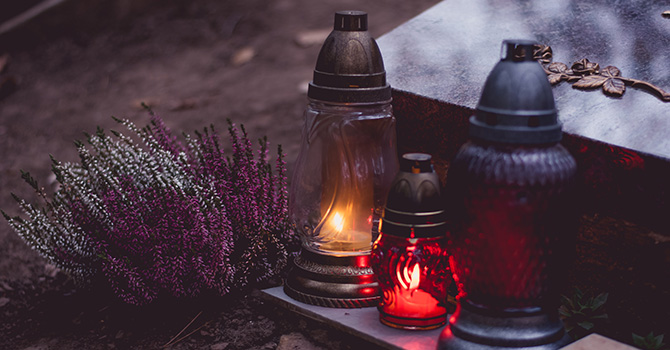
I stared at the ofrenda in front of my neighbor’s fireplace, the altar of remembrance clothed in a dozen tea lights and strings of marigold flowers.
The tan stones in the background were brightened by a lacey, multi-colored paper banner, papel picado, along with a trio of intricately decorated paper skulls (calaveras) inviting us to bear witness and beckon in those who are no longer with us.
This simple space became the star of the night. Small tables and boxes draped in red and black and amber-colored fabrics hosted vases filled with even more marigold flowers: sunny blossoms that were bigger, brighter, fuller even than their accompanying garlands.
Over time, the altar filled with photographs and other tokens of remembrance — a bottle of soda, stuffed animals, mosaic art, backpacking gear. Before it filled, however, my neighbor gave a brief history and described its significance.
Teresa spoke of Día de los Muertos, a holiday that honors the dead and tells the story of her people. As she explained, the Day of the Dead is rooted in Indigenous Mexican tradition with later additions from the Catholic tradition. It’s a celebration of color and light marked by ancestral love.
Some who might not otherwise know it may recognize the holiday because of the animated film “Coco.” In it, a little boy adventures to the Land of the Dead to discover his family’s true history. When different characters there sing the lullaby “Remember Me,” viewers are encouraged to “Remember me, though I have to say good-bye, remember me."
More often than not, remembering is our invitation.
Teresa’s words weren’t all that different from that lullaby for the motley crew of neighbors and friends, strangers and family gathered during the twilight hours of the day.
“Who do you want to remember? Who would you like to honor tonight?” she asked, pausing and looking at each of us between her questions.
As daylight waned, the nine or 10 of us sitting on couches and chairs and yoga cushions did as Teresa instructed: We grabbed colored markers and thin sheets of balsa wood of different shapes and sizes, and we began to write.
Wooden stars and hearts, circles and rectangles became our thin places — holy spaces where earth and heaven meet in a smattering of names and sacred memories, of details that matter to those who are on this side of the veil, who’ve been left to tell the story.
We wrote of our mothers and fathers, our grandmothers and grandfathers, our aunties and uncles. We wrote of our friends and our dogs and our brothers, of the faithful departed we wished to honor, of those we hoped might somehow speak to us that day.
I thought about Grandma Mac, my father’s mother, a woman who taught me how to play scrappy ragtime pieces on the piano when she wasn’t pounding out old Baptist hymns she knew by heart. She’d slip into the garden every day, gathering a tomato or a few pieces of lettuce, and then to the garage for a scoop of sourdough from the five-gallon bucket on the floor.
“Angus,” she’d named the sourdough starter, like any good Scottish woman would.
“Angus,” my cousins and I repeated, when the pancakes we ate for breakfast and the chiseled loaf we dove into for lunch and the rolls we broke apart for dinner made us close our eyes in hallowed ecstasy.
As Alzheimer’s slowly stole Grandma Mac away, she kept playing the piano. She kept feeding us Angus, until she didn’t, until she couldn’t anymore. And when she could no longer feed us, we fed her — our food never as good as what she prepared, our piano playing never as skillful as the octaves she crossed.
But saint of a saint, soul of a soul, I spoke her name aloud in Teresa’s living room that night. I remembered and breathed in and beckoned her come, join me, be present with me, with us, in that moment.
As I placed her wooden square on the altar, I thought about the church I now call home. Along with my siblings in the Catholic Church and in Protestant traditions, we celebrate All Hallows Eve, All Saints’ Day, and All Souls’ Day as an invitation to God’s beloved to prepare for the holy, honor the saints who have gone before us in the faith, and remember the souls that are no longer with us.
Alongside Día de los Muertos, Allhallowtide always happens on Oct. 31, Nov. 1, and Nov. 2. And like that night in Teresa’s living room, the faithful mark these days by remembrance — desperate, perhaps, to say the names and not forget those who have preceded us. Desperate for hope to meet us in our grief.
Because isn’t this what remembering often does? When we remember, an alchemy occurs, if only for a moment. Grief and hope intermingle and dance side by side, the two seemingly joined at the hip, swaying and moving in unison.
This much I have witnessed as a hospital chaplain, when holy accompaniment invites me to sit with a family who is saying goodbye to their loved one, when a lonely patient begs me listen as they recall and recount aloud the stories of their people. Here, we become our most vulnerable selves, left to the mercies of hope and to a desperate longing that everything wrong be made right again. To me, that’s when the power of naming and giving voice to memory become most profound, most fleshy and real.
The former Baptist in me doesn’t always know what to do with all this remembering. It wasn’t what we did growing up. It wasn’t something our church leaders begged us to partake of and swallow down as a way of wrestling with cycles of life and death, and of the entire family of God, past, present and future.
But now I recognize the power of remembering.
I think about that night in Teresa’s living room, when naming saints and souls became a simultaneous celebration of Allhallowtide, and an altar clothed in bright blooms and dotted with white flames became a most holy space of grief and hope. Remembering invited us to dance with them both.
More often than not, remembering is our invitation.