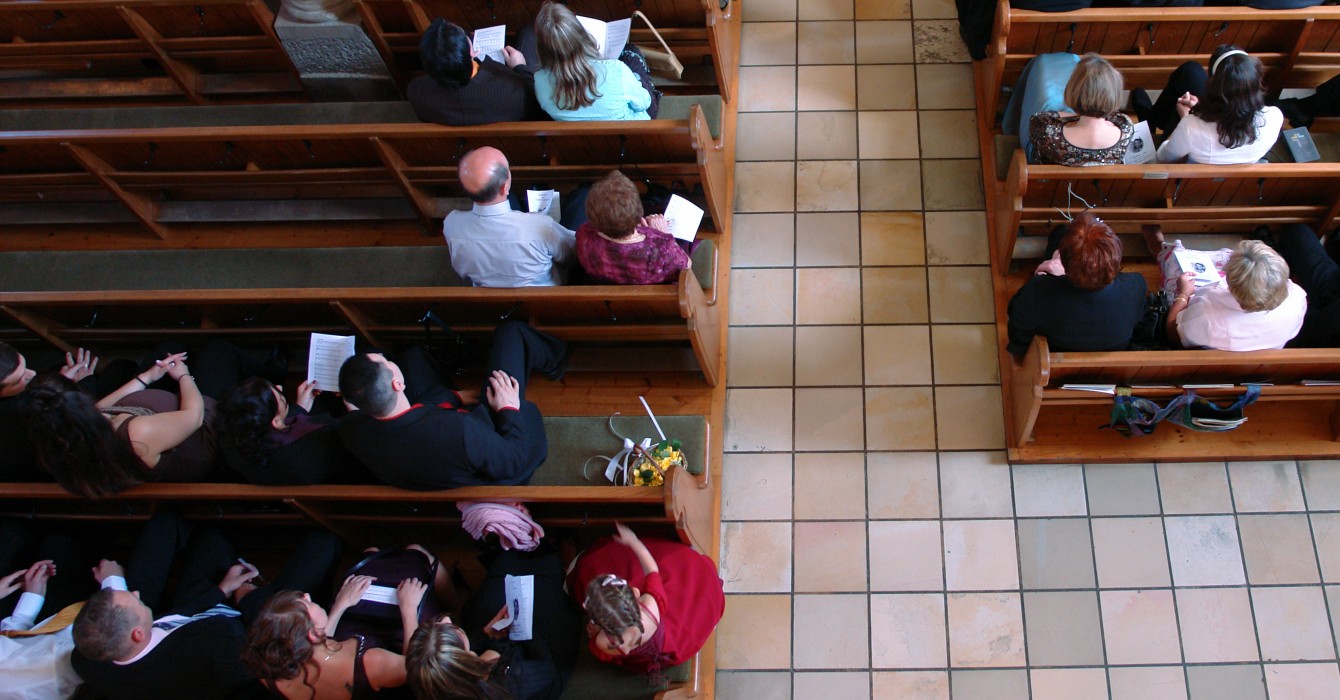

Every Sunday morning, my congregation prays the Lord’s Prayer together. We often repeat in unison the Apostles’ Creed or some other statement of faith. For the psalm of the day, one voice will read the opening lines, and the rest of us will respond with the next lines. This rhythm between leader and congregation continues with call and response, call and response, back and forth, back and forth, until we end the psalm together.
Although the words of our liturgy change from week to week, our reading together is a regular part of every Sunday morning in my nondenominational church. This worship practice reminds me of the Lutheran and Anglican churches of my childhood and high school years. In the Baptist, Mennonite, and other churches of my adult life, reading together has been less of a focus, but I’ve always loved that part of worship.
It was only when I visited a friend’s new church that I realized how much I had taken reading together for granted. Like my present congregation, his was a small group of fewer than 50 people gathered for worship. But unlike our mainly middle-aged and retired folks, his church was intergenerational: a few seniors among families with school-aged children, some youth and middle-aged folks. I loved the warm, informal atmosphere and the lively music.
About midway through the service, the screen at the front of the church displayed a responsive reading with parts for the worship leader and parts for all of us to read together. For the congregation’s part, one voice hesitantly started, then others chimed in. Some spoke faster or more slowly than others, which meant that a few voices ended a line together, but many others needed to catch up before the next line began.
That’s when I realized that reading together takes practice. “We learned that as children,” one member of my congregation said. “We grew up saying the Lord’s Prayer together at school. We had choral reading groups that recited poetry together. We would even enter choral reading competitions. That doesn’t happen anymore.”
What I had taken for granted as part of our worship practice was exactly that: practice. Whether as children in school or as a congregation reading together Sunday after Sunday, somehow we had learned to read as one: taking a breath and saying the first word together, unconsciously listening for one another, speaking in shared cadence, ending our lines together. No advance rehearsal. No director but the words in front of us to cue us when to begin or end.
Reading in unison as a congregation helps me settle into worship together with others. I set aside my personal thoughts and concerns to focus on our common text: the words of Scripture or a prayer or confession that gathers us together. Instead of passively listening as a text is read, I participate: sitting or standing and saying the words aloud. And when I am too lost in grief or distracted or upset to participate, I let myself be carried and comforted by the collective voices of those around me. Reading together is an expression of our community in Christ. In joy and sorrow, in praise and lament, in confession and forgiveness, we are one body, and we express all of that and more as we read together.
I hadn’t realized what a gift it was and is to read together! And just as I had taken our reading together for granted, I’d never considered how much that practice has shaped our life as a congregation, how much it has shaped me.
In the field of education, choral reading as a teaching strategy helps readers build comprehension, fluency and self-confidence. Many people who stutter in conversation stutter less when reading in unison with others, although the reasons for this are not yet fully known. Blogger Lance Glasser writes, “Educators who use choral speaking as a classroom practice often report that students who rarely volunteer to speak begin to emerge. The ensemble becomes a rehearsal space for individual courage, a place where the voice discovers what it can do before the full weight of exposure arrives.”
This ancient practice is an enduring one in many churches and across denominations. I’ve seen seekers blossom and find a new language for their faith. I’ve seen confidence and commitment grow — not entirely due to the experience of reading together, but I’m sure it’s played a part. At least, I no longer take reading together for granted.
Pastor of worship and liturgy Fran Pratt writes in “Call and Response: Litanies for Congregational Prayer” about how her introduction to liturgy and reading together saved her life:
Here on the page was a prayer that we would all pray aloud together and most often it was prayer disguised as poetry, and more often than not it was the only prayer I’d emitted that week.
We prayed for all kinds of things together: government officials, world crises, the city’s homeless population, health, world peace; we observed silences, recited confessions and creeds. I had never encountered such a buffet of spiritual elements. It was a dream-world, but it was a solid rock. Instead of me forming my prayers, I could let the prayers form me.
For me, reading together as a congregation is a beautiful expression of our life together as part of the body of Christ. As we repeat the Lord’s Prayer, I am reminded of our connection to Scripture. As we repeat the Apostles’ Creed, I think of our connection to the church throughout history and around the world.
Often a line of liturgy will stay with me throughout the week. Just last Sunday, we read together in our time of confession and assurance of forgiveness a line based on Philippians 2:13: “Enable us to will and to work for your good pleasure.” I’ve held on to that line, grounding my week in Scripture and in our shared calling as people of faith. Thanks be to God.