
When Greeks and Romans ruled ancient Egypt, a period of history that includes the first 300 years of Christianity, papyrus documents transformed written communication. Thanks to the region’s climate, many papyrus manuscripts from Greco-Roman Egypt survive, including personal letters, legal petitions, magic spells, medical recipes and early fragments of the Gospels.
Indeed, the earliest known Gospel fragment, Papyrus 52, is coming to North America for the first time as part of an exhibition co-organized by Geoffrey Smith, an associate professor and director of the Institute for the Study of Antiquity and Christian Origins (ISAC) at the University of Texas at Austin. The exhibition is in collaboration with the John Rylands Library at the University of Manchester in Manchester, U.K.
The exhibition, Lives and Literacy in Ancient Egypt, on view at the Harry Ransom Center in Austin, Texas, from April 11 to Aug. 2, showcases the literary output of the multilingual, multicultural community that produced the world’s most ancient Christian writings.
Smith spoke with Faith & Leadership contributor Courtney Thomas and shares what these early writings can tell us about early Christian practices and the development of doctrines and traditions. The following is an edited transcript.
Faith & Leadership: What surprises might the exhibition have for modern-day Christians?
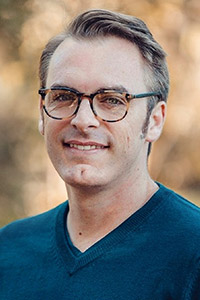
Geoffrey Smith: Most people will be surprised to learn that a lot of our early fragments of the New Testament come from the garbage.
We do have a couple pieces in the exhibition that have an association with the city of Oxyrhynchus. It is where, in the late 1800s through the early 1900s, archaeologists from Oxford excavated roughly 500,000 fragments of papyrus from 40-plus dump sites.
These were things that were just thrown away, and it includes all different kinds of literature, but the very first manuscript that was pulled from the trash was a very early fragment of the Gospel of Matthew. And the second fragment that came from the trash was the Gospel of Thomas. Since then, there have been hundreds of biblical texts that have been published from those garbage dumps.
It’s because of these trash fragments that we’re able to reconstruct with a high degree of accuracy the earliest versions of the New Testament writings.
F&L: Which artifacts would you encourage clergy to keep their eyes out for, if they are able to visit the exhibition this summer?
GS: The fragment of the Gospel of Mary, I think, is a really cool piece. Members of the clergy will be familiar with ongoing debates within Christianity of all different varieties on what leadership roles, if any, women can have in the church. That’s an ongoing debate throughout Christianity, and the Gospel of Mary, I think, shows us that that debate existed already in the second century.
There’s a wonderful scene in that text where Mary is with some of the disciples, and they’re sharing memories of Jesus, after Jesus’ death and resurrection. She’s saying, “Hey, Jesus actually revealed a bunch of additional stuff to me.”
Peter acknowledges that Jesus and Mary had a close relationship, but then he’s really skeptical about whether Jesus would tell her something that Jesus hadn’t told Peter, his right-hand man.
Then Levi intervenes and says, “Peter, you’ve always been a hothead. Just let her share with us what she was taught.”
I think that there’s something very familiar about that scene in the Gospel of Mary that would resonate with Christians who are actively thinking through questions of gender and leadership in the church today.
Papyrus 52 is thought to be the earliest known fragment of a New Testament writing that survives from the ancient world. It is a small, credit-card-sized fragment of the Gospel of John.
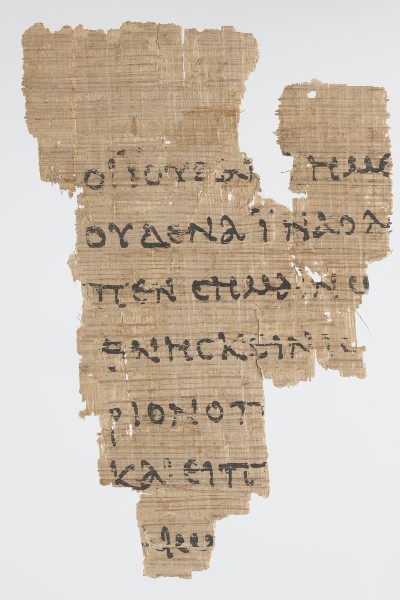
It has been dated on the basis of the style of handwriting to a fairly broad range, from the 120s up to about the 220s, about a century, with most, I think, now preferring a slightly later date. But that’s still an exceptionally early fragment of the Gospel of John.
Now, if we’re to take the consensus view that the Gospel of John was composed around the year 100, this would mean that even the latest date of 200 to 220 is only three generations removed from the original copy of the Gospel of John. It’s an exceptionally early piece that has never before, to my knowledge, come to the United States. Since it arrived at the Rylands Library in the 19th century, it has not left. So, this is a rare opportunity to see that fragment in person, if you don’t have any immediate plans to go to the U.K.
A third one would be the Deuteronomy fragments. These are fragments of Deuteronomy that prior to the discovery of the Dead Sea Scrolls in the 1940s and early ’50s were thought to be among the earliest manuscript evidence for the Pentateuch. They’re exceptionally early, and scholars have been fascinated with them for a number of reasons, one of which being, How is the divine name written in these fragments?
I could go on and on, but those are three big ones.
F&L: Besides scriptural texts, what other sorts of texts were part of the lives of Christians in Greco-Roman Egypt?
GS: Besides canonical writings — that’s the 27 writings that ended up in the New Testament — we have noncanonical writings. So these would be texts that didn’t make it into the New Testament but are nonetheless Christian. The vast majority of these would be what we would call apocryphal writings. That’s all literature.
And then we have subliterary material, which would include magic. We have a lot of early Christian magic.
Then we’ve got documentary materials, which is their mail, their tax receipts, those kinds of things. Those are particularly interesting, because those texts were never really meant to be read by a broad readership, let alone by people 1,500 to 2,000 years in the future. So it’s almost as though we’re rummaging through their trash bins in antiquity and get to read a whole bunch of private documents that they never thought would have a broad audience.
F&L: You mentioned early Christian magic. What do the papyri reveal about how early Christians used magic? How did their understanding of magic differ from modern perspectives?
GS: I teach classes on Christianity and magic here at the University of Texas, and I find a range of gut responses from students who are Christian or have been raised in Christian homes. Some of them cannot believe that magic was a part of the early Christian experience, and others are like, “No, no, no, we totally do that. We just don’t call it magic.”
Hundreds, if not thousands, of early Christian magical texts survive from the ancient world. These were people that believed in the teachings of Jesus but nonetheless [also] believed that if they were sick, or if they were in love with somebody who didn’t love them back, or if they had a business rival in town, that they should resort to magical spells and charms to solve their problems.
It’s one of these things where we have a whole host of early Christian writers who are saying, “Don’t do this, don’t do this, don’t do this,” but the fact that they have to say, “Don’t do this,” means that for a lot of people it was a fine practice. The material record confirms that. Many early Christians in the ancient world relied on magic for everything from health care to business dealings to romantic relationships.
I think if you were to really reflect on Christian practices today, it wouldn’t be that hard to find practices that you might consider magical. Maybe keeping a copy of a Bible under your mattress as a way of either being protected by the divine or having better luck than you have had in the past. Wearing a cross around one’s neck; what exactly is someone doing when they do that? Do they believe it gives them some sort of apotropaic [evil-averting] protection, or is it really just a symbol of fashion? Not taking the Lord’s name in vain [is another]. There are a lot of practices today that if you think about them hard enough, you might ultimately concede that these could be seen as magical practices rather than religious.
F&L: What does it mean, in terms of their audience, that the earliest known Gospel fragments are found in Egypt rather than in places more associated with the events of the New Testament?
GS: It’s one of the curiosities of early Christian history that we don’t exactly know when Christianity first made it to Egypt. But on the other hand, the vast majority of our written material evidence for early Christianity comes from Egypt, and that just has to do with the environment in Egypt that allowed for the preservation of organic material like papyrus.
We’ve got a literary record that doesn’t say much about Egypt, but then we have a large number of actual artifacts that come from Egypt, so one of the questions that we have to deal with methodologically is, How representative is the Egyptian material of Christianity in the first three centuries? That’s kind of an ongoing debate in the field.
I think each issue has to be taken on a case-by-case basis. There are some things that are going to be unique to Egypt, but there are going to be some things that we find in the Egyptian papyri that allow us to talk about broader trends in Christianity throughout the Mediterranean world.
F&L: Why does it matter what Christianity was like before the current scriptural canon was set, and how might that have impacted the development of faith, doctrines and traditions?
GS: If you’re interested in the question of what it was like to be a Christian in the first three or four centuries, then you have to take seriously the range of materials that were written that didn’t end up in the canon, because for many early Christian communities these texts were considered authoritative.
If you read the Gospel of Thomas today, you might think, “OK, this is noncanonical. Maybe it’s heretical.” It’s a very different take on Jesus than we’re accustomed to in many Christian communities today.
But if you read it from the perspective of a second-century Christian, or even a third-century Christian, you get the impression that for that particular group, what mattered most about Jesus was not his death and resurrection. What mattered most about Jesus were his enigmatic teachings. And salvation, or eternal life, comes not through being baptized into the community, and in some way participating in the death and ultimate resurrection of Christ, but it comes through the interpretation of these riddles. The text says whoever finds the interpretation of these sayings truly will not taste death.
Now, the question about what role these may have played in the development of Christianity is quite an interesting one. They were absolutely central to the development of what Christianity became, and we can illustrate that in a couple of ways.
The first way is with the earliest Christian creeds that we have. These are doctrinal statements about what Christians ought to believe is true about Christianity, and one of the earliest ones that we find is actually in the writings of Irenaeus.
Irenaeus was a church father active in Lyon, modern-day France, in the second half of the second century, around 175 to 180, and he’s one of the first to publish a Christian creed. He calls it a canon, interestingly enough, a canon of truth. He has these points that he makes — there’s one God, the creator of heaven and earth.
The question is, Why does he have to say that? It’s because there were Christians who believed that there was more than one god, and there were Christians who believed that it wasn’t the highest god that created the world; it was a lesser god. In some cases, it was an ignorant lesser god. In other cases, it was a malevolent lesser god.
It’s almost as though you wouldn’t have the formation of Irenaeus’ creed if you didn’t have Christians who were advocating something different. What taking seriously the noncanonical literature from the early period suggests is that Christianity’s orthodoxy could only emerge in conversation with Christians who disagreed with them.