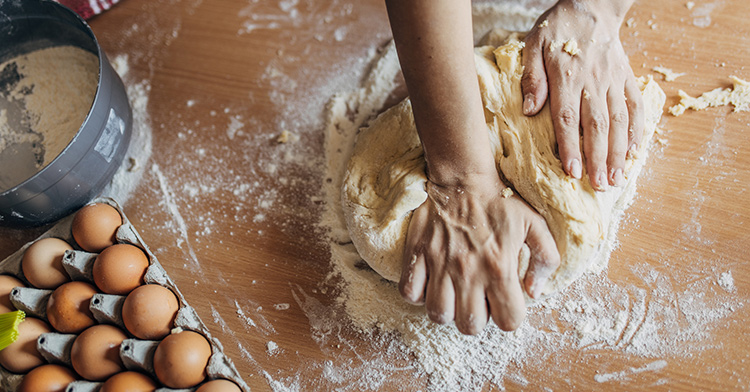


Baking bread is a deeply embodied task.
It’s possible to measure and mix up ingredients without touching the dough, but any experienced baker will tell you that there is no way to make good, consistent loaves without getting your bare hands involved.
A baker needs to be aware of a kitchen’s ambient temperature as well as the temperature of each ingredient, to gauge how hot the water must be, how long the fermentation should last. And there is no way to shape the dough or to tell if baking is complete without the information gleaned through touch.
For this reason, I believe that baking bread and reflecting on all it has to teach us is the perfect Lenten practice. In this season so focused on human limitation, we need tools to help us think well about what it means to be embodied.
This bodily exchange is especially valuable for the sourdough baker. The wild microbes in the air, on the flour and on the surface of the baker’s skin all play a part in flavoring and leavening a loaf.
Does this reality disturb you? You certainly wouldn’t be the first to be concerned.
In the late 19th and early 20th centuries, fear of microbes inspired the invention of new baking technology. With a growing understanding of bacteria, American culture entered an era hyperfocused on sanitation. The bodily nature of bread baking, together with the wildness of the yeast and bacteria that raise dough, served as a conduit for fears of the bodies of professional bakers — mostly immigrants, who were perceived to be both dirty and poor. Inspired by those fears, technology emerged that harnessed the speed of newly available commercial yeast. Machinery could mix, shape and bake dough untouched by human hands.
This bread was soft, fluffy and bleached white. Every loaf looked exactly the same. It was considered the safest, purest, cleanest loaf.
In the decades since, many people have paid the price for this kind of bread. It turns out the steps once thought to make bread “dirty” are necessary for flavor, texture and digestion. A long, slow fermentation, especially the kind afforded by the fibrous compounds in whole grains together with wild yeast and bacteria (often called sourdough in the United States), transforms the nutrients in the grain into a form most easily assimilated by the human body.
It’s easy to read this story and to decry the dangers of technology. “We must return to 100% home-ground, whole grain, organic sourdough breads!” cry many a social media influencer.
“That flour on the grocery store shelf is DEAD!” shout others.
But our relationship to technology is not quite so straightforward.
It’s tempting to embrace one of two extremes: that of the technophile or that of the technophobe. I view bread, though, as a helpful reminder of both the gifts and the limits of technological innovation. Using bread as our lens, we can foster a relationship to our bodies and to technology that holds together both gratitude and humility.
Bread historian William Rubel writes that from the beginning of agricultural history, bread has been both a blessing and a curse for humanity. The labor required to grow, harvest, thresh and grind flour, to transform that flour into dough, and to gather firewood to heat an oven in order to bake that dough is immense.
From start to finish, a loaf of bread takes nine months or more of labor. For most of human history, people have been vulnerable to the whims of the weather — a successful harvest determining whether or not they will eat for the year ahead.
At the same time, bread contains most of the nutrients humans need to survive. We can live off water and a hearty bread for a very long time. That’s the reason bread has been such a staple of the human diet across cultures throughout history, despite all the labor involved.
Many of the technological advances of the 19th and early 20th centuries removed a great deal of the precarity in our food system. The advent of roller milling by Swiss and Hungarian engineers in the 1820s and ’30s, a system adopted on a wider scale by Hungarian mills in the 1860s, allowed flour to be processed at a faster rate with much less waste, lowering the price of flour for both home and commercial bakers around the world.
The introduction of commercial yeast allowed for more predictability in the baking process, a huge relief to those who cannot afford the potential of lost food when wild yeasts don’t behave as expected. Glyphosate sprayed on a field that’s faced heavy rains can prevent an entire year’s crop from rotting.
These advances have also revealed what is lost due to innovation: more efficient milling processes can degrade some of the nutrients that make bread easier to digest. The loss of bacterial fermentation when using commercial yeast can also hinder the transformation of starches into their most digestible form. And research shows that consuming foods sprayed with glyphosate can disrupt the gut microbiome as well as the female endocrine system.
The answer to these problems is not to eschew the technology altogether. A more stable food system is a good thing for our global population. Instead, we must learn how to work within these limitations — to consider what faithful use of technology might look like in our lives.
As someone who teaches others how to bake bread as a spiritual practice, I allow Genesis 3 to guide me here. In Genesis 3:18-19, we are told that as a result of humanity’s expulsion from the garden, the soil will sprout forth thistles and thorns. It is by the sweat of the brow that we will eat our bread. Ever since, humans have been learning to live within the limitations of a good but broken creation.
The human creativity and ingenuity that allows us to form responses to the precarity of this broken world is a gift from God. But these responses are still subject to the reality that creation is groaning in anticipation of restoration. So how then do we discern faithful engagement in our own lives? I believe it requires three practices: rest, curiosity and joy.
We must slow down to pay attention to our bodies and the world around us, to things like the transformation that takes place as soon as water touches wheat.
We must foster a curiosity about how the world around us came to be — the people, the foods, the technologies that form us. When grounded in humility, this curiosity allows us to play around with the foods and ingredients available to us, learning how we can accommodate for the limitations in our own lives. For some people with difficulty digesting grains, that might mean a shift to home-ground, whole grain baking. For others, it might mean using affordable flours with a long, slow fermentation. And for still others, it might mean giving thanks for their bodies’ ability to easily handle almost any item on the grocery store shelf.
No matter the limitations that shape your habits and choices, you can choose whether to be governed by fear (of the body, of bacteria, of technology) or by joy. Once grounded in practices of rest and curiosity, the latter becomes the natural choice — and I believe the most faithful one as well.
The human creativity and ingenuity that allows us to form responses to the precarity of this broken world is a gift from God.