

It is late winter, and I’ve spent many days looking out my back door window, through my neighbor’s empty tree branches, the old elm as close a neighbor as the quiet couple that lives in the house behind us.
Any time the wind blows, the elm drops branches over our fence; elms are always losing their limbs. I watch sparrows grip the fallen twigs, the tree’s bony, budded fingers now resting in garden leaves.
I have spent many days watching the elm because home is where I can be. My chronic illnesses have pulled tight curtains around my energy, and I portion my time between the university classes I teach and our family responsibilities: church, grocery pickup, not much else.
If I take my son out to Barnes & Noble, I know my celiac-ravaged gut will disrupt our visit. If I chance a trip to the craft store, I make sure to grab a cart as a makeshift walker in case my POTS, or Postural Orthostatic Tachycardia Syndrome, spreads its dizzy fog over me.
It is a common life, the life of disability. Almost 30% of Americans live with one or more disabilities, according to the CDC. And theological approaches to illness and pain, ability and the lack of it, are as plentiful as the elm branches buried in my winter leaves.
In the midst of my lived experience as a disabled person, I don’t have a word of cheer or a raised fist of solidarity. To be honest, the exhaustion of my daily life, what I thought I’d be like and what I find myself to be, is a tension, a divided thread.
I love my family, the teaching I do and the community that holds me. But I find myself, as Psalm 102 says, like a “pelican of the wilderness,” searching for rest in the nearest tree that will take me, the buds of my own life sitting in dry leaves.
Instead of moving up professionally, as I had expected, I have accumulated more prescriptions and expensive scans. And likely more: Once you get an autoimmune disease, your likelihood for picking up more diagnoses increases by 25%. I can’t help but anticipate future illnesses awaiting me, as brittle a place to perch as that is.
Here in late winter, it is also Lent, where our 40 days of preparation for Easter bring us to pick up the work of watchfulness. It is a season of preparation for the saving death of Christ, remembered in cross and ash and candlelight. We keep watch over our passions, our confessional practices and our hurtful tendencies. We are given images of watching, waiting, with and for Christ: the virgins perched with their oil lamps, the disciples trying to stay awake, the women weeping and bearing spices at Christ’s tomb. We hear the words of the hymn leading us toward more watchfulness: “To you O Lord, my soul in stillness waits.”
But as someone whose life is bound by watching, I find myself looking at the practice of watchfulness “slant,” as Emily Dickinson (herself disabled by illness) might describe. I am already constantly “on watch”: monitoring migraine symptoms, sleep patterns, the ways in which my body can send me reeling without apparent reason. I am constantly monitoring my body, my surroundings, and my bandwidth, and the work of watchfulness in Lent feels like overloading an already fried circuit.
My disabilities also come as the result of childhood trauma, and exhaustion from hypervigilance is common for those who live through adverse childhood experiences. When your formative years are shaped by neglect and family harm, your body is aflame in survival. Even with years of therapy and medication, your nerves have an overabundance of panic grafted in, eager to “protect” you from potential harm.
It is live wire after live wire. As I write this, I have to scroll past news of a sick baby being deported, unable to breathe, labeled as “worst of the worst.” I am already vigilant in this perilous time. How am I — and how are we — able to keep bearing witness when every nerve in our bodies is burning? How much more watching, and waiting, can we truly bear?

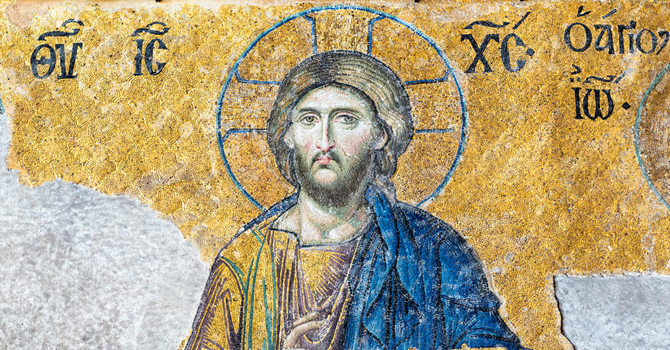
In the Christ the Bridegroom icon, Jesus leans with his crown of thorns, his robe stuck to his wounds, grasping a staff that might have been used to beat him. During Holy Week, we decorate the icon with red roses and process around the church, singing: “Behold, the bridegroom cometh in the middle of the night; and blessed is the servant whom He shall find awake and watching.”
A friend of mine has called this icon “Christ’s wedding portrait,” explaining that, in the icon, Christ is dressed for his wedding to the church, his beloved bride. “He is standing at the altar, so to speak,” she has said, holding the icon in her hands. “Waiting.”
Sometimes I wish that I had no pain. Some days I feel limits tunnel around me and yearn to be free of them. I yearn to be the sparrow at God’s doorstep in Psalm 84, building my nest without attention, or fanfare, or spectacle. And I wonder if this yearning is really grieving, if Christ is waiting for me to bring that grief up the aisle, waiting with his broken body, not to remove my disabilities, but to hold me with his wounded hands.
I fear this. It is much easier to grit my teeth and bear it, to spit out a bit of sarcasm. “I’ll get over it,” I want to say.
But I also hang the red roses my husband bought me for Valentine’s Day next to the back door, framing my view of the elm tree. The roses are full of thorns, the rich petals drying paper-thin next to the glass, the elm reaching far over my head. Starlings line the branches in thick clusters of speckled black.
I stand to behold them and they woosh past the window, swooping in murmured loops toward the hills, the evening sky deepening behind the elm as I keep watching, as I hold all my heart carries and look toward the waiting night.