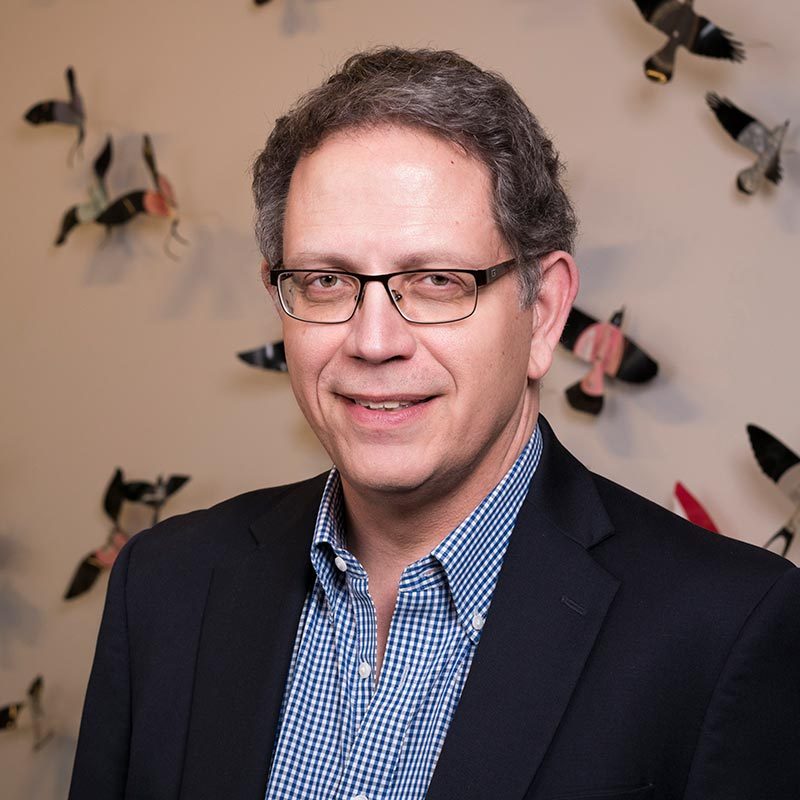
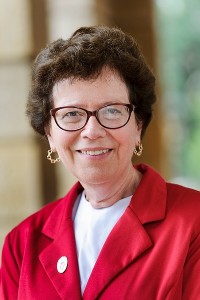
Rebecca M. Blank has been a leader in a number of spheres. Currently the chancellor of the University of Wisconsin-Madison, she also served in top positions at the U.S. Department of Commerce, as dean of the Gerald R. Ford School of Public Policy at the University of Michigan and as a faculty member at a number of institutions.
Blank is a Christian who says she goes to church every Sunday, not only because she believes, but also because the church offers a message that few other institutions in our secular society do.
“There’s a set of frameworks out of the Christian faith about concern about others, concern about the poor, generosity, kindness that doesn’t come to me, at least in my daily life, from almost any place other than the church,” she said. “I certainly know that I need that reminder regularly.”
An economist by training, Blank is co-author of the 2003 book “Is the Market Moral? A Dialogue on Religion, Economics and Justice.” She chaired the committee that wrote the statement on Christian faith and economic life adopted by the United Church of Christ.
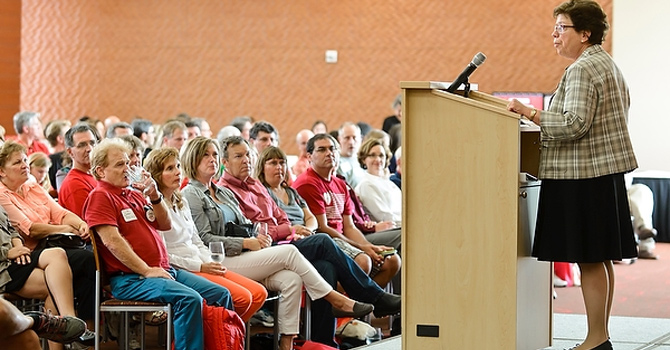
Blank spoke to Faith & Leadership while at Duke to give a lecture as part of the Duke Economics Department’s Allen Starling Johnson Jr. Lecture series and the Center for Christianity and Scholarship’s Distinguished Christian Scholar Lecture series. The following is an edited transcript.
Q: How does your Christian faith affect the work that you do in your many fields, as a leader of a university, a market economist, at Commerce -- all those different high-level positions you’ve had?
Some of the books I’ve written are about how economics and faith interact, and how do you as a Christian think about living and working in a world that’s dominated by markets -- how do these two fit together?
If you say, “What difference does being a Christian make in my life?” I would say, “I’m in church every Sunday.” And I’m in church every Sunday for a number of reasons beyond just that I’ve grown up Christian and I believe.
Beyond that, church every Sunday is a constant reminder of the value and worth of all human beings and the need to think of yourself not as separate but as one of the group. The need to listen, the need to treat other people as you want to be treated.
There’s a set of frameworks out of the Christian faith about concern about others, concern about the poor, generosity, kindness that doesn’t come to me, at least in my daily life, from almost any place other than the church.
Those messages and those teachings and being constantly reminded of them -- I certainly know that I need that reminder regularly. That’s probably comment No. 1.
Comment No. 2, particularly as you move into leadership positions, there’s a constant reminder in the Christian faith that we are all fallible human beings and no one has any commerce on truth.
You’ve got to listen to other people. You’ve got to be open about where you might be wrong. The reminder of needing to engage in the world in humility -- whether that comes out of coming to the communion table or comes out of a weekly confession of faith that happens in worship -- it’s an incredibly important reminder.
It’s increasingly important as I move into roles that in the secular world have been relatively powerful roles. You need those reminders, and there’s very little in other parts of my life that gives me those reminders in the same way that Sunday morning worship does, so I find those messages incredibly important.
I’ve been a believer all my life. That presence of the Spirit, and the teachings of the church, acting in my life is important for me to be an effective leader. I hope it shapes my leadership behavior, at least occasionally.
Q: What’s your religious upbringing?
My family all were German Evangelicals, which then merged with the Reformed Church. Some of my earliest memories as a child were of the adults around me having these meetings and conversations about the merger of the Evangelical and Reformed Church into the Congregational Christian Church, and the creation of the UCC.
So I have been in a UCC-affiliated church most of my life, but some of those churches were also affiliated with the Methodists, with the Baptists, with the Presbyterians. I married a Lutheran, so I have a lot of connections into mainline Protestantism.
Q: Turning to your work as an economist, in particular your book “Is the Market Moral?” what do you say to the argument that the church’s job is to change the system? Some might even say that markets are evil. What do you think about that argument?
I don’t think any systems are inherently evil in and of themselves. The question is how they operate, and of course the events behind some of the economic recession failures -- the things that happened in 2007, 2008 -- were as much about public institutions and what they did or didn’t do as they were about the operation of markets.
It’s why I try to avoid the term “capitalism” and I just want to talk about a simpler concept of “markets.” Those get overlaid with political institutions; those in turn get overlaid with other social behavior, attitudes, biases; and all of that together produces a set of economic outcomes that we can all argue about -- whether they’re good or bad and who they favor and who they don’t.
If you look over the last 10-20 years at an international level, I will tell you that I think one of the most striking things is the reduction in world poverty. From a world perspective, we’ve seen huge reductions in the number of people living below $1 and $2 a day.
And the reduction in world poverty, more than anything else, comes out of China -- the growth in China, the rising incomes in China, and a high share of that is the marketization of China and its integration into a global economy.
Now, there have been some costs to the growth of China, and some of those costs have come to the U.S., but it’s hard not to say that there have been some real benefits in terms of human suffering and human well-being.
Market systems are not perfect systems; there clearly have been failures. I think one of the real questions is why has the growth in the U.S. economy in recent years not translated into a growth for large numbers of people in their incomes and their wages.
To me, that is the key economic question of the last 10-15 years, and that’s a question that economists do not fully understand.
I can reel off a number of factors in that, but I can’t tell you it’s this and it’s that and if we could just turn this around …
I mean, I can give you ideas of things we should be thinking about and doing, but I can’t promise you what the true effect of any one of those policies would be. That’s a real challenge to economics, and it’s a challenge to our political debates about what should we be doing.
The simple answers -- “let’s just stop trade”; “let’s just stop immigration” -- I can promise you, are not very good answers.
I understand why people want to go there, because the next round of answers are uncertain and complex and very hard to discuss in simple terms that come across on the evening news in a three-second sound bite.
Q: What do you see as the role of the church in injecting morality into the market, so to speak?
Markets function in a number of ways, and they’re very amoral. If there’s a buyer and there’s a seller and you buy it, I’ll sell it. We don’t decide whether that’s a good choice or a bad choice.
Certainly out of a Christian religious perspective, choices have much more moral weight to them. There are good choices and bad choices. There are choices that are life-affirming and there are choices that are sinful.
And so there is a framework with which you look at economic life and market life. I think the value of the church is preaching and teaching about alternative frameworks, frameworks of being concerned about community, being not just self-interested, being concerned about the well-being of the poor, which I think is a major message coming through from both the Old and the New Testaments and a mandate to Christians everywhere.
Those are not messages that you get anyplace else in your life in the secular society. Perhaps one of the more important messages is the question of what is abundant living. And everything around us in secular society says abundant living is having more things.
“Diamonds are a girl’s best friends.” “Coke is the real thing.” “Let’s go get more and we’ll be happier.”
The Christian church in part is about saying there are other things that lead to abundance, and specifically in Christian theology, it’s moving closer to God and moving closer to Christ.
But one can talk even to non-Christians about the fact that abundance is not just having more. Abundance is being more and having a fuller life, spiritually as well as physically, and those are really important messages in a world where almost no other institution is delivering them.
You can also talk about the role of the church in a public debate, in a policy debate and all of that, but I actually think the church’s role in talking about other frameworks -- moral frameworks, which people can bring to their behavior in market society -- is deeply important, partly because there are almost no other voices in that arena.
Q: Are you imagining this as a message for individuals as consumers or for players in the bigger market?
One role of the church in all of this is to be a community where people can raise and talk about these questions. It’s both the church as a solace to those who truly have been dispossessed in this economy and a place to open up the questions and to let people talk about, “How do I live in this market economy? What choices should I be making? What is right action and good action if it’s not just getting more things? How do I think about my life out there in the world?” The local church, through preaching, teaching, education, should be about giving people some sense of that, and so I think the first role is to the church community.
Now, I come out of a tradition, in the United Church of Christ, that also strongly believes in the role of the church in a more public space.
More prophetic, and speaking to policy and to people in power. One always has to do that with a great deal of hesitancy and humility, because honest people can disagree.
But out of certainly my faith tradition, I believe there is a role for the church to be involved in some of the public debates over the big issues.