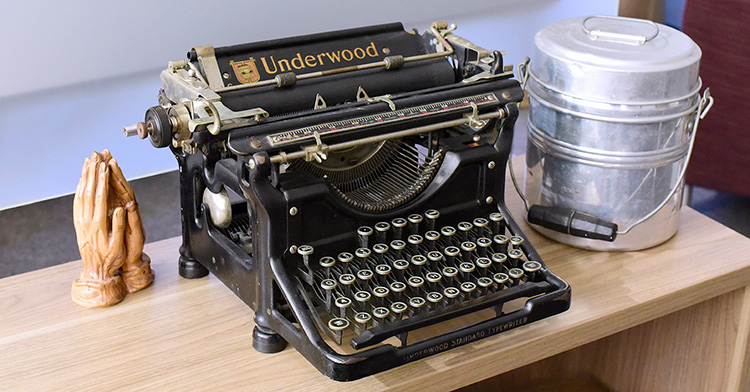

My grandfather’s early 1900s Underwood typewriter sits on a bookcase in front of my office desk. Visitors admire it as an antique. For me, the typewriter — along with a lunch pail and a cherished set of praying hands displayed with it — are artifacts from my grandparents. They remind me of where I come from and represent how institutions can sustain us.
My grandfather was a coal miner as well as the founder and longtime secretary of the mine workers’ local union chapter. He prepared the local’s minutes on that typewriter. My first memories of the machine are of its prominent place on the desk in my grandmother’s living room. My grandmother would occasionally allow my brother and me to type on it. Only in the last year, when my dad gave me the typewriter as he was packing to move into a retirement community, did I understand its symbolic importance.
I never met my grandfather but was named for both him and my dad. Granddad worked in underground coal mines, carrying the lunch pail etched with his name. He died of black lung disease when my dad was in high school. My grandmother continued to live for decades in the house where my dad was raised. It sat on top of the same coal mine where her husband worked. The extended family owned the land all around but not the minerals underneath.
My dad credits the union members with supporting the family after his father’s death. The mine had closed by that time, but the local’s leaders escorted the family to see a lawyer and helped make the funeral arrangements.
When visitors ask about the typewriter, I tell this part of my family’s story. We reflect on the importance of institutions and the support they can provide. My family was one among countless others whose loved ones were sickened by their working conditions. Eventually, the federal government enacted the Black Lung Benefits Act in 1972, nearly 20 years after my grandfather’s death. As a result of the union’s advocacy, my grandmother received support through the rest of her life.
These days I have wondered if state or federal governments would listen to results from medical research, enact regulations to protect miners from exposure, and rectify the harm done. Institutions can move very slowly and are susceptible to all sorts of forces. But the typewriter is a symbol of what can happen when institutions are devoted to the common good over a long period.
The typewriter represents a small portion of the support my grandmother received. She was a fiercely independent person who worked for decades as a housekeeper and caregiver for a family. She did her part to thrive. In addition, she lived in a small house on the family farm. No other houses could be seen from her front door. My grandfather’s brothers and families lived across the pastures, and they included her in their daily lives. They raised gardens together and continually checked on each other.
She was also devoted to her church, which included her husband’s family and many others in the community. In her last years, she came to live near my parents. My mother was as devoted to grandmother’s care as she was to that of her own parents.
Individual effort, family, congregations, unions and government are elements of the systems that sustain life. When one of these elements is weak, other parts can step up and provide support. My grandfather’s lunch pail and the praying hands from grandmother’s home are reminders of the interconnectedness of these systems.
During my years as a consultant to congregations, I often visited leaders during times of distress or conflict. When I asked the leaders to tell me about their congregation, invariably one person would say, “This congregation is different from others you know. Here we love each other and stand with each other.”
I pondered how so many church leaders in so many settings believed their congregation was unique. I came to understand that this phrase meant that people felt seen and heard in their congregation unlike in any other place in their lives. Congregations step forward to support people in seasons when family or government did not have much to offer.
Now, my work is focused on supporting the institutions that support congregations. It is more like the union’s efforts for those suffering from black lung than the daily work done by families and congregations. In these days when almost every institution is under attack and individuals are expected to fend for themselves, this 100-year-old typewriter reminds me that institutions matter. Individuals do not thrive in isolation.
In a time of disruption, who can you count on to keep working for the good of all? What contributes to thriving for you, your family, your neighbors and co-workers? Which institutions can you rely on to help you remain steadfast?