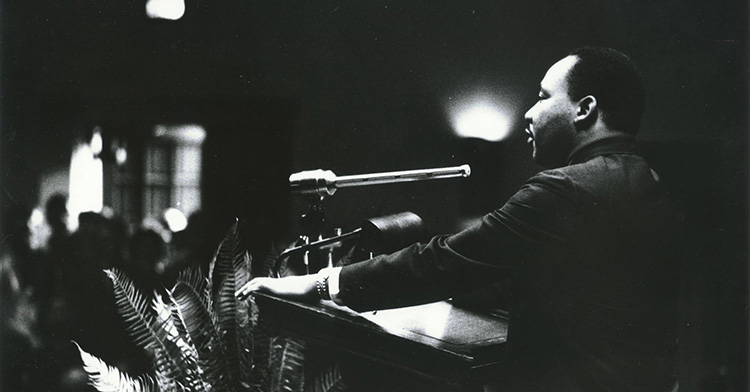

January brings a familiar ritual in America. We pause to remember the Rev. Dr. Martin Luther King Jr., to quote a line or two from a speech we only half remember, to affirm once again that he mattered, that he represents something noble about who we want to believe we are.
Increasingly it feels that this ritual is met with resistance. Not always openly. Sometimes as suspicion about the man. Sometimes as a re-narration of history that reframes progress in civil rights as overreach, remembrance as indulgence, and moral clarity as naivete.
Public recognition of people of color has been met with pushback wrapped in new language. The history of slavery and the Civil War is softened or redirected while Confederate memorials are defended as heritage rather than intimidation.
Jim Crow is framed as distant rather than still shaping our present. Names on buildings and institutions are protected as neutral rather than political. Affirmative action is undermined. Diversity, equity and inclusion are recast as threats rather than efforts at repair.
Against this backdrop, King is remembered not solely as someone who carried the weight of a movement and the expectations of a nation, but as a contested symbol. This tension is complicated by an uncomfortable truth — he was a flawed man. He was human in ways that are not flattering, including credible accounts of infidelity. Naming this does not require us to excuse it.
The discomfort some Americans feel here reveals something deeper than concern for ethics, reflecting little patience for personal shortcomings in some individuals while tolerating more deeply problematic behavior with broad consequences in others. We are uneasy, in part, because King’s shortcomings interrupt the kind of hero we prefer.
America loves heroes, but we don’t love the kind of heroes Scripture gives us. We have traditionally preferred our heroes to be clean, coherent and uncomplicated. We want history to read like fiction, with clear protagonists and clear antagonists, because complexity asks something of us that we would rather not give.
The Bible does not cooperate with this preference. The Old Testament, in particular, is populated by figures who are courageous and compromised, faithful and fragile, called by God and capable of harm.
David is anointed and abusive. Moses is faithful and violent. Jacob is chosen and deceptive. These are not cautionary footnotes. They are central characters. Scripture refuses to sanitize them because Scripture is interested in grace at work, not mythmaking.
We want our heroes to be better than us. But King was, in many ways, like us. And that may be precisely why he still matters.
It is worth naming a cultural contradiction here. Americans are deeply obsessed with sex. We market, monetize and weaponize it. We consume sexualized content constantly but are shocked when our heroes turn out to be shaped by the same longings that mark the rest of us. We want our heroes to live above the mess we privately inhabit.
But if our heroes are not like us, then their courage offers us no hope. If their moral lives are effortless, then their public witness is unreachable. If they are more fiction than flesh, then their legacy becomes ornamental rather than formative.
King was not holy because he was flawless. He was significant because he was willing to stand where standing was costly. He lived under extraordinary pressure, enduring surveillance, slander and eventual death for the sake of justice rooted in love. That does not erase his failures. But neither do his failures erase the moral seriousness of his witness.
The Christian response to this complexity cannot be denial, nor can it be cynicism. It must be formation.
Christian life has always been shaped by discipline — not as punishment, but as practice. Christians do not wait until crisis to decide who we are. We microdose faithfulness so that when pressure comes, we are not improvising integrity.
We fast so that desire does not rule us. We save so that generosity is possible. We practice confession so that shame does not isolate us. We forgive and receive forgiveness so that resentment does not calcify. We practice Sabbath so that productivity does not become our god.
Each of these practices forms us slowly. None of them guarantee perfection. But together they create coherence. They make a disciplined life possible in a culture that profits from distraction, indulgence and excess.
This matters because complexity does not absolve us of responsibility. To say that King was human is not to say that fidelity does not matter. It is to say that fidelity must be formed. Sexual restraint is a good discipline. Not in the thin and often cruel ways of purity culture, but as part of a larger tapestry of practices that make restraint intelligible and humane. Celibacy, chastity and fidelity only make sense when they are woven into prayer, community, accountability and grace.
Christians are not called to be perfect. We are called to be faithful. And faithfulness takes work — daily, ordinary work.
It is like tending a home. If you only clean once a month, it becomes overwhelming. The mess grows. The task becomes stressful. But small, daily attention makes the work possible. Not effortless. Possible. Even then, disorder still appears, but it does not rule.
Christian discipline works the same way. It does not remove temptation or eliminate failure. It creates patterns that make repentance real and repair imaginable.
And discipline, at its best, is never for its own sake. Christian discipline is about communion. We practice not to prove our worth, but to remain close to Christ. We submit ourselves to formational practices because we believe the relationship is worth the effort. Fidelity to Christ comes first. Fidelity to others flows from that center.
This is why we need heroes who are complex, morally serious people whose lives are marked by grace. We need figures who look more like Scripture than propaganda. We need people whose courage is real because it costs them something. People who fail and repent. People who stand with those on the margins not as saviors but as companions.
Maybe hero is not even the right word. What we need are Christians who are willing to be present. To stand with the despised and refuse demonization. To disrupt injustice by proximity and persistence. To be formed deeply enough that when standing becomes costly, they do not disappear.
If history later calls them heroes, that’s fine. But it would be enough if they were known as kind people who cherished others. Known as compassionate. Known for tender and faithful love.
That kind of life does not fit neatly into American mythology. It resists the urge to flatten people into symbols and demands formation rather than fantasy. It reminds us that grace does not erase complexity but meets us within it.
King still matters not because he was perfect, but because his life invites us to take faithfulness seriously in every sphere. That is not a comfortable legacy, but it is an honest and hopeful one.
King was not holy because he was flawless. He was significant because he was willing to stand where standing was costly.