
I hope you were sung to as a child.
One of my earliest memories — too long ago for clear details of time and place — is my mother singing “You Are My Sunshine” to me. It is an act I’ve repeated with my sons and granddaughter.
I more clearly recall being read “Good-bye, Tonsils” — featuring the improbably, delightfully named Dr. Constantinople — when I couldn’t have been much older than 4.
There is something significant in sharing words with children this way. Through lullabies and storybooks we offer poetry and promises. It is one of the ways we show love.
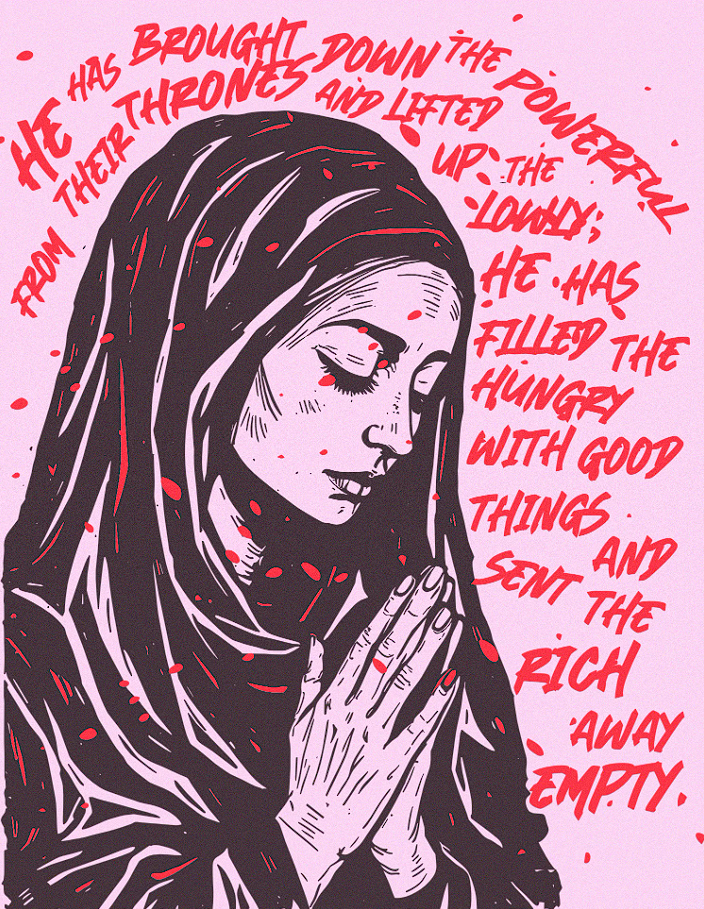
Through that lens, I have come to read Mary’s Song, the Magnificat, as an expression of maternal love, wrapped in defiance and the soul-deep protectiveness of a parent. What begins as a lullaby becomes a hymn of praise and protest, an anthem of liberation grounded in the prophetic vision that anticipates empire’s unraveling. In the first chapter of Luke, Mary declares:
My soul magnifies the Lord,
and my spirit rejoices in God my Savior,
for he has looked with favor on the lowly state of his servant.
Surely from now on all generations will call me blessed,
for the Mighty One has done great things for me,
and holy is his name;
indeed, his mercy is for those who fear him
from generation to generation.
He has shown strength with his arm;
he has scattered the proud in the imagination of their hearts.
He has brought down the powerful from their thrones
and lifted up the lowly;
he has filled the hungry with good things
and sent the rich away empty.
He has come to the aid of his child Israel,
in remembrance of his mercy,
according to the promise he made to our ancestors,
to Abraham and to his descendants forever.
We often picture her as an overwhelmed teenage girl, unexpectedly pregnant and about to be displaced. But this Mary recognizes her blessed role in history. She reminds us to be fierce in our fear and clear-eyed about what truly threatens us. Her words are a rallying cry to unite against systems that hoard and misuse power, and she assures the most vulnerable that they will be elevated and nourished.
In the story she tells, the script is flipped, the wrongs are righted. It is a transgressive, transformative, transcendent proclamation to God as her parent, to her unborn child and to all of us.
Our own sense of being overwhelmed this Advent might align with young Mary’s plight, so perhaps we can draw on her wisdom. How might we avoid falling into despair in these darkening days before Christ’s birth? How might we sing with her in this season of watching and waiting?
Writing for the Kairos Center’s anthology “We Cry Justice: Reading the Bible with the Poor People’s Campaign,” Savina J. Martin reflects on the Magnificat as the song of revolutionary mothers.
“Let us be reminded of the songs we sing as we build power and take control of our narrative. Let us be called to action in spirit and in truth, joining both the revolutionary mothers of old and those of our time, who sing their song like Mary did,” Martin writes. “The Magnificat is a song of salvation, with political, economic, and social dimensions that cannot be blunted.”
I have been encouraged lately by stories of parents helping parents, and especially mothers helping mothers, perhaps because that is the role I have inhabited now for more than half my life.
In the face of attacks on our immigrant siblings, job losses, precarious health care and food insecurity, I see people stepping forward with a commitment to the flourishing of not just their own children but the children of others.
On my afternoon commute a few weeks ago, I drove by a small shopping center that anchors a busy intersection near my home. A collection of shops and restaurants have found a place there, almost all of them established by entrepreneurs who are also immigrants.
This was a day when federal immigration officials had arrived in our town, sweeping people up indiscriminately. Out of my passenger side window, I saw a very practical example of mercy.
Prominently seated beside one of the shopping area’s entrances, two women had perched themselves much as they might at a kids’ soccer game — folding chairs, insulated cups and cell phones. They didn’t seem worried for themselves but were paying attention for others, monitoring every car that turned into that parking lot, watching and waiting.
We have seen such attentiveness throughout the country in recent months. People showing up with whistles, taping encounters on their phone, kneeling in prayer. They have protected parents dropping their children off at school, delivered groceries to those fearful of leaving their homes, stood in solidarity against the proud.
This Advent, when the world feels so overwhelming, may we find reassurance in the feisty song of one who saw herself as a lowly servant. But she still declared her faithfulness to a merciful God in the confidence of God’s plan for her and for those who would follow. May we find strength to be a part of that promise, remembering the songs and stories of our childhoods and of this holy season.