
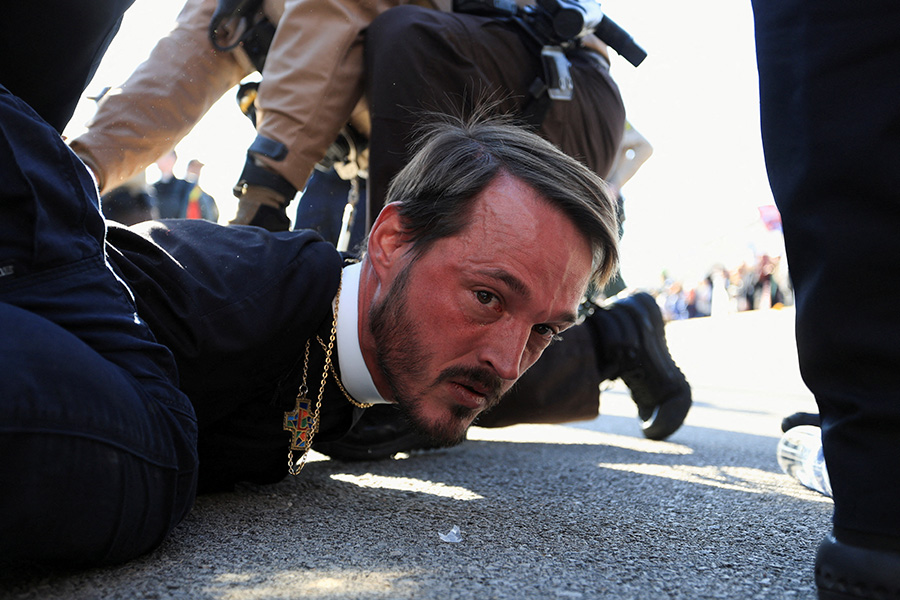
Even if you don’t know me, you may have seen my picture in the past few weeks. I was the person in a clerical collar slammed to the ground and arrested outside of the ICE processing center in Broadview, Illinois. For a while it seemed impossible to avoid the news images of myself online.
What was I doing there? I’m an Alliance of Baptists and American Baptist Churches USA pastor in Evanston, Illinois. I had never been arrested before. Yet in Broadview, I found the thing that I am willing to fight and suffer for.
It was not an abstract theological idea that led me here. It is my deep belief that the people locked in Broadview and the network of internment facilities that dot this country’s landscape aren't just a random group — they are Jesus Christ himself.
Once you know certain truths, you cannot unknow them.
For years I have been captivated by a scene from the BBC series “Wolf Hall,” which dramatizes two sides of a conflict during the English Reformation. It’s a tragic tale, one that always left me wondering whether I believed anything strongly enough to suffer for it.
On one side stands ardent reformers who insist on reading the Bible in English and reforming the Mass. On the other are figures like Thomas More. Both sides are intractable, and both sides suffer for their beliefs, because once they know a truth, they cannot unknow it.
It is hard for those who live outside of Chicago to understand the terror that has seized our communities as masked ICE agents kidnap our neighbors and tear-gas those who would oppose them. After they are abducted, they are taken to the facility in Broadview, where they are held in conditions a federal judge has described as disgusting, inhumane and “unnecessarily cruel,” without access to medication and spiritual care. They are held in unsanitary conditions including sleeping on a floor next to an overflowing toilet.
In perhaps the most visceral touchstone of the cruelty of this place, several attempts to offer Communion to those detained have been denied.
For weeks, I had joined my fellow protesters at Broadview. Then, on Nov. 14, I was slammed to the ground, cuffed in zip ties and charged with three misdemeanors. I got a brief taste of the sort of dehumanization that goes on in that facility every day: I was held for seven hours in lockup and taken by bus to two different facilities.
When my hands started going numb, I asked to have my restraints loosened. The response? “No one wants to talk to you. Shut the f— up.” If this is how they behave while the whole world is watching, what are they doing when there is no accountability?
Once you know the truth, you can’t unknow it. What do we do when we learn that our government is mistreating detainees right in our backyard? That is the question that people of faith in Chicagoland have been presented with, and it is a question the church must consider nationally.
What we do with this knowledge tells us everything about the Christians we are. For faith leaders with privilege like me, this means that we must take some risks for the sake of the gospel. Otherwise, we risk merely becoming a social club that coddles those in power.
Progressive faith leaders often operate on the assumption that all we can do is preach about the social issues that are threatening the very foundations of our democracy. This is not true. We can act on our strongest convictions that dehumanization anywhere is unacceptable because we are all bearers of the image of God.
Despite my recent experience, I am filled with great hope about our future. I was not alone that day in Broadview — hundreds of religious leaders had gathered to lift their voices in prayer and nonviolent resistance to the torture taking place inside. Nearly two dozen protestors were arrested. It was a holy experience, as sacred as the best church service you’ve ever been part of.
It is the knowledge that we do not do anything alone that grounds my hope. Alone, resistance crumbles easily, but together we can be what Paul imagined when he called the church the body of Christ.
At Broadview, I found my “Wolf Hall” moment. I knew that this was what I was called to do. Not everyone will choose the same path, but there is a role for everyone to play in making God’s vision of the beloved community come into being.
The most important thing is that we do not tarry in making God’s love known. We are facing a moral and spiritual emergency, and faith leaders have to step up. Otherwise, I am afraid it will be too late — for our democracy and for the church.
What do we do when we learn that our government is mistreating detainees right in our backyard?