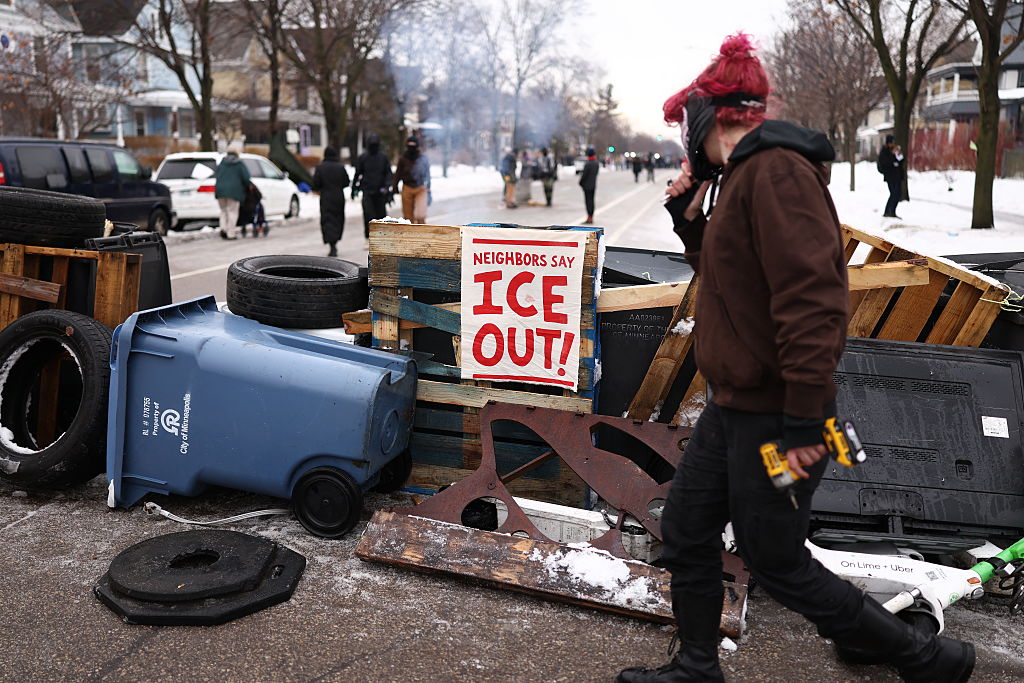
With the increase of activity from federal agents in Minneapolis, pastor Hierald Osorto of St. Paul/San Pablo Lutheran Church and pastor Ingrid Rasmussen of Holy Trinity Lutheran Church have organized and borne witness to the immigration raids.
Days are full, with interruptions from raids and organizing to provide for the concrete needs of those most affected by the daily violence, but both pastors also prioritize time with their congregants to meet and process the events together.
Both pastors have made changes to their Sunday services. Osorto’s congregation has been singing more songs, replacing hymns with emotionally resonant songs that hold significance for them. Rasmussen’s service has added a prayer station where individuals come for lament, encouragement and commiseration.
“There’s this willingness and this need in this time to be nimble and adaptable,” Rasmussen said.
The pastors have also tried to keep themselves cared for, noting that they went dancing one evening to “metabolize the experiences” that they are having every day.
They spoke with Faith & Leadership’s Chris Karnadi Jan. 15 about their work in Minneapolis and how the work began much earlier than these most recent immigration raids. The following is an edited transcript.
Faith & Leadership: Can you introduce yourselves and say how long you’ve been in Minneapolis?
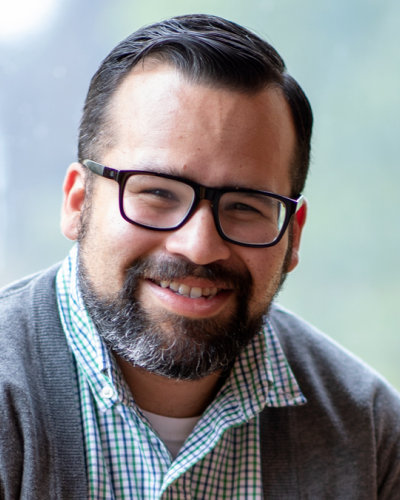
Hierald Osorto: I’m the pastor of St. Paul/San Pablo Lutheran Church in South Minneapolis. And I have been here for a little over four years — five years in November of this year.
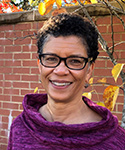
Ingrid Rasmussen: I serve Holy Trinity Lutheran Church as a lead pastor, and I am entering my 13th year of ministry here.
F&L: What does your work look like these days?
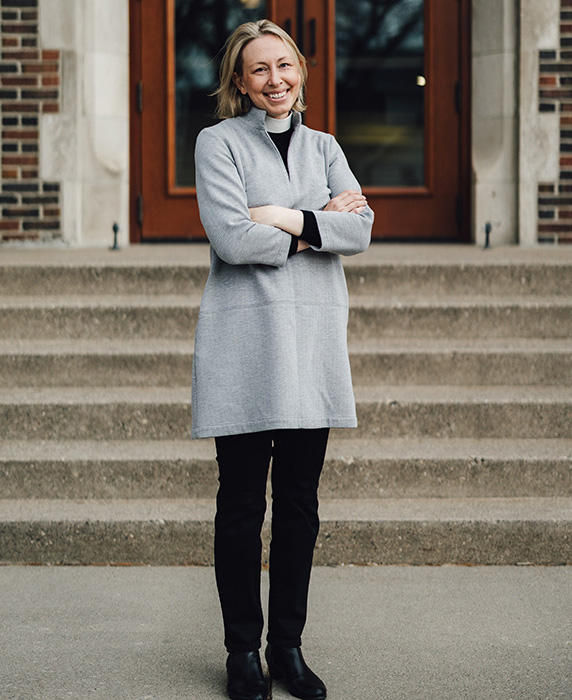
IR: It might be easiest for me to just say what yesterday looked like at this moment in history. I left my home to come to work, and about two blocks in I found myself in the middle of an ICE convoy right beside our neighborhood middle school. We were at a four-way stop together when I looked up and realized it was the paramilitary.
They turned in front of me. It was my turn next at the stop sign. I went behind them, another came behind me, and I found myself boxed in, honking, when one of the convoy vehicles behind me passed me to cut me off. This is a regular occurrence in both of the neighborhoods that Pastor Hierald and I serve and beyond.
For the rest of the day I was tending to legal issues related to those who are most affected by the federal presence here. I was working with humanitarian concerns related to groceries and pastoral care. I was organizing churches to adopt immigrant-owned businesses along our Lake Street corridor so that the businesses can pay their January rent, because they have been unable to welcome clientele for a whole variety of reasons.
And then there’s the regular pastoral stuff: somebody is sick; somebody is in hospice; we have worship on Sunday. Has anybody called so-and-so? What are we doing for Sunday school? We’re trying to do our best of continuing the patterns that people are depending on for their very lives and letting some of the other things go so that we can be as present to the moment as we can be. Hierald, what would you say?
HO: Primary for us is what you just named, Ingrid. It’s maintaining the patterns that allow people to have a sense of normal outside of what’s abnormal around us. I’ll follow your lead of describing what yesterday looked like.
I received messages saying we need to be on high alert because of the increased presence of ICE, particularly in our neighborhoods. Both Pastor Ingrid and I are in communities where there’s a high presence of these paramilitaries constantly — physically on the ground but also hovering over us with helicopters. All day today I’ve been hearing helicopters outside. Starting a day like that really sets you up in a particular way, when your inner being has to constantly carry that.
But yesterday, I also found myself having really powerful moments sitting with people. We’re responding to physical needs, and we’re also creating spaces for people to process what they’re carrying and to talk with each other, because people are sheltering in place and aren’t having the opportunities to come together.
So yesterday, I took four folks to our friends at Shir Tikvah, which is a Jewish synagogue, to get to know this synagogue. They’ve never been. They’ve never been to a synagogue. And we went and we sat and we talked with each other, and the rabbi came out and we shared, all in Spanish. It was a beautiful moment that in spite of what’s happening around us, we were able to still carve out space to be in community with each other. And I think that really set the tone for the rest of my day. It was a nice reset.
And then for the rest of the day, most of it was supporting people who have needs, whether that’s food, whether that’s prescriptions, whether that’s getting to work. I’m on my phone constantly triaging and seeing how people respond quickly, because sometimes things change. I then met with the immigration task force that I chair for my denomination’s work here in the Minneapolis Area Synod.
That meeting happened across the street from Roosevelt High, where last week, students were being pepper-sprayed. Then I came back to my office and tried to catch up on the stuff that I need to do for Sunday, because Sunday still happens. I was here till 11 or so and came back in the morning today.
F&L: How are you offering spiritual care to your congregants?
HO: I have found myself returning with people to Scriptures that for generations have played a role in sustaining during moments like the ones we’re seeing. And the songs. Liturgically, we’re thinking about Sunday and staying flexible and adapting the space to make room for what people are carrying. As a Lutheran pastor, I’m also being mindful of my role as a minister of word and sacrament, valuing how they sustain our people week after week.
Last Sunday, I shifted things around, created space for many more songs and less hymns than we might typically do. We are drawing from people’s life experiences with songs that they remember as important during really difficult times. We sang a song from the ’80s that a really popular band, Los Tigres del Norte, sung called “Un Día a la Vez” (One Day at a Time). And it’s a song that still resonates in our community because it reflects their own story of journeying.
And I was like, this wouldn’t have been my choice typically, but I saw in the room how people in that moment held onto those words. The song wasn’t “OK, let’s lament together,” but it was saying, “We’re connected in this, and we remember that this isn’t the first time that we’ve had to encounter these oppressive forces in our lives.”
And halfway through the service, I saw the shift in energy when we sung this other popular song from Latin America called “La Montaña” (The Mountain) that everyone knows by heart. And it’s a really joyful song.
This is what liturgically we can do. I’m thinking about that now as I move through this season, of how it’s going to shape how we gather on Sunday and thinking about Lent and all those other pieces that will follow.
IR: The refrain that I’ve been using in congregational life is a reminder that we follow a God who is more interested in tending our dreams than in fueling our despair. We have been talking about how we keep our dreams, our community joy, our sense of tenderness for this neighborhood at the heart of who we are as Christian people.
And like Pastor Hierald, I was thinking about worship this past Sunday being a place where the community could be soft with one another, because it feels like there are so many hard edges all around us, and the worship space felt like it was a place where we could be soft together. We had, and we will now do this every Sunday, an individual prayer station where people can come and bring whatever is most alive for them.
There were people wailing over at the individual prayer station last Sunday. There were people who couldn’t utter a single word at the prayer station. There were people who wanted to pray for leaders in the midst of all of it.
So I think, like Hierald, there’s this willingness and this need in this time to be nimble and adaptable. And we say often this is not the first enormous community crisis that we have lived through and in some ways led through. And what we have learned over the course of time is that that adaptability, that agility, allows us to continue to follow the way of Christ even when the going gets really, really hard. And it is really, really hard right now.
F&L: How does this moment feel different or similar to five years ago after the murder of George Floyd?
IR: It feels similar to me in the way that community members are finding one another. It feels similar to me in the overwhelming nature of the overscaled militarization of the city. It feels similar to me in the ways that faith communities are being called to be vigilant and courageous in the midst of so many unknowns.
What feels different to me is that — I don’t even know what the words are for this yet — churches are just as threatened as any other institution, and that feels different to me this time around. Churches, schools and hospitals are no longer considered safe spaces in the way that I think I did kind of assume that they were five years ago.
HO: I wasn’t in Minneapolis five years ago, so I’m going to just go in a slightly different direction in terms of comparison. This moment feels familiar because it reminds me a lot of the feeling of what was navigated in countries like El Salvador, where my family of origin is from, and that church in particular was seen as a threat against an oppressive regime, and churches were not seen as places that the government would protect.
To see it now play out here in the U.S., to see what’s unfolding, it mirrors what some of us are familiar with having lived through those experiences in Latin America. The reckoning that churches are having — and in our particular faith communities, and this conversation around sanctuary — with the moment that the government made a very explicit decision to say, “We won’t honor sanctuary; we will go in.”
For us, we’re familiar with that kind of threat, and we’re going to insist on being sanctuary, because as a church, that is what we do.
But now what I’m contending with is the reality of death being much more present as a pastor and remembering Óscar Romero being shot in the middle of communion as he lifted up the wafer.
And this Sunday, it is a real possibility that I could die as I celebrate communion. It always has been, but I think I’m contending with it being much more real than I had imagined possible.
F&L: Have there been moments that have been affirming of your vocation over these past couple of weeks?
HO: This isn’t something that I would sign up for, because it’s hard, and I’ve always known that, but I see bright spots that remind me that this is the place that I need to be right now.
This Sunday when we gathered, we all were anticipating having almost no one in our service, but we had a full house. And then we had a couple hundred people come through in the afternoon for a singing vigil where they sung in our sanctuary, filled the space with songs of solidarity and songs of justice, and then continued outside. They walked out singing those songs through our neighborhood, honoring the lives of folks that have been abducted and honoring the families that have been divided. They even chased away a convoy of paramilitary.
And the small part that we played in that was important. Our building, our doors, should always reflect what we’re claiming in terms of the good news. And regardless of whether you are a Lutheran or you are a person that believes in God, whenever you step foot into this place, you will feel a sense of solidarity, you will feel a sense of belonging, and you know truly in your heart that we enter here and this is a place where you can feel welcome.
IR: I have been thinking a lot about that Thomas Merton story when he was in Louisville and standing at Fourth and Walnut streets. And he is looking out at this community, this gorgeous collection of strangers, and he has a spiritual experience where he says, “There is no way of telling people that they are all walking around shining like the sun.”
And I think about that every time I step outside onto the street, especially on Lake Street, which is the beloved corridor that connects Pastor Hierald’s church and mine. I step out onto that corner, and people are just shining like the sun. There’s constitutional observers who are at every corner. There are people who are trying to get to work despite all of the blockades.
There are children who are still showing up for school and teachers who are still willing to put their lives on the line for these kids, even though the government is tear-gassing and using chemical irritants on public school property. There are people in this community that are just shining like the sun.
And it’s our job as a community of faith to continue to say, “This community is beautiful.” We can continue to build up and to create and cultivate the world that we want to live in.
Two days ago on my way to work, I got caught up in a raid, and I jumped out with my whistle and people were like shining like the sun all around this convoy. And then when the raid came to completion and the convoy left, I looked to my right and there is someone I know. I looked to my left and there’s somebody I know. And it’s that ability to keep claiming what we know to be good in God’s eyes; that is my vocation as a clergyperson right now.
F&L: Is there anything we’ve missed that you want to speak about?
HO: I think it’s important to continue to remind folks that this didn’t just happen 45 days ago. Fourteen months ago, we started preparing as best as we could. We’ve been going through this need of having to respond and protect our people for quite some time.
Now is the rupture. This is the culminating point where now the world is paying attention, but it’s been hard for a while. And for our community, and for Pastor Ingrid as well with our friends at Holy Trinity, we continue to insist that joy will always be at the forefront of our lives.
After the election, our folks gathered at our church. There was a lot of sadness at what had happened, but folks gathered to make tamales. I was like, “Oh, you’re making tamales to distract yourself.” And they were like, “Nope, I’m not going to let that person dictate my ability to enjoy being able to gather and make tamales with my community. I’m doing this because this is joyful. That person isn’t going to be the one that defines for me how I live."
We’re a community that is going to continue to insist on joy. Relatedly, one of my highlights of the past week is that Ingrid, Anna (another pastor friend) and I went out dancing. We’ve taken that on as a practice over the last year. And reflecting this week, I think that strengthened us and permitted us to be present in a different way. We’re going to continue to dance, and on the streets when the time comes.
IR: I think that’s right. I came back from a sit-in at a corporation through a very militarized area of the city and walked into the building, and our Center for Adults with Disabilities has an Elvis impersonator today! That’s our life.
And like Hierald, I think of our practice of dancing over the last year as being embodied clergypeople. It helps us to metabolize the experiences, and it helps us to remind our hearts that they are deeply connected with celebration and with joy. We will continue to carve out the space that the Spirit makes available to us to live and thrive and celebrate and share joy in the midst of the circumstances of terror that we are living in.