

For the Rev. Dr. Carlos W. Perkins the Gospel parable of the good Samaritan has stewardship at its core.
“For many of us who are doing the work of community transformation, of moral development, moral formation, and community work, we are doing the work of an innkeeper,” he said, with this work happening after people were “generous enough” to pay for certain needs.
Perkins, associate director of engagement in the Lilly Family School of Philanthropy at Lake Institute on Faith & Giving, said stewardship cannot be something that faith leaders focus on only when building a budget.
It’s “a completely year-round cycle” that starts with determining why your organization deserves philanthropic support and why people would want to support your ministry, said Perkins, who also is senior pastor of Bethel Cathedral AME Church in Indianapolis.
“These answers come with both a clear definition of your mission and vision as well as “some clear teaching and preaching.”
Many faith communities are deep into stewardship season, ahead of planning budgets for 2026. But what happens when church leaders see stewardship as more than once-a-year pledging? What new opportunities and gifts might be uncovered?
For congregations considering new ways of looking at time, talent and treasure, here are three stories of churches that have begun that work.
Expanding community
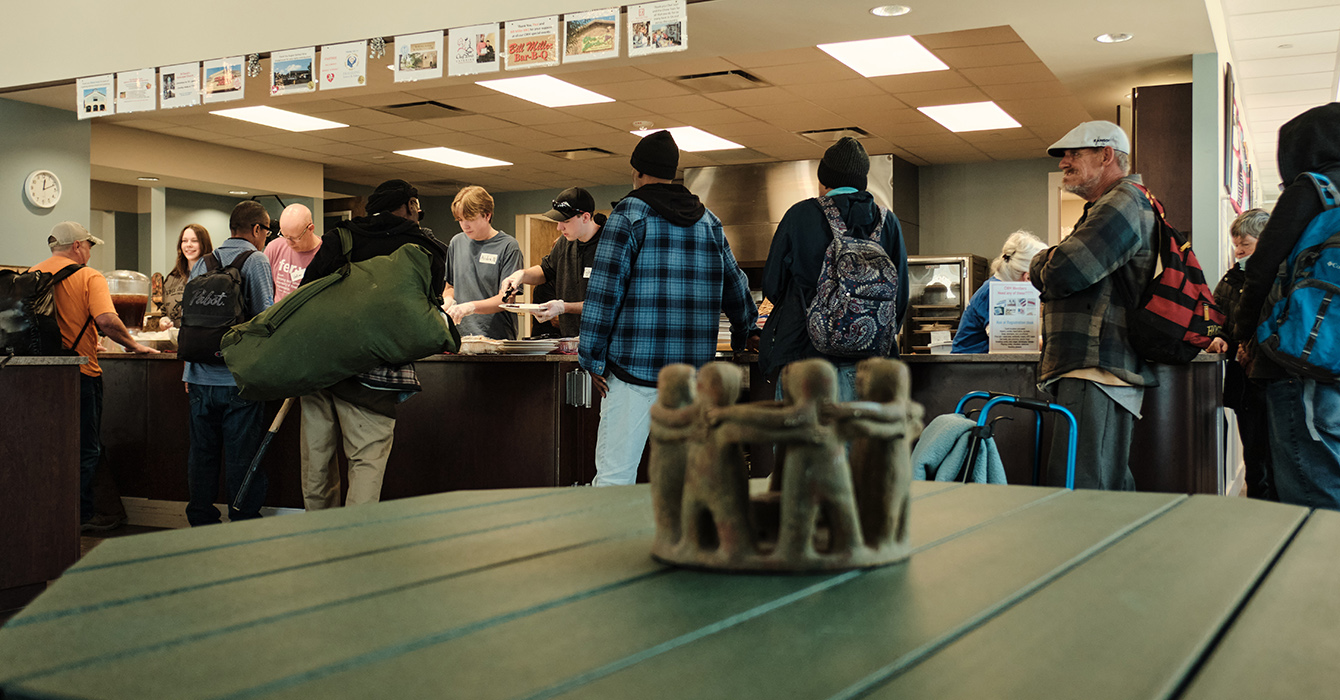
St. John United Lutheran Church in Seattle has a small congregation of about 96, with 20 to 30 people typically attending Sunday service. But they're embracing a small church identity and celebrating that their footprint extends beyond their pews into the neighborhood. That grows out of the generosity of its members as well as the contributions of those who rent church space, which has helped create a collaborative commons where community members can gather and recharge.

The church found that “about 500 people moved through our property in a week,” said Sister Jessica Zimmerle, the church’s director of community engagement. Various organizations rent church space, including 12-step groups, arts nonprofits, and a hot meal program. The church then helps support the community through its CoCreate Project, which offers daytime work space, biweekly craft/game nights and quarterly potlucks, with skill-share workshops planned for the future.
Does your ministry have a compelling story that conveys its purpose?

Every other Thursday night, a former church classroom is transformed into the CoCreate room, which features a lounge area with couches, chairs and beanbags, along with tables where people can do crafts and puzzles, said David Favour, a church member and CoCreate volunteer. This entire project became possible due to intentional stewardship by church and community members.
“Towards the [end] of 2022, the congregation had a bit of a wake-up call prompted by our bookkeeper that the status quo operations here were not going to continue to be sustainable and [that] we were running a deficit budget and relying on reserves to fund operations,” said Zimmerle, also a deaconess and minister of word and service in the Evangelical Lutheran Church in America.
Church members have expressed a willingness to tap into its endowment not for themselves but to “think about the broader community and how this place can continue to be in service to the neighborhood,” she said. They also were honest with renters about the property’s physical needs and the plans for a new project, and they successfully raised rental rates, which are on a sliding scale and below market rate, Zimmerle said.
With much of their work rooted in a community-organizing model, the CoCreate Project was born. It will, in time, become a separate nonprofit focused on property stewardship in service to the community.
“Creating a new nonprofit opens up different funding opportunities for grants,” Zimmerle said. It also broadened the donor base, allowing people who may not have been interested in giving to St. John to give instead to this community project.
Notably, to launch the new project, the church did not limit itself to stewardship discussions or fundraising during the fall.
“Our first fundraiser was a trivia night that was specifically to raise funds for the CoCreate project,” Zimmerle said. “We set a bit of a low bar for our fundraising goal of $5,000, and we tripled it.”
She said that the church invited community members to the fundraiser, with one of the choirs that rents space emerging as “a significant component of that fundraiser being a huge success.”

What are some tips to consider for building a year-round philosophy of stewardship?
First, consider holding free community events year-round.
“Seattle is known for its very low church attendance,” said Jan Olson, a member of the church and of the CoCreate core team. (The Seattle Times has reported that the city is the “least-religious large metro area” in the United States.) But the congregation continues to welcome community members to its property.
Second, if community members already rent church space or benefit from church resources, consider also inviting them to fundraisers throughout the year.
“We’re really intentionally trying to not be fee-for-service and to keep things affordable. And so not having paywalls for events that we’re offering but hoping that people find enough meaning and community in the space and in those events that they’re willing to contribute to keep it going,” Zimmerle said. “So far, that model is working.”
Third, consider how you can continue to steward existing church resources — like an endowment — to create spaces or services to benefit your community.
Lake’s Perkins said he works with pastors who are frustrated as they try to find funding to fix old church buildings.
“Folks are not interested in fixing the building if you’re just going to show up and worship on Sundays,” he said. “Folks are, however, interested in fixing the building if you are willing to offer a community outreach project, a tutoring service [...] something that’s going to impact your immediate community or the community in which God has called you in this season.”
That has happened at St. John. “We get people donating frequently just without asking,” said Olson. “As soon as the building users get more involved, they see what some of the issues are that we’re leading to that we need to fix.”

“For us, it’s maybe a reframing away from a traditional notion of stewardship. One of my pet peeves as a leader is ‘stewardship’ just being [a] code word for ‘donations’ or ‘financial sustainability,’” Zimmerle said. “We’re talking about stewardship much more holistically — of stewardship of place, of this resource for the community that’s been entrusted to us, of people’s time and talent.”
Intentional connection
In the northwest quadrant of the nation’s capital, St. Stephen and the Incarnation Episcopal Church is a parish with a multicultural congregation that worships in English and Spanish. Its members unite as one parish that has “a long history of supporting social justice issues,” including the ordination of women in the 1970s and the issue of affordable housing, said the Rev. Yoimel Gonzalez Hernandez, the parish rector.
What comes to your imagination when thinking about how your congregation can have a communal impact?

“We see stewardship here as an ongoing process of lifting up and creating spaces for people to put in practice their talent, their gifts [and] their treasure,” he said. While money is an important part of stewardship, it is only part of the picture.
To this end, the parish has a year-round stewardship committee of about five to six volunteers, many of them younger adults who have joined the church within the last three to five years, Gonzalez Hernandez said. This committee has important work in the fall, when it designs and develops a pledge campaign, but it is also “very intentional during the whole year” to identify and reach out to parishioners who can contribute in other ways, the rector said.
The stewardship committee developed a cleanup day for the parish, since several nonprofits rent office and program space in their large building, and other groups use the space free of charge. The group then asked parishioners to volunteer on a Saturday to help declutter and clean, including by clearing two smaller spaces that the parish sought to rent.
“It was a day and event to do work, but, at the same time, it was an opportunity to meet each other, to know each other more, to create relationships between members,” Gonzalez Hernandez said.
During church announcements, members also will ask parishioners to volunteer in specific areas. In this way, they found volunteers to work on the church website and avoided having to pay an outside contractor.
While it can be difficult to talk about church needs — and difficult to talk about money, according to the Rev. Dr. Tim Shapiro, president of the Center for Congregations in Indianapolis — these conversations matter for faith leaders and members of their communities.

“Most things, if they can be talked about, then they’re more solvable, or there’s a greater comfort to go deeper into the topic. And there’s such a rich living tradition in the Christian faith about our generosity that it is possible for it to be woven in and out of the practices of the church all year long,” Shapiro said.
Parishioners at St. Stephen and the Incarnation have encouraged these talks for some time, predating Gonzalez Hernandez’s arrival as rector in 2024.
“I think one of the most successful moments we have in our parish is our coffee hour after our services,” the rector said. “Intentionally seeing the coffee hour as a place to build relationships, and not only to take some food and leave, that’s something that has really been important.”
How does your faith community define stewardship? In what ways does this definition need to be challenged?
When Gonzalez Hernandez has asked newcomers why they decided to stay, one of the things they’ve said is that they “felt welcome — that they felt that they were seen.”
This focus on stewardship of time and talent highlights the importance of connection.
“The church in some ways becomes a group, a group of friends,” he said. “This kind of relationship, I think, is very important. And it is the only way for people to understand, ‘Oh, this is not only a space for me to sit down for an hour on a Sunday and leave but also to get more involved, especially in service of others.’”

Education and inspiration
While the careful management of finances isn’t the only part of stewardship, it is important. With consumer confidence lagging, a majority of Americans say they’re in fair (40%) or poor (17%) shape, with “a rising share” (28%) saying they “expect the financial situation for them and their family to be worse a year from now,” according to 2025 research from Pew Research Center. As people around the country suffer financially, stewardship of their existing resources holds continuing relevance.
Keeping biblical principles in mind, Dave Briggs, director of the Enrich Financial Ministry at Central Christian Church of Arizona, leads his church’s stewardship ministry. He helps teach and coach members of the congregation and community to better understand three key aspects of money: the practical side of how to budget, the biblical side of money management principles, and the emotional side that drives decisions.
Briggs runs financial literacy classes in addition to offering information and opportunities for people to meet with leaders one-on-one to receive coaching for unique stewardship questions and financial issues, he said.

Lots of people who live paycheck to paycheck “don’t know where their money’s going,” said Briggs, noting one helpful step is to ask people to write down what they spend every day, so they can prioritize what is most and least important.
Other tips for developing a philosophy of stewardship? “One of the ways you can do things on a year-round basis is [to] engage people in something more than just a one-time event,” said Briggs, who also is a board member of the Christian Stewardship Network.
Staff at one of his church’s five Phoenix-area locations may encourage people to volunteer in their Acts Ministry, which serves the homeless and working poor. Or they may encourage people to participate in mentoring that involves monthly check-ins.
When it comes to creating a year-round philosophy of stewardship, congregational leaders and people with a sense of abundance can weave these ideas “into sermons, Bible studies, carousels — whenever the opportunity arises or the Scripture passage arises,” said Shapiro, who also is the author of “How Your Congregation Learns.”
Could you tap into rhythms in your organization’s life to have better conversations around stewardship?
While Briggs holds a staff position, he noted all churches may not be able to offer this kind of role. But that doesn’t have to stop expanded stewardship efforts.
“There are, oftentimes, people that are willing to … lead this ministry on a volunteer basis within their church, if somebody is just willing to ask them to start it or to give them the support to start it,” Briggs said.
Jeff McCaleb is a member of Central Christian who serves with Briggs as a volunteer coach. McCaleb has a personal story of declaring early bankruptcy but still continuing to tithe and “give faithfully.” He now has no debt and has financial peace, he said. “I want to share that hope with other people.”
“I’m a firm believer that if you get it right with stewardship, the rest of this stuff’s going to fall into place,” McCaleb said.
In fact, good stewardship can benefit individual members of congregations, communities and churches. Briggs also points to the parable of the good Samaritan.
“We view that as a parable about compassion, but I think it’s a parable about stewardship. Because that good Samaritan, if he had not been a good steward, he would not have had the resources to help that man,” he said.
“If we are not good stewards, our ability to help others is significantly limited,” Briggs said. “That’s kind of the bottom line of why I think this is important.”
What is your ministry’s philosophy of stewardship beyond meeting immediate financial demands?
Questions to consider
- Does your ministry have a compelling story that conveys its purpose?
- What comes to your imagination when thinking about how your congregation can have a communal impact?
- How does your faith community define stewardship? In what ways does this definition need to be challenged?
- Could you tap into rhythms in your organization’s life to have better conversations around stewardship?
- What is your ministry’s philosophy of stewardship beyond meeting immediate financial demands?