
Roughly 30 years ago, a friend suggested I read some of Wendell Berry’s work. Having recently moved to Kentucky, I was eager to know some of the region’s writers. When I looked him up, I saw that he had published dozens of volumes of poetry, stories and essays, most all of them to very high acclaim. I tried some of each and was immediately hooked.
Wendell’s writing is clear, and his insights are profound. To read him is to encounter an author who speaks truly about the vulnerabilities and the beauties of this life and who writes wisely (and humorously) about what it takes to live attentively and compassionately in this world.
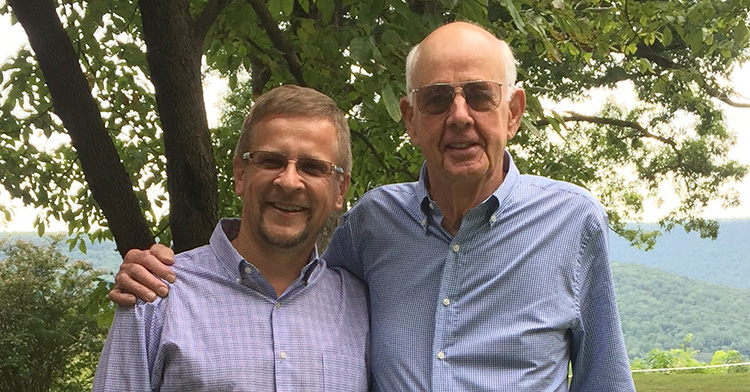
It took some courage to write Wendell and ask if he might welcome a visit from me. I needn’t have worried. I drove out to the family farm in Henry County, Kentucky, where Wendell and his wife, Tanya, greeted me with big smiles and a generous embrace. What began as an introductory visit turned into a friendship that, over the years, enabled me to integrate my upbringing and my vocation as a teacher and writer.
Wendell has been my abiding mentor. He has taught me to resist abstraction, speak plainly, stay (literally) grounded and keep the concerns of common folks steadily in mind and heart.
I grew up on a farm in southern Alberta but then left to study theology and philosophy. I thought the world of farming, along with the sensitivities and sensibilities that farm work affords, were firmly in my past. After all, no farmer ever showed up on any syllabus for the classes I was taking. Moreover, the demographic trends were pointing to an urban future. As a newly minted Ph.D., I assumed that farmers didn’t have much to teach us and that attention to farming risked devolving into an exercise in nostalgia.
Yet over the course of regular visits, Wendell was helping me see that these assumptions were wrong. If you eat, you must also care about farming. If you care about life, you must also nurture the land and the creatures that nurture you.
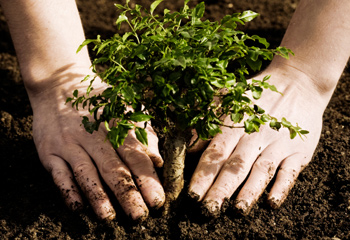
In one of our earliest conversations, Wendell said that the prophets Amos and Hosea were among the world’s earliest agrarian writers. He then pointed me to Genesis 2 and said that it gave the best description of what a human being actually is: soil + divine breath. The Bible said it long ago, while recent scientific research on the human microbiome confirmed it: Humans are a variation on soil.
So many of the philosophers and theologians I had been reading were dualists: A human being = soul (or mind) + body. Wendell and I would go on to spend several years together unpacking the agrarian difference, what it means and why it matters for everyone, city folks included.
He folded me into the work he was doing (with the Community Farm Alliance, for instance) to bring rural concerns to an increasingly urban public. Gradually, I came to understand that there can be no long-term human health apart from the health of all the plant and insect and animal lives that draw their nurture from soil.
The theological implications of this central insight are enormous.
Much of the Christian spirituality I grew up with supposed that the aim of a faithful life is, eventually, to be with God in heaven after we die. The trajectory, in other words, is usually “up and away” from here. Why? Because so much of our life on earth is mired in pain, suffering, damage and violence. What matters most is that we not be distracted and corrupted by the sensuous temptations that abound.
The trouble with this characterization is that the God of Scripture is an agrarian God. Rather than being distant and perhaps angry, God is ever near and intimate: as intimate as the breath moving through your body right now.
God delights in soil and all the life that circulates through and depends upon it. God animates the soil and is present within it, making the diverse profusion of life we can see, hear, taste, smell and touch both good and beautiful. God cares for the soil because it would be impossible to care for people without also caring for the land upon which people depend. No wonder, then, that the scope of Christ’s saving and reconciling work is necessarily cosmic, meant for “all things in heaven and on earth” (Colossians 1:15-20).
In his early essay “A Native Hill,” Wendell says that as important as heaven is, his questions and his thinking do not aspire beyond the earth. In part this is because we can only imagine and desire heaven in terms of what we know of earth. Instead, his questions aspire toward and into the earth, perhaps even aspire through it.
I find Wendell’s characterization of his spiritual quest both compelling and profoundly biblical. It not only affirms the Genesis description of God’s love made material in the liveliness of creatures. It also affirms the incarnational principle that divine life is never opposed to flesh, for it is precisely in the breathing, eating, touching, feeling body of Jesus that the fullness of God dwelled (Colossians 2:9).
If we understand heaven to be life with God, then it is important to say that heaven has never been closed to creaturely bodies. It has only ever been closed to sinful ways that degrade and destroy them.
It is a sad and well-known fact that Christians have often been hesitant, if not resistant, to joining forces with people committed to the care of the earth and the protection of its diverse species. As Wendell lamented in his essay “Christianity and the Survival of Creation,” today’s “certified Christian seems just as likely as anyone else to join the military-industrial conspiracy to murder Creation.”
It needn’t and shouldn’t be this way. From beginning to end, Scripture reveals God to us as the one who always comes close, even comes within, to feed, heal, forgive, befriend and reconcile the whole of creaturely life. The Christian drama does not end with people’s souls escaping earth to be with God somewhere “beyond the blue.” It ends with God descending to earth to dwell among mortals forever (Revelation 21:1-4). What sort of homecoming are we preparing for God?
Now in his early 90s, Wendell continues to call Christians to a more earthly faith and a spiritual life that results in practices that promote soil fertility, clean water, vibrant plant life, contented animals, respected and honored farmers, nutritious food, safe neighborhoods, strong communities, good work, person-affirming health care, just economies, democratic and participatory governance and Sabbath rest.
We don’t need to go elsewhere to find God, because Creation simply is, as Wendell says, “God’s presence in creatures.”
God is ever near and intimate: as intimate as the breath moving through your body right now.