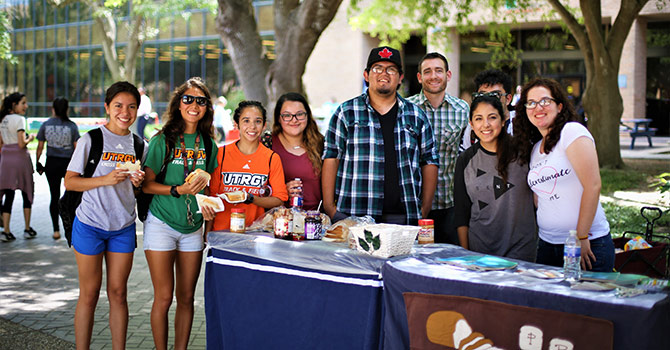


On a Tuesday morning, one of the college students in the ministry I serve stopped by my office before class. He asked for permission to use the building’s kitchen to prepare bags of sliced mango and cucumber to sell at the busy soccer fields in his Latino neighborhood. He was raising money so his college friends could go on a mission trip.
He wasn’t going on the trip. He just wanted them to.
I work with Latino college students, and moments like that one have subtlety reshaped how I think about generosity. Many of them are first-generation college students who live at home by choice — not because they can’t leave, but because moving away would mean leaving their families without a lifeline. For instance, one of my students schedules all her classes on Tuesdays and Thursdays so that she can help her mother clean homes on the other three days so their family can make ends meet.
What I witness on my campus is not an exception. It is a pattern. And I am convinced that most of our churches are missing it entirely.
In many churches, it is common practice to publicly share how much money members of the congregation are giving. This information often is printed in the back of the bulletin, shared in email newsletters, distributed during business meetings or displayed on boards inside the church.
In my Baptist context, this practice often becomes more pointed when churches launch Spanish-language ministries. Giving updates frequently showcase differences in how much was given in the English service and how much was given in the Spanish service. Often these reports make the Spanish-speaking community appear less generous than their English-speaking counterparts.
I know that institutions rely on financial metrics because budgets, buildings and programs require monetary resources. But when financial reporting becomes the primary lens through which generosity is interpreted, other forms of contributing can become invisible.
Over time, seeing lower financial contributions from the Spanish-speaking congregation can lead some congregants to assume that Latinos do not give as much as others. I have seen these assumptions emerge not only at the local church level, but also in association and convention reports, where predominantly English-speaking churches are often listed as giving larger amounts, while churches made up primarily of minority communities appear to give less.
When these patterns are discussed among congregational leaders and members, the common explanations are that Latino congregations earn less money or that a culture of giving has not yet fully developed among them. These explanations are typically offered with good intentions, but they reveal something worth examining: We have quietly reduced generosity to a financial transaction, and in doing so, we have blinded ourselves to the generosity happening all around us in other forms.
A few years ago, a friend told me why he had stopped attending church. The congregation was raising money to build a new fellowship hall and they were asking for donations. He didn’t have money to give at the time. But he was a construction worker, and so he showed up after work, day after day, and helped build it.
When the fellowship hall was finished, the church held a celebration. A program was printed listing the names of everyone who had contributed to the project. My friend’s name was not in it. Only those who had given money were recognized.
He told me he wasn’t angry. He was just sad that money had come to matter so much.
That story has stayed with me because it names something I think many people have felt without quite knowing how to say it: The way we talk about giving in church can quietly communicate that what you have to offer only counts if it can be turned into a bank deposit.
This missed connection is not unique to churches. In Western countries, philanthropy tends to focus on financial contributions because such contributions provide a clear way of measuring generosity. But our approaches to reporting are keeping us from seeing the incredible generosity of different cultures all over the world.
Recent research helps explain why Latino generosity often remains unseen. While fewer than half of U.S. households now give through formal nonprofit channels, research shows that generosity is not declining — rather, it is shifting to other channels.
The Everyday Donors of Color: Diverse Philanthropy During Times of Change report shows that many households of color are more inclined to give directly to individuals and families in need rather than to nonprofit organizations; in doing so, they show deep commitments to relational and community-based traditions of care.
This matters for churches. The Generosity Commission’s 2024 report, Everyday Actions, Extraordinary Potential: The Power of Giving and Volunteering, finds that religious communities remain one of the primary spaces where people give and volunteer.
That is a remarkable opportunity. Churches are uniquely positioned to name, honor and encourage every form of generosity. The question is whether we will take that opportunity seriously, or continue to use the offering plate as the key way to measure how much people give.
A study by Baylor University found that racially diverse congregations have nearly tripled in the past 20 years. As we minister well to these communities, it becomes necessary to adjust how we report people’s contributions in a way that recognizes the diverse expressions of giving that make churches a powerful force for kingdom work.
A few shifts in how we speak about giving could go a long way. Here are some suggestions:
- If your church reports financial giving publicly, consider reporting a single total for the whole congregation rather than breaking it down by service or language group. Comparisons that sort people by how much they give quietly shape how those groups come to be seen.
- Treat serving and giving as equal expressions of generosity, not as first and second options. Resist the habit of saying, “If you can’t give, at least you can serve.”
- Encourage collaboration among everyone by teaching that generosity is a disposition of the heart rather than something tied to financial wealth. This means that people with fewer resources can give as much as the wealthy.
New efforts are being made on how we think about generosity. For example, Giving Tuesday issued a report seeking to shift giving from a financial model to diverse expressions of care that capture how people from different cultural backgrounds practice generosity. Our congregations can do the same. This offers a fuller picture of what it looks like when people live generously.
My student selling fruit at a soccer game so his friends could board a plane and serve strangers? That is generosity. The construction worker who gave three weeks of his evenings and his labor to help build the new fellowship hall? That is generosity.
The offering plate will always have an important place in the life of the church. But it was never meant to be the whole story. My prayer is that our congregations would learn to recognize and nurture giving in all its forms, honoring acts of service, care and mutual support as faithful responses to God’s own generosity — and, in doing so, that our congregations would bear clearer witness to what generous living truly looks like.