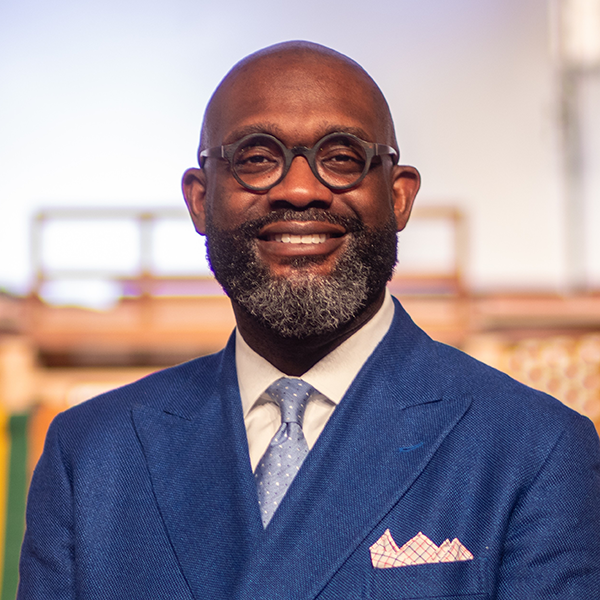
The Rev. Dr. Earle J. Fisher’s time leading Abyssinian Baptist Church has been marked by activism from the start. The Memphis, Tennessee, pastor is also the founder of UPTheVote901, a nonpartisan, Black-led voter empowerment effort whose name reflects the region’s area code.
Fisher, associate professor and dean of the chapel at LeMoyne-Owen College, describes his work at Abyssinian as cultivating a model for Black faith expression and social witness. He spoke with Faith & Leadership’s Aleta Payne ahead of midterm elections, which some voting rights advocates are concerned will be affected by significant gerrymandering and hampered by new election restrictions. The following is an edited transcript.
Faith & Leadership: Could you talk about your work with voting rights?

Earle Fisher: I’ve seen voter empowerment as an extension of my pastoral platform and really central to a lot of my advocacy and activism for at least the last 10 years.
I really started my journey in activism and organizing more formally while I was in seminary — that would be between 2004 and 2008 — because I was becoming familiar with Black liberation theology and wanted to connect what was happening in pulpits and public squares to what’s happening in ministry and the different areas of the marketplace.
And after the Clinton-Trump election in 2016, I was so shocked at the results that I started looking at where low voter turnout precincts were in Memphis and Shelby County. I found out that a lot of them were in close enough proximity to Black churches where I would’ve thought the Black church had more influence on voter turnout than it actually had.
In 2018, we formally launched UPTheVote901, which is a nonpartisan voter empowerment collaborative. Its vision is helping to produce more power, information and representation for more people and increase voter turnout in Memphis and Shelby County in every election.
I’ve tried to be very intentional about partnering with, training, working with, collaborating with the Black faith community, because I understand the opportunity that exists within that.
I’ve been working most closely over the last couple years with Dr. Jason Lawrence Turner, who is the pastor at Mississippi Boulevard Christian Church. I actually was licensed and ordained under his predecessor, Frank Anthony Thomas. [Turner] formed the Black Clergy Collaborative of Memphis and African American Clergy Collective (ACCT) in Tennessee. When he organized those initiatives, he asked me to serve as one of the catalysts on the steering committee and executive committee.
Our aim has been to engage and educate and empower faith leaders, especially in Memphis and Shelby County, with the Black Clergy Collaborative and now across the state of Tennessee with ACCT. We believe the better we do that, the more equitable the results of our elections will be. It was Eugene Peterson who [described] that as “a long obedience in the same direction.”
F&L: Would you discuss the theology and why you think faith leaders should be in this work, regardless of denomination or other identifiers?
EF: It is ultimately about leading our congregation. Those in the Christian faith tradition think about Scripture. Above all, we ask for things according to the power that works within us.
More precisely, it relates to those who follow Jesus of Nazareth, who Kelly Brown Douglas called the Black Christ, Albert Cleage the Black Messiah, Woody Clermont the Negro from Nazareth.
Jesus’ inaugural sermon is quoting Isaiah 61, talking about what the Spirit of the Lord has anointed him to do. And all of the things that the Spirit has empowered him to do are connected to concrete sociopolitical reality: good news to the poor, recovery of sight to the blind, setting the captives free, proclaiming to be acceptable here at the margins. All of that stuff is health care, criminal justice reform, reparations.
People can move by their own theological convictions. But I simply can’t align with those who try to detach the theological from the social, the political and the anthropological. William Augustus Jones would say that your theology determines your anthropology, determines your sociology.
If our theology does not take into account the social and political realities, then our theology is ultimately irrelevant.
F&L: Memphis has been hit particularly hard by gerrymandering, so it is a local issue but one being experienced in other places. Meanwhile, I hear a lot right now from church leaders who are feeling so overwhelmed by trying to respond to the needs of immigrants and to the needs of folks who economically are struggling. How can issues be connected so that people will feel inspired to vote?
EF: When I started this, it felt like we could be a model for other cities and municipalities and areas to do similar work under the umbrella of UPTheVote. My niece is in Ypsilanti, Michigan. Her name’s Tiana, and she just launched, as part of one of her projects in her high school class, UPTheVote734.
She’s taken some of the cues of organizing for voter registration and voting engagement that we are sharing with her. That’s part of what we anticipated would happen.
I did not know that the redistricting would catapult UPTheVote into an arena where we were forced to reach across the state because of how they gerrymandered the congressional districts. Clearly, they shifted the landscape and trajectory of our engagement work.
But I have still been primarily trying to engage faith communities across the state, because I felt like that’s where my most immediate network was. I’m able to call pastors across the state and say, “Hey, let’s try to talk about how to implement some of these initiatives where you are.”
We spent a substantial amount of time over the last several weeks looking at low turnout precincts and trying to assign faith communities to do canvassing work specific to those precincts.
I’ve drafted and organized a lot of lists of voters assigned to a particular precinct. I just send a file to the pastors in that area and say, “You need to make some phone calls, do some canvassing, host a town hall, do a poll party” — something to that effect — and [encourage them to] try to do a better job of being tactical and intentional about engaging the people they know who make up the 275,000 people in Memphis and Shelby County and the 1.7 million people across the state of Tennessee who were registered to vote in 2024 but did not turn out.
As it relates to the issues, this administration in the last several political cycles has thrown so much at communities of color that it is rare that one can focus on just one thing. And it is also difficult to be extremely impactful if you don’t focus on one thing. That’s the quagmire.
My primary focus has been around criminal justice reform. So, that has probably been one of the major anchors, even though there are issues of not just crime and public safety or policing but also education. And with the rise of the data centers in the area, now you have housing and the environment.
It’s hard to talk about this stuff and not talk about money or the budget. And then you have labor and wages, which are all categories that ended up on the Memphis People’s [Convention] agenda that we published in 2019 after doing a series of 2,200 surveys asking people what issues were important to them.
Now one of the things people have to do strategically in organizing and convening groups to discuss these matters is being crystal clear on what the topic is for that particular session. If you don’t, you’ll think you’re going to start talking about education, and then somebody is going to start talking about crime. Then somebody else will start talking about wages, then somebody else is going to start talking about budget, then somebody else is going to start talking about real estate, and you’ll be all over the place.
We’ve held dozens of what we call voting and planning symposiums. And we try to structure them in ways where they target a particular issue, whether it’s discussing criminal justice reform or the city budget. Are we discussing the data centers? [No.] Are we discussing the school system? [No.]
Or focus on the demographic. We’ve been very intentional the last few election cycles about setting up some time to talk specifically to Black men. [Judging from some reports,] you would believe that Black men aren’t voting at all, or if they are voting, they’re voting for the conservative candidates, when the numbers show Black women are voting for the Democratic candidate at about a 92% level and Black men at about an 80% level, but a lot of people don’t notice.
Just trying to be as engaging and as informative and as inspirational as possible. But it is complicated when there are so many issues that people have to deal with in these communities that suffer from political exploitation and disinvestment.
F&L: One of the things that is associated with get out the vote historically and with Black churches is Souls to the Polls. What you’re talking about is a much more nuanced, layered approach. It is not any single effort.
EF: There had never been a single effort. Even at the height of some of the Souls to the Polls initiatives, they were still connected to labor organizing initiatives, teachers who were organizing, and localized campaigns. They were much more effective in times past, based upon what I heard or what I’ve observed. It’s not like I did deep research on this, but I definitely have read enough to know.
The congregations were much more neighborhood-driven in the ’60s and the ’70s. People who went to the church lived in the neighborhood. The teachers worked in that school system in the neighborhood, and people who held businesses were typically in that neighborhood. You convene the people at the church and then you can shuttle them to the polling precinct.
Now you have [community-wide] churches primarily. Most of the people who go to the church don’t live in the immediate proximity of the church. The church community is also a lot more transient because people have their own independent transportation. It’s really not wise to tell people to drive to the church just for you to drive them to the poll.
What we tried to restructure over the last couple of cycles is having congregations just schedule the time when they will meet at a particular poll. And so it’s “souls to the polls” but not with the same type of transportation focus as much as a focus on turnout in time and tactical location.
In June, we held a rally just to motivate congregations and faith communities to participate and giving them a lay of the land in light of what happened with redistricting. That was still very much focused on what was happening in Memphis and Shelby County, because that is where the local election was taking place. It was a countywide election. This is when the freshness of redistricting was still very palpable amongst the community members.
Knowing now that we are facing the state and federal general election in the midterms, we’ve decided that our Souls to the Polls rally this time will be on the first Saturday of early voting, and we’re doing it statewide. We have called faith communities across the state to join us and gather that day in community in a congregational context, [then] leave from the rally at the church or the mosque or the synagogue and go straight to the ballot box.
It’s also better to work in groups as much as possible. Sometimes perhaps we try to be lone rangers, which is not real wise in moments like this. Do the best you can to be in collaboration with other colleagues, especially those who are like-minded and similarly situated.
Another thing I’ll say is it’s a shame that you have political parties that are not committed enough to the full engagement and investment of the Black faith community. There should be more substantial investments in these Black communities that these parties know are being exploited politically, but you have to create that kind of political will, that political courage, and that political appetite.