My Mother Never Told Me to Hush!
I am an only-child-turned-holy-disruptor, reared by a mother who never told me to hush and a lineage of women who taught me what Black feminists like Audre Lorde and Tamura Lomax have written about: that silence is the tax Black girls pay when the world can’t afford our brilliance.
Growing up, my voice was my most cherished companion. I talked to myself often. I would recite scripts I’d written in my head to respond to neighborhood bullies. The bathroom was my set and the medicine cabinet mirror my camera. I would also rehearse what I would say to a crush, often ending with a coy laugh, something I’m sure I picked up while listening to the teenagers I was often around. I would also sing to myself and my imaginary audience. I would place a towel around my head tied with a rubber band to keep it in place, then grab the hairbrush and sing all the songs my mom played while we cleaned the house on Saturday mornings or while she talked on the phone with her girlfriends. My mom caught me, and soon after, I became the crowd favorite during Friday night card parties and Saturday cookouts. Between bid whist sets and doing the hustle, my mother would come to my room where I was pretending to be asleep.
“Che Che, get up and come sing for us,” she’d ask.
I’d jump up and walk into the living room in my onesie with the feet in them that made the scratchy sound when you walked. Now on another stage, the white shag rug that laid over the red carpet, I’d look to my mama and ask, “You want me to sing my song?” She would always say, “Yes baby, sing that song mama likes.” I would go over to the stack of albums that sat by the side of the record player and thumb through them until I found it: Debra Laws’s “Very Special.”
I loved playing records. Hearing the needle touch the vinyl and make that static sound made me excited; it was also my cue to get ready. The title song “Very Special” was sung by Debra and her brother Ronnie. I sang both parts. It was a call and response. The adults, usually the women, would be high-fiving each other, saying “I know that’s right. Sing, baby, sing!” It wasn’t that my mother thought I could sing especially well. As a matter of fact, she didn’t really think I was good at all, but that was never really the point. The point was to stand and be heard.
The same was true when I auditioned to be a contestant for the Miss Black Teenage Pageant. My mom asked, “What are you going to do for talent?” I said, “Sing.” She shot me a look as if to say “Girl, this ain’t the living room.” Just like when I was ten, I would rehearse my song in the bathroom mirror. To perform your talent on stage in front of the audience on the night of the pageant, you had to score high enough to be in the top fifteen contestants.
I didn’t make it either of the years I competed, but I sang in the choir at church and school. I was nominated to audition for the Center for Musically Talented to commence training. I didn’t like the music, charge it to my lack of exposure, so I quit. I secured a manager instead. I told my mother that I needed a boom box to practice, and she obliged. Every Saturday morning, I would either walk or catch the bus to Cherry Street in the Lincoln Heights neighborhood [of Pittsburgh], take my stand in front of the mirror, and belt out Shannon’s “Let the Music Play.”
Years later, it dawned on me that my mother’s support of my taking center stage was never about singing; it was about taking up space. A child of the segregated South, my mom came of age in an era when taking up space could be dangerous. Others blamed my mother for the assaults she endured, as if the violence was summoned by her very existence — by her refusal, or perhaps inability, to shrink. This cruel logic is the burden placed on so many Black women: that our bodies are both the site of harm and, unjustly, the reason for it.
To stand out and to speak up about anything was to draw attention to herself in ways that she always paid for, so she hid herself. She remedied invisibility by reading books and escaping to imaginary places where her voice was not unwelcome. Even though she didn’t think I was the greatest singer then, she didn’t want silence to be a forced necessity, so she never told me to be quiet.
I didn’t just sing; I asked questions. In a neighborhood where “Stay in a child’s place” was gospel, I refused to comply. When my mother started dating my bonus dad, she loved retelling how I looked him square in the eye and asked, “How long are you staying tonight? My mom goes to work in the morning.” Sex, faith, violence — nothing was off-limits. After overhearing my teenage babysitter mention a term I didn’t recognize, I marched straight to Mom for an explanation. She never flinched; she simply breathed, asked where I’d heard it, and then answered in full.
That fearless curiosity soon turned outward. I grilled her post-divorce suitors — “Are you married?” — and pressed for answers to harder truths: “Why do you let him hit you?” “Why cook for him after he fights you?” One night, finding her weeping after an argument with Dad, I pulled For Colored Girls from the shelf, read Shange’s poem “Sorry,” and wondered aloud why people keep doing what forces them to apologize again and again. Each time, Mom paused — not in annoyance but in reverence — then spoke honestly. By honoring my questions, she trained me to claim space and to believe that justice begins with an unfiltered voice.
That conviction followed me onto every stage. At the Miss Black Teenage Pageant I declared, “I want to become a lawyer because justice needs help finding its rightful place,” a dream shaped by what I saw women in my community endure. Pregnant with me, my mom filed briefs as a legal secretary — “paralegal” when the title felt safer — and brought home stories of revolutionaries that soaked into my spirit long before I could spell jurisprudence.
By elementary school I was already resisting injustice. When a teacher singled out my Muslim classmate, I didn’t yet know the word racist, but I knew it was wrong. I stuffed eggs in a brown paper bag, ready to splatter her car in protest — until a classmate foiled the plot. My mother was summoned, and she and the teacher recognized each other from high school, confirming my instincts: my protest had merit. Rather than scold me, she polished my audacity. She turned my margin into the center — what bell hooks calls making the outskirts home — because, as Audre Lorde warns, silence will never protect us.
When the Central Park Five case broke in 1989, my senior year, I watched justice take a wrong turn down a dark alley, and my resolve to study law blazed even hotter. I wrote in an admissions essay that I hoped to guide justice back to the people who needed it most. Though I didn’t come from a line of lawyers, I descended from cultural workers who took up space to birth, heal, and proclaim: Great-Aunt Bonnie, a midwife; Great-Aunt Annie, a traveling evangelist; Great-Aunt Susie, a fire-talker; Great-Grandmother Mamie, a nurse.
Their witness showed me that a voice can midwife liberation as surely as hands can deliver babies. Ultimately, my mom’s greatest gift was centering my voice and body, equipping me for a different bar — one that measures courage rather than case law. From that inherited margin-made-center, I now preach Afro-centered, Afrofuturist womanist sermons that bend time: honoring ancestors, naming present wounds, and conjuring liberated futures. I speak truth to power, claim space, and help justice finally take its place — because a Black girl who was never told to hush grows into a woman determined that the universe hear her song.
I preach because, despite what the mired US criminal systems posit, I don’t have the right to remain silent in the face of savage church and government politics. I don’t know how to not raise my voice on behalf of the least of those who are they/us that sit at the dehumanizing intersections of white supremacy, patriarchy, and unbalanced socioeconomic class strata. I preach as an act of resistance and acceptance. I resist the backward thinking that relegates women and other marginalized people to the periphery of organized religious proclamation while exploiting and policing our/their bodies. I accept that I am what womanist Renita J. Weems named “a thinking woman of faith” on her blog Something Within.
Because I know what I know, and it cannot be contained in one religious tradition or flat spiritual trajectory. I preach Oludumare and Yahweh; Jehovah and Nzambi Mpungu; Yeshua and Shango; Mary and Oshun. I preach because it is nefarious not to shout out the worth of Black lives, the value of Black girl brilliance often referred to as magic, and the innovation that is Black embodiment. I preach because I was once a colored girl who considered suicide when the rainbow was enuf. Then one day, “I found God in myself, and I loved her, I loved her fiercely (Shange).” I learned that within me was buried a deep well, known as Source. I learned that I carried “womanist asé — ‘spiritual power invoked by Black women,’” a term I first heard Monica Coleman use during a presentation in 2017, for our well-being from traditional and unconventional sources to unfetter ourselves and our communities from the vestiges of interlaced oppressive systems.
I preach not to save sinners from external forces of evil but to emancipate many from the church industrial complex, where souls desiring redemption are on lockdown in pews beholden to tragic theologies; where Jesus is a bearded white man and God is a neo-Nazi moving folks to build walls of exclusion instead of bridges of collective work and responsibility.
I preach to set the captive free, even when the captive is me. I preach. We preach. My body preaches through womanish gestures, and I wish a ninja would standpoints. My breasts preach sermons of anatomical acceptance when they refuse to be disguised by shapeless and non-pink robes that bear the tried marks of truth telling and wisdom sharing.
Instead, they stand mostly with assistance to proclaim the acceptable day of God. I am fearfully and wonderfully made! My stomachs, yes plural, preach when they refuse to be subdued by corsets and girdles, all forms of patriarchy, misogyny, and respectability. My hoseless thighs preach as they thunder to and fro, loosening the shackles of the hoodwinked and bamboozled. We preach. I preach with feet marching to freedom’s land, with my hands lifted whether I’m yelling “Hallelujah,” “Fight the power,” “These is bloody shoes,” or “God’s Plan.”
I preach because my momma never told me to be quiet. I preach because my great aunt Susie knew how to “talk the fire out” of people. I preach because my ancestors trust me, and our seeds are counting on me. Why do you do what you do?
Pause & Ponder
Who first told you that your voice mattered?
Whose refusal to hush still echoes in your own speech?
What have you been silencing in yourself for the sake of someone else’s comfort?
What truths are still waiting to be spoken?
What did your mother — or your mother-figure — not say, that shaped you anyway?
And what stories do you carry that deserve to be heard?
What does it mean to speak with love and with fire?
To ask questions that disrupt, not just inquire?
Where were you taught to stay in a child’s place — and when did you outgrow that place for good?
What would it sound like to pray with your full voice?
To shout, to whisper, to rage, to weep — without apology?
Take this moment to honor the ones who let you speak.
The ones who didn’t flinch when you asked hard questions.
The ones who raised you in truth, even when they didn’t have all the answers.
And the voice that’s still unfolding in you — bold, Black, and unbothered by decorum.
Speak, beloved.
And don’t you dare hush.
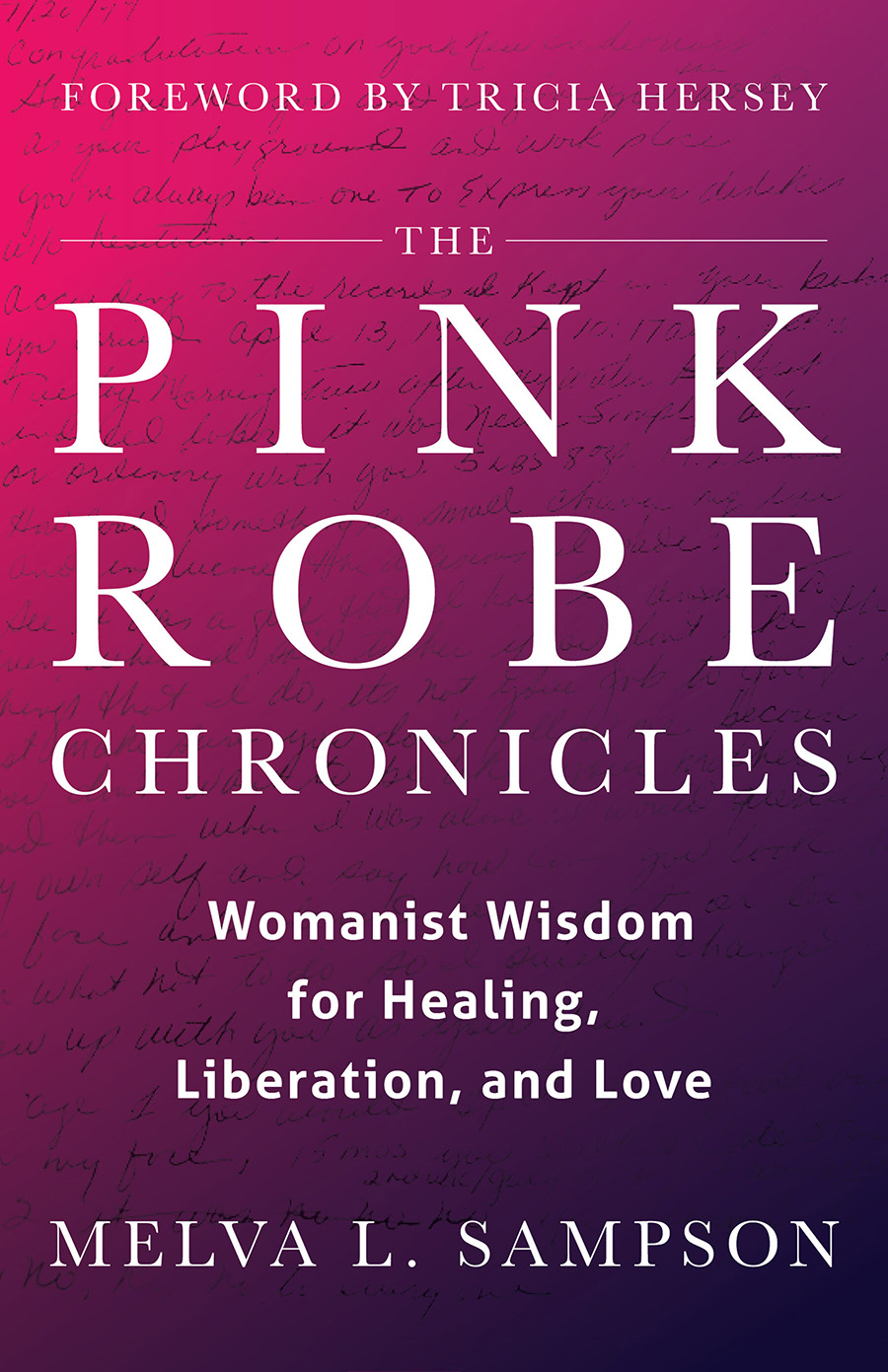
Excerpted from “The Pink Robe Chronicles: Womanist Wisdom for Healing, Liberation, and Love” by Melva L. Sampson. Copyright © 2026 Broadleaf Books. Used with permission.