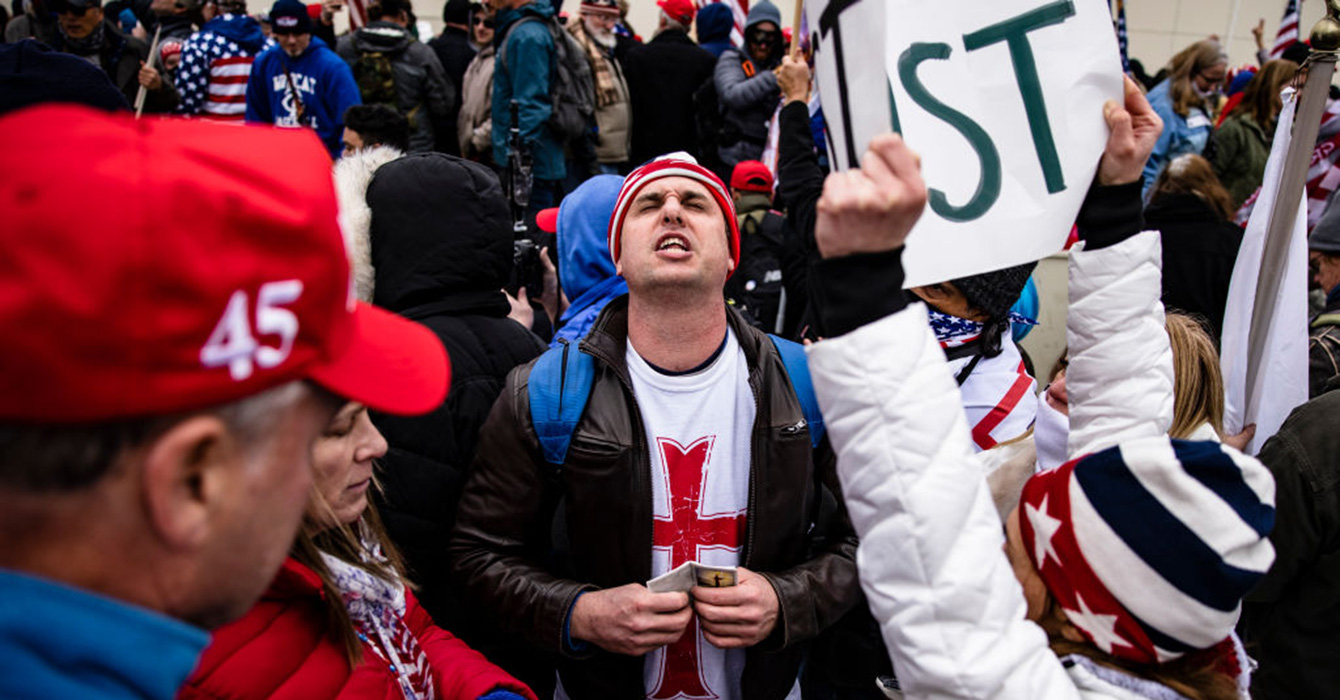
Robert P. Jones is pointed in his analysis of the connection between white evangelicalism’s foundational beliefs and the rise of Christian nationalism. As the president and founder of the Public Religion Research Institute, he comes to the work as a sociologist and theologian, and also as one raised in the faith tradition he now believes is slipping into apostasy.
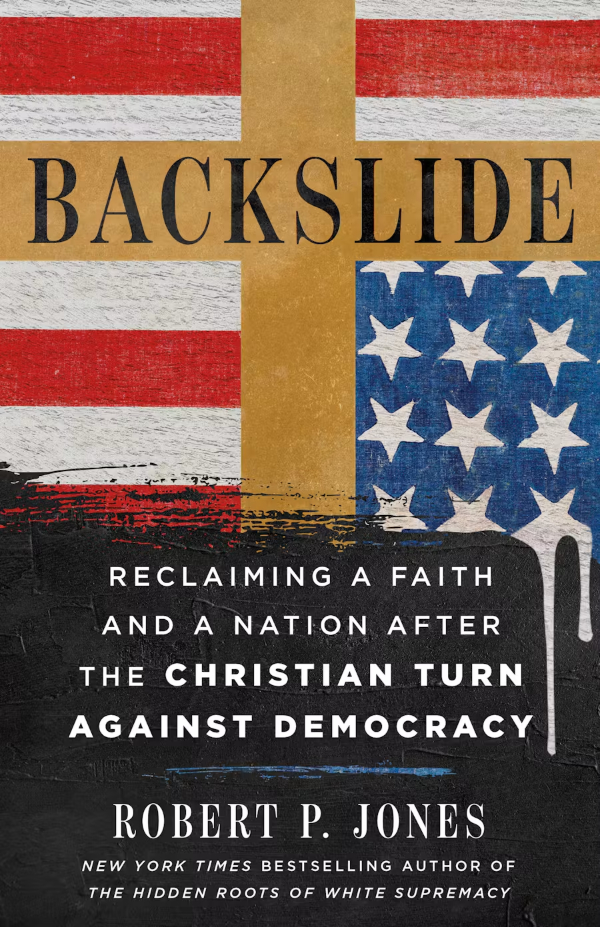
His latest book, “Backslide: Reclaiming a Faith and a Nation after the Christian Turn Against Democracy,” is unflinching in its critique of the crises facing Christianity and democracy and the intersection of those threats. Jones points to times in history when the church has done harm — either through silent or active complicity — and identifies parallels to today.
Speaking with Faith & Leadership’s Aleta Payne, Jones discussed a chapter about the war on empathy. He cited the research of psychiatrist G. M. Gilbert, who interviewed Nazi leaders on trial at Nuremberg and found a lack of empathy to be a shared trait among them. Eighty years after Gilbert’s work, Jones said:
There is now a concerted movement in white evangelical circles to undermine the very notion of empathy as a foundational moral sentiment. The real question that should give us pause is, why is this concerted effort happening now? Why would anyone need a theology that calls empathy a sin? I think there are only chilling and disturbing answers to that question.
“Love your neighbor as yourself” is about as clear a concept of empathy as you could get. It is one of the two greatest commandments, according to Jesus: Love the Lord your God with all your soul, all your heart and all your might, and love your neighbor as yourself. If you don’t do anything else, these things will keep you on the right path.
These concerted attacks on empathy are being promoted, not by fringe characters, but by people like Al Mohler, who is the president of the Southern Baptist Theological Seminary. It’s the flagship seminary of the largest Protestant denomination in the country. That’s how serious this is.
The following is an edited transcript of the conversation between Jones and Payne.
Faith & Leadership: You use “backslide” both as a secular and religious term.

Robert P. Jones: I grew up Southern Baptist in Mississippi, and particularly during my adolescence, as part of the youth group at my local Baptist church, this word “backslide” was never really far from my ears. It was a constant warning about falling away from the faith or not continuing to grow as a disciple of Christ. There was a low hum of moral anxiety or spiritual anxiety during my adolescence — this warning about falling away from the faith.
In my day job now at Public Religion Research Institute, I hang out with a lot of social scientists and political scientists, most of whom do not share that background with me, but I noticed they were using this term, backslide. You’ll see it in peer-reviewed political science journals now, and it is usually attached to the word “democratic,” as in democratic backsliding.
It’s a similar use of the word — to fall away from previous commitments — but in secular spaces. I’ve had now two separate conversations with political scientist friends of mine who had no idea that the word backslide had this older theological meaning.
F&L: You approach this through multiple lenses. You tell personal stories, you cite statistics, theology, history. How do you think it helps you tell the story with these different perspectives?
RPJ: I think I’m the only person who often gets labeled a pollster in Washington who also has a master of divinity degree from a seminary. That’s helpful. It means that when I hear theological terms, I know how to unpack them. I know theologically what’s underneath. All those terms are pregnant with meaning, and I understand those layers of meaning.
I’m also able to use historical or sociological lenses to take a look at the bigger patterns and the longer sweep of time. This book, maybe more than any of the others I’ve written, brings those threads together.
F&L: We are in a time when some people are more comfortable with lies and lying, even when what is being said is clearly not true. You make the point that if you’ve hung your identity on something that’s untrue, then additional lies are not a stretch.
RPJ: I was having a conversation with a friend [recently] who I’ve known a long time, and he was asking me, “Why do you keep writing books about these same sort of topics, about Christian nationalism or white supremacy and the way it’s been entangled with Christianity?”
I think my motivations have been primarily about searching for the truth. I grew up understanding myself to be white and all that means culturally — not just the skin color, but everything it means to claim that identity. If I can boil down my mission here, or my calling, to speak theologically, it is really about trying to get my people to tell the truth.
What does that mean exactly? It means telling the truth about how we got here and what our ancestors’ roles were in getting us here, telling the truth about what that means for the current kinds of inequalities we see in the country. It helps make sense of things, like the fairly thin commitment to democracy that we see among white Christians today, for example.
The abandonment of democracy by so many white Christians might seem mystifying to some people, but then you remember that white Christians in the South didn’t have a commitment to democracy prior to 1965. They had a commitment to white democracy or democracy for white people. It’s not that far back. That insight, that truth, helps make sense of where we are and why the struggles look the way they do, why the backlash looks as fierce as it does.
Mostly, I think that if we’re going to move [ahead as a country], we first have to look back to the past. If we’re going to live into a future that has integrity, it can’t be built on a lie. It has to be built on the truth.
F&L: You also write about Christian propriety that leads to attitudes of “We need to build bridges.”
RPJ: I take this lesson from the African American church and African American Christian leaders. I struggle with this a lot, because I do share the Christian impulses that instinctively lead with unity, big tent, putting our arms around everyone, everyone’s welcome, all these things that make your heart warm and fuzzy.
At the same time, I worry that we’ve lost our ability to just ask, “Is unity really our highest calling as Christians? Does that even make sense if we read the life of Jesus and the Gospels? Is [unity] really what he was after more than anything else?” I think the clear answer to that is no, and we’ve had people reminding us of that all along the way.
Center- and center-left mainline Protestant congregations love to quote Martin Luther King Jr. Far too often we’ll do readings from his speech on the National Mall. [We] don’t often read “Letter from Birmingham Jail,” where he is specifically calling out the moderates in Birmingham, Alabama, who were telling him he’s being too divisive.
He is calling them out there and not making friends, drawing lines in the sand and saying, “Yeah, we can’t just agree to disagree on segregation. We can’t just agree to disagree on racism. These are not things that you can [have] both sides.”
I think we’ve forgotten this lesson. We’ve forgotten that he even made enemies inside the National Baptist Convention. He was a fairly divisive figure among many African American congregations, but he drew clear moral and theological lines in the name of love and justice.
Not to say that he or anyone else always gets it right, but he was not of the illusion that Christianity and following Christ were going to be a comfortable path that was going to make everybody his friend.
I chose that word “propriety” because too many of us think of Christianity as bestowing social benefits upon us. It makes us more respectable people in our community. By going to the right church and sitting in the right pew and being on the right committee, we have somehow raised our own social standing. There’s a risk of losing all that if you start being too strident or drawing lines in the sand.
I also think of Frederick Douglass and the abolitionist movement and that great speech he gave where he said, “We want crops without the disruption of tilling the soil. We want the rain without the thunder and the lightning.”
If there’s a cardinal sin of predominantly white congregations, I think it’s this: We’ve mistaken our primary commitment to be about unity and niceness rather than about love and justice.
F&L: You are uncompromising about two issues: the urgent role in get-out-the-vote efforts for white Christians opposed to Christian nationalism, and the path back from apostasy, which is a serious, serious word.
RPJ: I’ll take the apostasy one first. It’s a Greek word that literally means to fall away from or to stand apart from a previous place. I use it at the beginning of the book and in the end of the book, in the example of the church really struggling to find its voice and find its way with the rise of the Nazi party in Germany in the 1930s.
I’m an academic. I’m trained in all the ways that you should be cautious every time you reference Hitler. I [thought] long and hard about this, and while the contexts are not the same, they are nonetheless instructive for us.
When I first learned about the Christian church’s complicity in providing moral cover for the Nazi party, and that there was only this really small minority of opposing voices [that] came to be known as the Confessing Church, led by people like Dietrich Bonhoeffer and Martin Niemöller, I was appalled.
How could so many German Christians possibly have gone along with this?
I say in the book that today, given what I’m seeing the Christian churches in the U.S. do, I’m more sympathetic to the situation of the German Christians than I was in my younger, more zealous days. It’s because I see us struggling to find our voice. I see us struggling to find our feet. And the question is always, “Where’s the line? Where’s the bright line?” I think we’ve got plenty of those bright lines and are still struggling to find our voice.
If you continue to do that, you eventually end up down the slippery slope — you end up in this place of apostasy, where you really have fallen away categorically from something that you once were. I would say that the 85% of white evangelicals who have voted for Trump and voted to put the MAGA movement into power every time he’s been on the ballot, I don’t think I have any problems saying at this stage of the game, they have fallen into a state of apostasy.
They’ve really lost their Christian witness and given themselves over to a movement that is driven by xenophobia and racism and is primarily animated by those things that we really ought to have a clear voice against.
I only wrote one postmortem election piece after the 2024 election, and it was called “What White Christians Have Wrought.” I wrote it because after the 2024 election almost all the pundits were spending their time saying, “Oh, well look how many Black men moved toward Trump this election. Look how many Latino men moved toward Trump in this election.” Those shifts were true. It’s important to note where people move, and that’s what pundits do.
But I also thought, “Yeah, they’re kind of losing the forest for the trees here, because we do not get Trump as a candidate — we do not get Trump as president — we do not get Trump with this kind of cultural power without white Christians putting him there.”
I think most people know that white evangelicals voted 80% or more for Trump every time he’s been on the ballot. Three separate presidential elections, even the one he lost, they still support him. Eighty percent or more.
What people don’t know is that nearly six in 10 white non-evangelical Protestants, that is, white mainline Protestants, voted for Trump every time he’s been on the ballot, and nearly six in 10 white Catholics voted for Trump nearly every time he’s been on the ballot.
There are persistent voting differences between white Catholics and Latino Catholics, between white Protestants and Black Protestants, there is a racial and ethnic chasm on voting in the religious landscape. We really ought to take this quite seriously.
I’m also, again, appealing to white Christians here — let’s just examine our history for a moment. What has happened when we have found ourselves far from our Black and brown brothers and sisters in Christ on issues? It is not a proud history when we look back on those moments.
We’ve been on the wrong side of slavery, we’ve been on the wrong side of segregation, and anything having to do with race, color, immigration. Why would we think that if we are this far from our Black and brown brothers and sisters now, that we shouldn’t have a little more humility and ask the hard questions of ourselves?
I begin the book with this idea of future regret. Are we going to regret it if we continue down this road? Will we later feel the same regret we now feel because of where we were on slavery? On segregation? Do we really want to put ourselves in a place where in the future our children and grandchildren are going to look back and ask us, “How could you have possibly supported that?”
We’re recording this a few weeks out from the midterm elections. I draw attention to the problem of turnout, which really is serious. Even in the last presidential election, we had more eligible voters who did not vote, than voted for either one of the two candidates who were on the presidential ballot.
In midterm elections, it’s going to be vitally important. Turnout is going to [decide] what government we end up with come Jan. 3 when the new Congress gets seated. Our future will be determined mostly by who decides to show up.