Editor’s note: The following is adapted from a sermon preached by the Rev. Isaac Villegas at Duke Divinity School on Sept. 24, 2026.
“Is the Lord among us or not?” (Exodus 17:7)
That’s what the people are wondering, the question they ask each other as they run out of supplies in their journey away from Egypt. They don’t want to die in the desert. They have no water. Their situation is dire.
Our bodies are around 60% water. We’re mostly water. When we lose 2% of our body weight in water, we start to get thirsty. Our brain triggers our thirst sensation. After two days without drinking water, we lose around 4% of our body weight in water. At that point, our blood pressure drops, we get lightheaded, dizzy, we might faint. Our body stops sweating, which means we can’t cool ourselves, and we start to overheat. At a 7% loss, our body stops sending blood to organs, like our kidneys.
When we lose 10% of our body weight in water, our vital organs overheat to the point that they begin to shut down. Our brain swells, causing confusion and delirium. Our kidneys and liver stop filtering blood, which means the heart doesn’t have enough blood to pump, and the blood available at that point is full of toxins. Blood, the flow of life in us, becomes deadly to the cardiovascular system.
This past month, 13 people were found dead in the borderlands of Arizona. These migrants were walking through the wilderness, wandering for days through the desolate landscape of the Sonoran Desert, hoping for life, a different life, for survival in a foreign land. But they ran out of water.
Since the late 1990s, the medical examiner’s office has documented 4,514 human remains in the southern borderlands of Arizona. Humanitarian organizations estimate that the number of migrant deaths is closer to 10,000, given the number of reports from families whose loved ones have gone missing after crossing into the United States.
“Is the Lord among us or not?”
In our passage from Exodus 17, this is the second time that the Israelites are desperate for water since their escape from Pharoah. In chapter 15, as soon as God liberates the people from slavery, as soon as they cross through the Red Sea, they walk three days without finding a water source, until God provides them with one. Now, here, in chapter 17, the Israelites are still wandering, and they’re thirsty again. Which, as you can imagine, is a predictable condition for human beings.
The people grow frustrated with Moses. Antagonistic, even. “Why did you bring us out of Egypt, to kill us and our children and livestock with thirst?” (17:3), they ask him.
Moses seems surprised to hear that they are desperate for water. At this point, I would have thought he’d have planned for basic necessities to keep them alive as they walked through the desert on their way to the Promised Land.
The Israelites struggle doesn’t end after freedom from Pharoah’s captivity. Liberated people still need water. They need food. After the exodus from Egypt, there’s the struggle to survive in the wilderness. After liberation, the Israelites will have to organize: to live as free people, to care for one another, to depend together as a people on the providence of God.
After liberation, there’s the desert. The people will have all sorts of needs tomorrow, and the day after tomorrow. Survival will be a daily commitment, an organized responsibility, an everyday struggle, en lo cotidiano, which is a call — we hear this call in mujerista and womanist theologies — to root our theologies in the everyday, in the work that begins after Egypt, in the wilderness, as people gather provisions and plan meals and do the dishes and figure out childcare and eldercare. It’s a call for everyone to come together and organize for the health of a whole people.
To develop mundane routines for survival, to care for one another, to look around and take stock of each other’s needs. To leave no one behind.
In the story, in their desperation, the people grumble to Moses: “Give us water to drink” (17:2). They demand what they need to live. They demand life.
In 2018, a man named Scott Warren was charged with two felony counts of harboring migrants. He was and is part of a group in Ajo, Arizona, that puts out water canisters in the desert, in remote areas of the borderlands, 40 miles north of Mexico.
One day, Warren was taking a break from refilling the water stations. He was resting at their supply depot, and two people wandered toward him from the mesquite trees. They were exhausted and needed medical care. Warren welcomed them, offering water, food, first aid and a place to rest.
Soon, border patrol agents converged on the site. They handcuffed Warren and the two migrants. An officer told him that he was under arrest for providing water, food, clothes and a bed for (in the officer’s language) “illegal aliens” and took him to jail. After Warren was bailed out, his attorney told him that, if convicted, he could face up to 20 years in prison — for helping two people struggling to survive.
A jury found him not guilty on the grounds of his exercise of religious convictions. Warren had argued the whole time that his religious beliefs compelled him to give water to the thirsty, food to the hungry, and clothes to anyone in need of them.
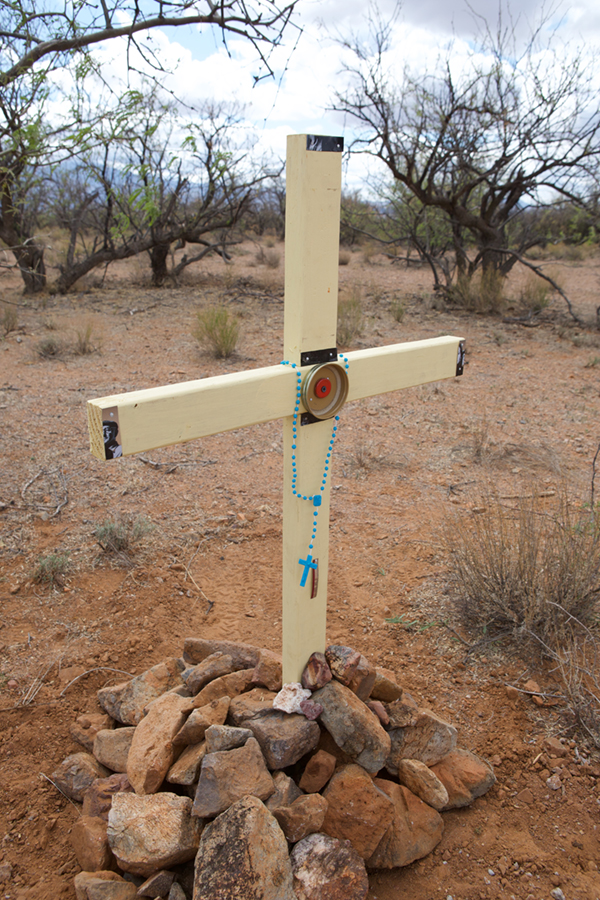
I first learned about people like Scott Warren and groups like No More Deaths and the Samaritans, when, a decade ago, I joined a Colombian immigrant, an artist named Álvaro Enciso, on his weekly treks to plant crosses in the desert. He crafts wooden crosses in his art studio at home and uses a public database of migrant deaths to find GPS locations where their corpses had been found. Enciso calls his art installation project, his crosses out in the desert, “Donde mueren los sueños,” where dreams die. He has installed over 1,200 crosses.
Enciso takes people out with him to plant those crosses in the exact spot where people breathed their last breath, most of them dying — according to the medical examiner’s office — from issues related to dehydration. Volunteers with the Tucson Samaritans go out with him, leaving behind water. I’ve watched and learned from them how to identify migrant pathways, and where to place water containers — to make them visible, available, to save lives.
Our passage from Exodus ends with water, with God guiding Moses to a miracle of provision, to a rock that becomes a fountain in the desert. When God responds to the Israelites’ desperation, God does not chastise them. God speaks no word of judgment against them, for their grumbling. Instead, God listens, God hears their voice and responds without commentary, without a lecture. There’s no time for that. God gets right to the point. The people need water. God tells Moses exactly what to do. It’s a practical directive: Grab your staff, take some elders, and go to Horeb, to the rock there, and strike it, “so that the people may drink” (17:6).
In the wilderness of this world, in the wilderness of ministry, as you prepare to serve your communities, you will find that there are people struggling to find water. I’m sure you know this already; you’ve witnessed the needs of your people, which is why you are here, at Duke Divinity School, to gather resources — theological, biblical, and historical resources — and to discern what needs to be done. You know that our people need miracles, they need signs of hope: acts of provision, of care, of accompaniment, of solidarity. Water stations in the borderlands. Miracles in defiance of unjust laws. Communal acts of goodness to declare that, yes, God is among us. Yes, God is among you.
And, yes, God is in the desert. With the water. And with Álvaro's crosses, marking the places to await resurrection and look for the world to come. A world without death, without the fear of death, without the threat of death.
After liberation, there’s the desert. The people will have all sorts of needs tomorrow, and the day after tomorrow.