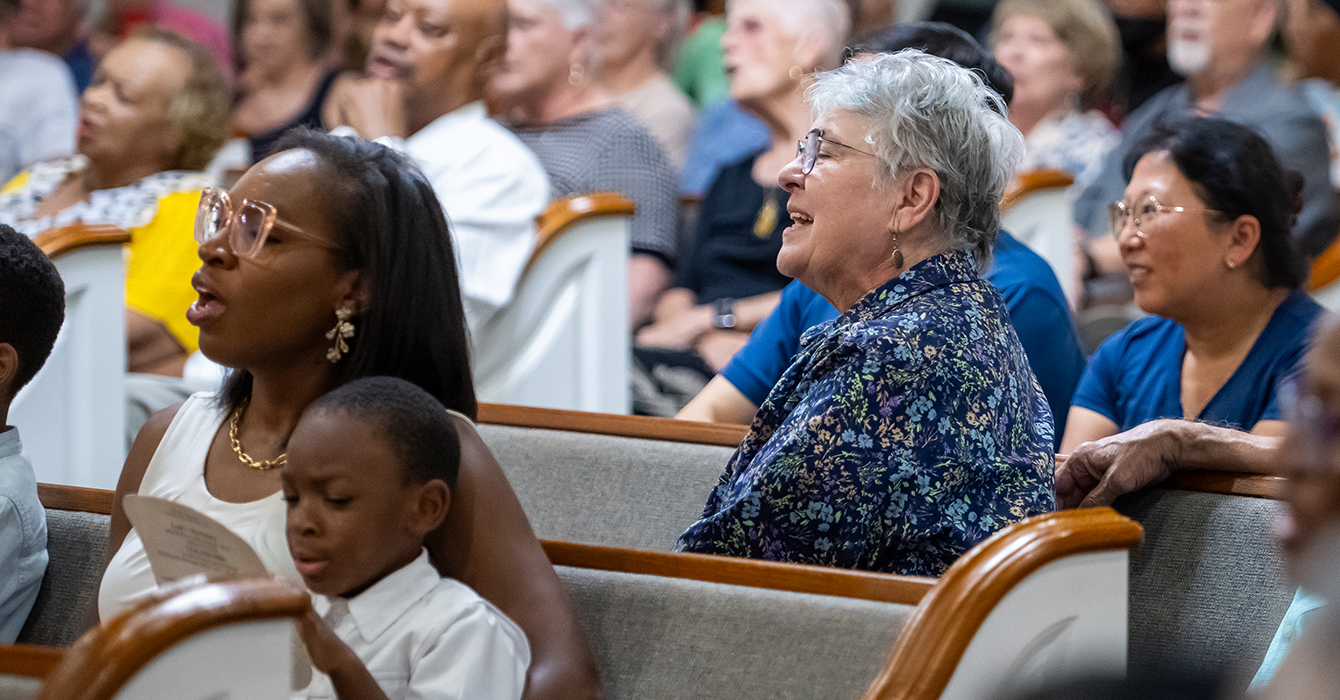

The four-part harmony is a little sharp and falters slightly when Hamilton Landrum introduces syncopation into the arrangement of the hymn he’s leading. But polish isn’t the point.
“This is what it’s going to sound like in heaven,” Landrum calls out as ushers pass paper fans up the aisles. “Tonight, we’re practicing.”

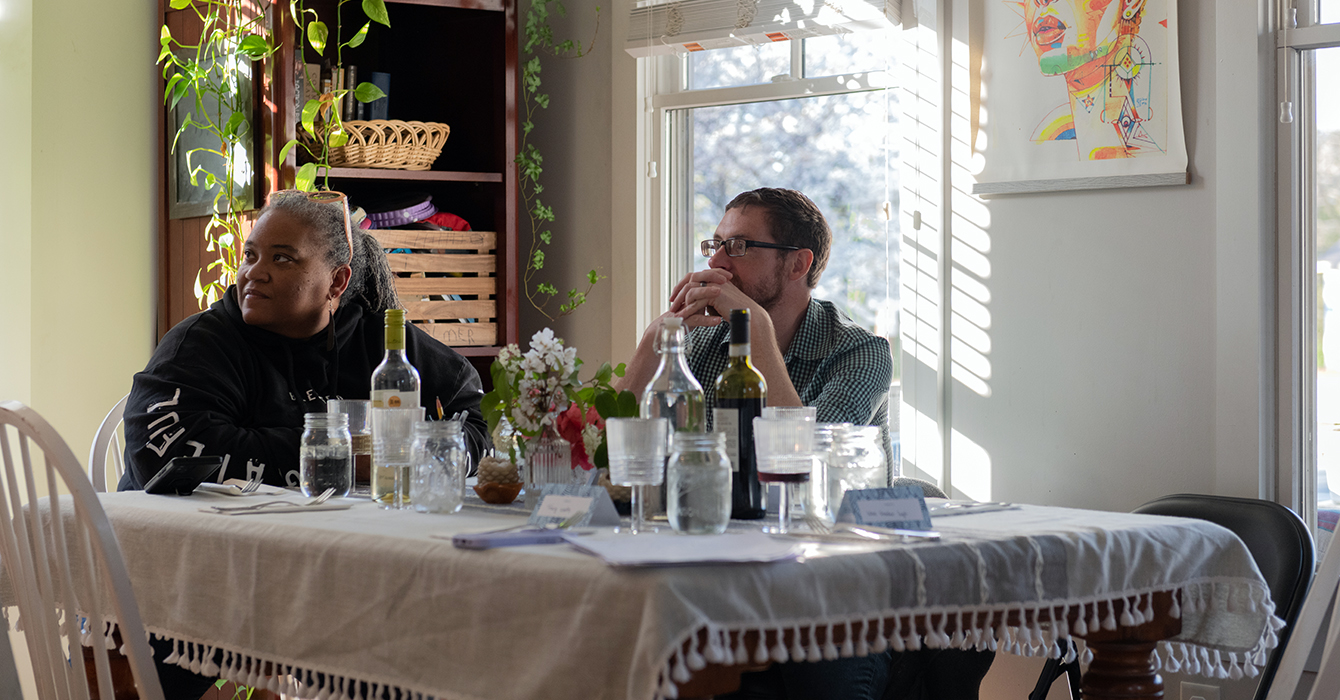
It’s a Sunday night in July, and Dallas West Church of Christ is full. Congregants and visitors have driven half an hour or more from every direction to participate in an intentionally combined service between predominantly Black and predominately white congregations. After a sermon and prayer, the service concludes with hospitality and fellowship over a meal of baked chicken spaghetti, vegetables and ice cream.
The event is an area-wide worship night, organized by M.A.R.C.H., which stands for Ministry for Awareness, Relationships, Change & Healing. The Christian nonprofit focuses its work on connecting Dallas-area Church of Christ congregations to promote racial unity.
In a city repeatedly rent by racism and racial violence, this simple summer gathering is radical: a gesture of unity that stands against a status quo of separation, appealing instead to the values of love and equality rooted in the Gospels. The worship builds relationships across divides.
“It’s hard to love a person that you really don’t know, to love them deeply,” said Paul Conway, M.A.R.C.H. co-chair. “To really make change, real progress in a person’s life, getting to know them is pretty important.”
Murder of Botham Jean

M.A R.C.H. began to form in 2018, after Dallas resident Botham Jean was shot to death in his apartment by Amber Guyger, a white policewoman who claimed she mistook the apartment for her own. His murder, which received extensive news coverage, added to a painful pattern of police violence against Black men in the United States. On Oct. 1, 2026, Guyger was granted parole after serving seven years of a 10-year sentence.
Jean, 26, was a graduate of the Church of Christ-affiliated Harding University and a regular song leader and Wednesday night young adult class teacher at Dallas West, a predominately Black congregation.
He had immigrated from Saint Lucia to the United States for college; after graduating he settled in Dallas for a career as an accountant. Fifteen hundred people filled the pews at his funeral, including ministers from across the city who mourned alongside his family and joined them in seeking justice.
Speaking to that crowd, Jean’s uncle Ignatius Jean described the loss as “a nuke … unleashed on our family, by someone charged to protect and serve.”
Sammie Berry, minister at Dallas West, called for action: “If a Black man — any man — can’t be safe at home, where can he be safe? ... The community should take action.”
As Collin Packer, a white minister based in Allen, Texas, witnessed the funeral, he had a realization that he described in a recorded lecture: “It was the shock of what had taken place with Botham, and the grief and the tragedy in our city, and trying to figure out, ‘What do we do in response to this?’”
Packer looked over the preacher section of the funeral and realized he didn’t know any of the Black ministers.
“How can my great-grandfather have been an elder in a Church of Christ in Dallas, my grandfather at a Church of Christ in Dallas, my dad at a Church of Christ in Dallas, and here I am, preaching in Dallas, and I don’t know any of the preachers who are African American preachers in this city in Churches of Christ?
“Something has to be done about this.”

Through social media, Packer connected with Berry, who asked him to join a group planning to press for accountability at Dallas City Hall later that week. The group included civil rights leaders and faith leaders pushing for the case to go to a grand jury.
Packer brought six or seven white ministers to the gathering: “It was awkward that day because we didn’t know each other. Here we are trying to advocate alongside each other, with somewhat, at least — I’ll speak to my own — shame that we had not developed these relationships before this moment,” he said.
This gathering was a beginning to break down the separation between Black and white ministers leading Church of Christ congregations in different corners of the Metroplex, the sprawling urban region anchored by Dallas and Fort Worth.
After that first joint effort, the newly acquainted group of ministers began meeting for monthly lunches, and before long, their project blossomed into M.A.R.C.H. Today, Berry and Packer both sit on the board of the Botham Jean Foundation.
Over the past eight years, M.A.R.C.H. has grown to connect not just ministers, but congregations as well.
Who is missing from your friends, acquaintances and professional contacts? How could you reach out to them?
Structurally, the organization is led by two co-chairs, and task forces coordinate activities. Relationships form at regular area-wide worship nights, such as the one in July at Dallas West, that bring together the congregations of predominantly Black and predominantly white churches. Each is held at a different church building in the Metroplex.
Through these events and other initiatives, M.A.R.C.H. seeks to overcome a longstanding racial divide that could remain the status quo if there are no efforts to change it.

Historical roots of today’s divide
That status quo has a long history. One hundred years ago, Dallas was a Ku Klux Klan stronghold; one in three eligible men were members of the terror group. After Brown v. Board of Education of Topeka, the unanimous 1954 U.S. Supreme Court decision that ruled racial segregation in public schools violated the Fourteenth Amendment to the Constitution, the Dallas Independent School District fought court-ordered desegregation until 1983.
Congregations in Dallas reflect this context, and the observation the Rev. Dr. Martin Luther King Jr. made in 1964: “Everyone knows that 11 o’clock on Sunday morning is the most segregated hour in American life.”
After the Civil War, in the churches of the Stone-Campbell Movement, which eventually gave rise to today’s Church of Christ, as well as in other church traditions, Blacks and whites went separate ways, says professor and preacher Edward J. Robinson, author of the book “Hard-Fighting Soldiers: A History of African American Churches of Christ.”
“It’s called de facto segregation. … Blacks and whites were drifting apart after freedom, and that was also an expression of their freedom,” Robinson said.
How have you reflected on the history and wounds of racial injustice in your community?
In his recent book “Courage in the Sheer Silence: Challenging Racism in 20th-Century Churches of Christ,” historian Wes Crawford notes that “Like most other predominantly White Southern denominations, Churches of Christ have poorly addressed racism within their ranks.”
When the Churches of Christ formally separated from the Christian Church (Disciples of Christ) at the turn of the 20th century, leaders and members of Churches of Christ embraced The Lost Cause myth and joined organizations promoting it, such as United Daughters of the Confederacy and Sons of Confederate Veterans, Crawford writes.
And, like members of most other Southern predominantly white Christian denominations, they “either spoke out against the efforts of Martin Luther King Jr. and his peers or ignored their activism altogether.”
In 2026, this history is reflected in the fact that in Dallas, many congregations, including Churches of Christ, are predominantly white or predominately Black. As of 2018 data, there were 1,172 predominantly Black Church of Christ congregations in the United States, and their membership makes up 14% of the 1.4 million total members of the denomination nationwide. Pew Research Center reports that as of 2024, 24% of Church of Christ members identified as Black.
Since Churches of Christ are autonomous, without a denominational superstructure or national leadership, members within the same city typically have little contact with each other, even though they profess the same beliefs.
In what ways does your tradition or polity encourage or discourage relationships between ministers of different races, ethnicities or socioeconomic status?

Commitment to justice
Joined for the first time in their advocacy for Botham Jean, the ministers of M.A.R.C.H. and the group’s Commitment to Justice task force began to have influence in the city through the political process.
One minister involved with M.A.R.C.H., Carl O. Sherman, based in Desoto, Texas, was elected to the Texas House of Representatives in 2018. In 2021, he co-wrote and sponsored Texas House Bill 929, known as the Botham Jean Act or Bo’s Law, to enhance police accountability.
Bo’s law requires police officers’ body cameras to remain on throughout the course of an investigation. Sherman said at the time that the law is about “more systemic accountability in policing,” and making sure “all the evidence is there to uphold the integrity of policing as a profession and not redact or edit out footage.”
The need for this law became clear after Botham Jean’s murder, as the police failed to record portions of their investigation.
Sherman’s fellow ministers from M.A.R.C.H. testified in support of the bill, and its passing was one of the group’s early successes.
“The law making it out of committee meetings and onto the floor and ultimately onto the governor’s desk to sign into law — it was a real victory for what we felt as political change that can happen as a result of an organization coming together and advocating,” Conway said.

Building relationships
The area-wide worship nights that are now the cornerstone of the organization’s programming also grew out of a desire to respond to racially motivated violence with unity.
In 2019, police killed Atatiana Jefferson in Fort Worth, and in 2020 George Floyd was murdered by police in Minneapolis, sparking nationwide protests.
“The ministers kept leaning in towards each other during that time,” Conway said. “From that, we felt that it was time for the congregations to begin to get together … It’s one thing for the ministers to know each other, but how can we bring our people together — God’s people together? That’s when the area-wides began.”
To date, more than 13 congregations have hosted area-wides at their buildings. The events establish a togetherness and shared commitment that allows for continued collaboration in the work for awareness and justice.
M.A.R.C.H. also began to formalize during this time. Congregations joined the organization as members; the dues they pay are M.A.R.C.H.’s primary source of funding. That structure supports the organization’s work by allowing it to position its activism as something Christians can participate in, but not a function of a specific church or congregation.
How could events — negative or positive — motivate your community and congregation?
“One of the main reasons that we thought it beneficial to establish a 501(c)(3) organization versus us just coming together as ministers and congregations and meeting for our lunches, it is really because … our churches can kind of get uncomfortable,” William Lamont Ross, senior minister at Marsalis Avenue Church of Christ, Dallas, explained in a talk at Harding University.
M.A.R.C.H. offers memberships for both individuals and for congregations to accommodate different levels of involvement. For instance, a minister can join as an individual, without requiring their congregation to join.

Ross said of the model, “Some people may just attend quarterly worships and lunch meetings, some people may be more engaged and go testify at the Capitol. We want people to do what they feel comfortable doing, and we want to be able to protect each other, because we don’t want ministers losing their livelihood trying to do the work of justice because they’re at congregations where their leaders may not fully understand or have embraced this idea.”
“The whole opportunity is to truly just to get God’s people in the building to worship him in spirit and in truth,” Conway said, alluding to John 4. “Here in the Metroplex, where there’s hundreds of thousands of people, we’re still finding a way to make a drive, to get together, to worship together as a body of people and do a work to cross the racial divide as much as we can.”
In addition, M.A.R.C.H.’s relationships task force makes connections between the participating congregations through events like outings to baseball games, service days and marching together in Dallas’ Dr. Martin Luther King Jr. Day Parade.
“To me there’s nothing like building friendships when you have to spend five hours walking together,” said Conway, referring to the parade.
Talking about race
When the murder of George Floyd in 2020 prompted a widespread desire to learn and understand racism in the United States, M.A.R.C.H. brought in an educational partner, Let’s Talk Race (LTR) Ministries, a nonprofit that primarily works with individual churches to help congregants begin the journey of racial reconciliation through in-person and online classes.
The organization began piloting classes in 2019, and the ministry’s reach surged during 2020. Over 300 people throughout the United States participated in an 18-month period.
In June 2020, LTR offered a joint class for members of any M.A.R.C.H. congregation over Zoom. Conway describes the courses as a good fit for M.A.R.C.H. members, describing it as “a very in-depth, really comprehensive first step if someone is new to the race talk and may have some hesitations to beginning.”
What educational opportunities could you offer your congregation and community?
Robyn Morton, a white financial advisor from Dallas who serves as M.A.R.C.H. treasurer, took LTR’s five-week course twice.
“I didn’t have any idea of what white supremacy really was and how prevalent it was in my life, in my thought process, in my approach to life,” she told Religion News Service in 2023. “It’s been a huge shift in a lot of ways.”
In the current phase of the partnership, LTR adds courses to their schedule if a M.A.R.C.H. congregation wants to offer it to its members.
The relationships formed through M.A.R.C.H. now echo throughout the Metroplex in multiple ways: in connections between pastors that didn’t exist 10 years ago, in new measures in police accountability, and in familiarity between Black and white Christians in the region.
Packer, who began to network across Dallas’ racial divide, speaks of a transformation. In the lecture he delivered at Harding, he said, “The answer to my prayer, ‘God, help me see this city as you see this city’ — He answered that prayer through relationships. … I am so grateful for the people I now call friends as a result of this work. It did not come without tragedy, and we never want to forget Botham Jean.”
Questions to consider
- M.A.R.C.H. began when Collin Packer realized that he didn’t know the Black ministers from his tradition in his area. Who is missing from your friends, acquaintances and professional contacts? How could you reach out to them?
- How have you reflected on the history and wounds of racial injustice in your community?
- In what ways does your tradition or polity encourage or discourage relationships between ministers of different races, ethnicities or socioeconomic status?
- Tragedies prompted the formation and expansion of M.A.R.C.H. How could events — negative or positive — motivate your community and congregation?
- What educational opportunities could you offer your congregation and community?