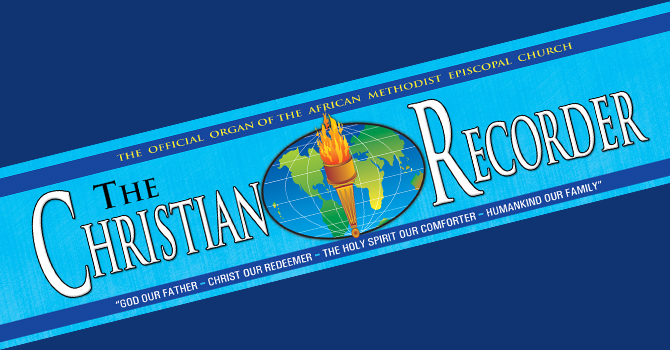
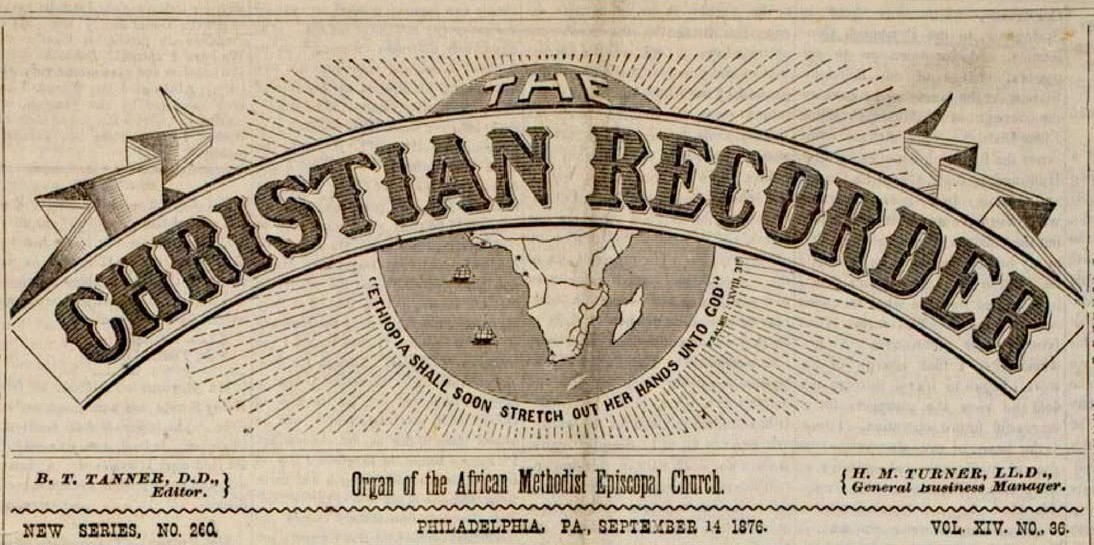
The Christian Recorder, official newspaper of the African Methodist Episcopal Church, is the oldest continuously published African American newspaper in the United States. Its pages contain vast amounts of information about life in the U.S. and in communities around the world.
Until now, however, its archive has been scattered and incomplete.
A new project aims to complete the collection and digitization of The Christian Recorder — first published under that name in 1852 — as well as the journal AME Church Review and periodicals The Missionary Magazine and The Voice of Missions. The newspaper, based in Nashville, Tennessee, since 1952, is currently edited by John Thomas III.
Soon readers, historians and other scholars will be able to go online and read 174 years’ worth of stories about a range of topics: theology, politics, violence, gender, sexual identity and civil rights, among others. After Emancipation, for example, the newspaper featured ads from people seeking to reunite with family members separated by slavery.
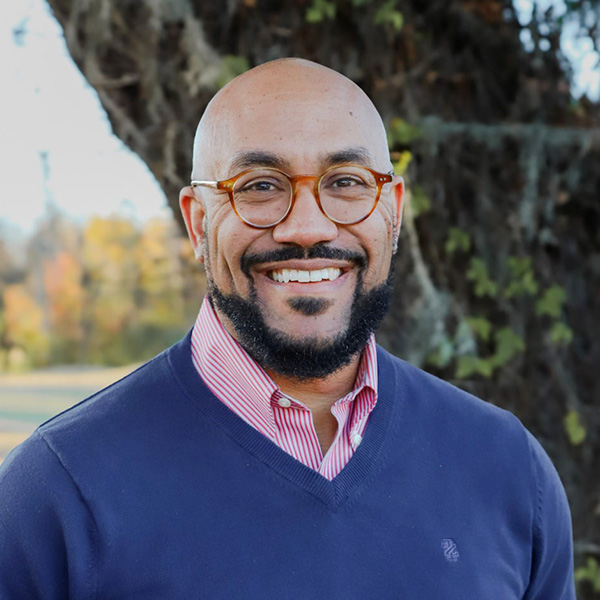
Historian Aaron Treadwell, an associate professor of history at Middle Tennessee State University, is heading up the project to collect, store and digitize the materials. He and his graduate student team have processed 500 volumes, which is more than 6,000 pages. The work includes collecting the documents, scanning them and using optical character recognition to make them searchable.
“It was really an open forum for Black conversation, and it’s not hagiography,” Treadwell said. “It is a very fascinating way to see and read and learn about conversations that were often left out of the mainstream media, as well as some of the larger historical narratives of this country.”
Though it is currently only accessible to members of the AME Church, Treadwell said he hopes that the archive, as well as maps, educational resources and other materials, will be available to the public this fall. He estimates it will take about 18 months to complete the archive of The Christian Recorder and the AME Church Review.
Treadwell, who used The Recorder as a primary source for his 2025 book, “Tongues of Fire,” spoke to Faith & Leadership’s Sally Hicks about the effort and why it matters. The following is an edited transcript.
Faith & Leadership: What’s the role of this project in this time of contention and attempted erasure of Black history?

Aaron Treadwell: It’s my hope and prayer that when persons are making these monolithic claims of the Black church, persons can utilize said archive to see that that’s far from the truth.
Instead of putting words into the mouths of those of the past, I think sometimes the power of the newspaper is just to allow individuals to express the reality of the culture — good, bad and in between. Allowing those voices to speak truth and suggest why we are where we are, why we think how we think. And this particular platform, I think, is the best way to do so.
That’s my hope and aspiration: That when individuals want to stake claim to their ancestors, they can use this and actually go straight to the source.
F&L: Describe the actual work. How do these fragile documents become part of a digital archive?
AT: When I say grassroots, I mean it to the core. Driving to Ohio, to Payne Seminary, which is an AME institution. Driving in a vehicle to northwest Washington, D.C., where the treasurer’s office is. Driving in a vehicle to Philadelphia, Pennsylvania, where Mother Bethel [AME Church], the genesis story of the denomination, resides. We have been blessed by Mother Bethel with bound copies from ’39 to ’49.
I have a large SUV, and we pack the SUV with these precious documents. We have graduate students in the publishing house who are helping to organize said documents. Sometimes the most important step in preservation is simply doing the work. And that’s where we’re at.
The No. 1 [priority] has been to do the work in-house. We want to make sure that the AME Church is in full ownership of the material and that there’s no integrity lost in terms of the AME Church being able to preserve its documents for the future.
What’s most pressing has been predominantly 19th- and early 20th-century documents, especially those in The Christian Recorder, because they’re so prominent as it relates to reporting the experience of American history, American religious history and the African American experience throughout the diaspora.
F&L: If you are an AME member, you can currently access this?
AT: The beta testing is for AME members who are interested in said materials.
F&L: What’s the timeframe for a researcher or maybe a pastor who’s not AME to access it?
AT: I’m hoping by the fall season, 2026, there should be good news concerning public accessibility.
F&L: Have there been any things you learned you hadn’t known about?
AT: The AME Church described what it meant to be Black, what it meant to be a self-identifying American, what it meant to be against colonization and also what it meant to be diasporic. It was very interesting to see at times very critical commentary within some of these papers from persons in the diaspora feeling left out of said conversations.
I was very impressed hearing some of the criticisms of how individuals were conducting themselves in the larger movements. Many people had just assumed that there was almost, shall we say, 100% backing of the African American population [for certain leaders or causes]. That’s just not true. People were able to speak their mind.
F&L: What are some of the most important functions that The Reporter has served?
AT: What literacy gave is not only an opportunity for persons to express their ideas; it also gave them an opportunity to create connectionalism or community. From the very get-go of its founding you have Daniel Coker, who goes from Baltimore, Maryland, to Sierra Leone to expand African Methodism.
So, the connectionalism is there, whether it’s from finding one’s family members or from identifying oneself in the diaspora.
What does it mean to be Black in America? Or to define theology and the expression of who Christ is? The questions that James Cone’s asking in the ’60s and ’70s are being asked in the late 19th century by individuals reporting in The Christian Recorder. You get to see the genesis of so many of these modern theological ideas really being woven out and massaged through the text of The Recorder.
You see reporting taking place from different regions. My family’s from Grenada, Mississippi. It would allow someone reading in Grenada, Mississippi, to get a sense of what the African American experience looks like in the Northeast or the West Coast, or in Haiti or in Jamaica, or in parts of South Africa.
And it allows them to realize that they’re bigger than just Grenada, Mississippi, that they have a connectional community. That community development and ideology, it gives you a bigger purpose to fill. It gives you a sense of pride that there’s development greater than one own’s environment.
F&L: Were there any things that were just funny or quirky?
AT: So me being an AME nerd, I love coming across articles describing the experiences of my seniors in their heyday, in their 20s and 30s, and some of the particular fights that they were taking on.
What you find in the AME Church, no different than many denominations that run on episcopal polity, is that they run for offices. You get to see people in their truest form running for an office, putting forth a campaign, maybe saying things that they don’t like about the church or they want to do for the church. It gives you a very connectional look into how some of the propaganda and campaign processes have evolved from the past.
I don’t know if that’s entertaining to everybody.
It was really interesting to look at ways in which people would literally call out presidents by name in papers, sometimes in a very abrasive way. I thought it was very interesting being able to identify people calling out Eisenhower and other presidents without fear.
We live in a time right now of so much political football and fear that many people are very hesitant. [This] allows us to say, “Hey, this is an individual in the nadir era of race relations and 4,000 lynchings taking place, and they’re standing and they’re speaking very boldly. Have we lost our purpose? Have we lost our sight?”
Those particular instances where people are loudly speaking their faith and their identity are always engaging.
F&L: The Recorder project is part of this larger digitization of AME publications, correct?
AT: It’s The Christian Recorder, it’s the AME Church Review and it’s The Missionary Magazine and The Voice of Missions. And we know that The Christian Recorder is the oldest organ of the AME Church, as well as the oldest continuous African American newspaper in the United States.
The AME Review is the oldest African American journal and current publication. But The Christian Recorder, because of the mass quantity — that’s taken precedence. Its collection is massive, it’s impressive, and it’s the crown jewel of the AME digital archives.

F&L: Why do you think these churches saved the volumes to begin with? We think of newspapers as being birdcage liner.
AT: They’re bibliophiles. They just enjoy collecting. And there have been many lost volumes and additions.
But ultimately, one of the things that I’ve found, and maybe this is one of the laughing moments, people like seeing themselves. People like seeing their picture. I think seeing your picture in a newspaper, especially in a time of segregation and some of these other things that have often belabored African American progress in the country, to see your name and face in a paper has been liberating at the least — maybe at the most, to use a theological concept, as we talk in Genesis about imago Dei and seeing yourself in the image of God.
Seeing yourself in a Christian paper gives one credence, or at least a claim to authority, of being a leader. And so a lot of individuals shamelessly saved volumes of themselves to let their congregations and their family know that we matter.
We matter in the narrative, not only of American history, but our voices matter. Because, again, The Christian Recorder wasn’t just theological reflection, but there was social and political, artistic conversation taking place. People wanted to make sure other people saw and heard their voices.
So much in fact that sometimes, when you go and you get a historical paper, people have cut their picture out of the actual document because they wanted to hang it on the wall, hang it in a barbershop, hang it in a church to say, “See, look, here I am in a paper. My voice matters.”
I don’t want to cheapen the overall impact and purpose, but I do think that there is a pride of writing and seeing one’s work, as well as knowing that it’s connectional, it’s international. Many churches have sought to hold on to volumes and editions of The Recorder because it reflected these voices and their role in American Christianity.
F&L: Talk a little bit about what’s next for the project.
AT: The current steps are just to continue to do the grunt work of digitizing, word recognizing and uploading. The ultimate goal is to have a public, accessible archive in a fully operational manner.
But there definitely are some additional interactive components that I would like to have in the archive that can speak to the growth of connectionalism, looking at interactive mapping to show evolution of the AME Church.
As the managing editor of the AME Review, I would also like our current materials to interact with the archive. So, people could read the paper, and if there is a related article or a debate [in the archive], we could say, “Hey, for more information as to where this article was inspired from or this particular argument was made in 1952, use this particular source and get some reference of how this argument has evolved.”
It would take them into the archives, and they could see some of the older conversations and debates. It will create a more holistic narrative. People can see the genesis of some of these thoughts — but also the interconnectivity they have, the ancestral theology of the AME Church. And so, that’s some of my goal: to create a unified conversation between these different dynamics of time and space.
We matter in the narrative, not only of American history, but our voices matter.