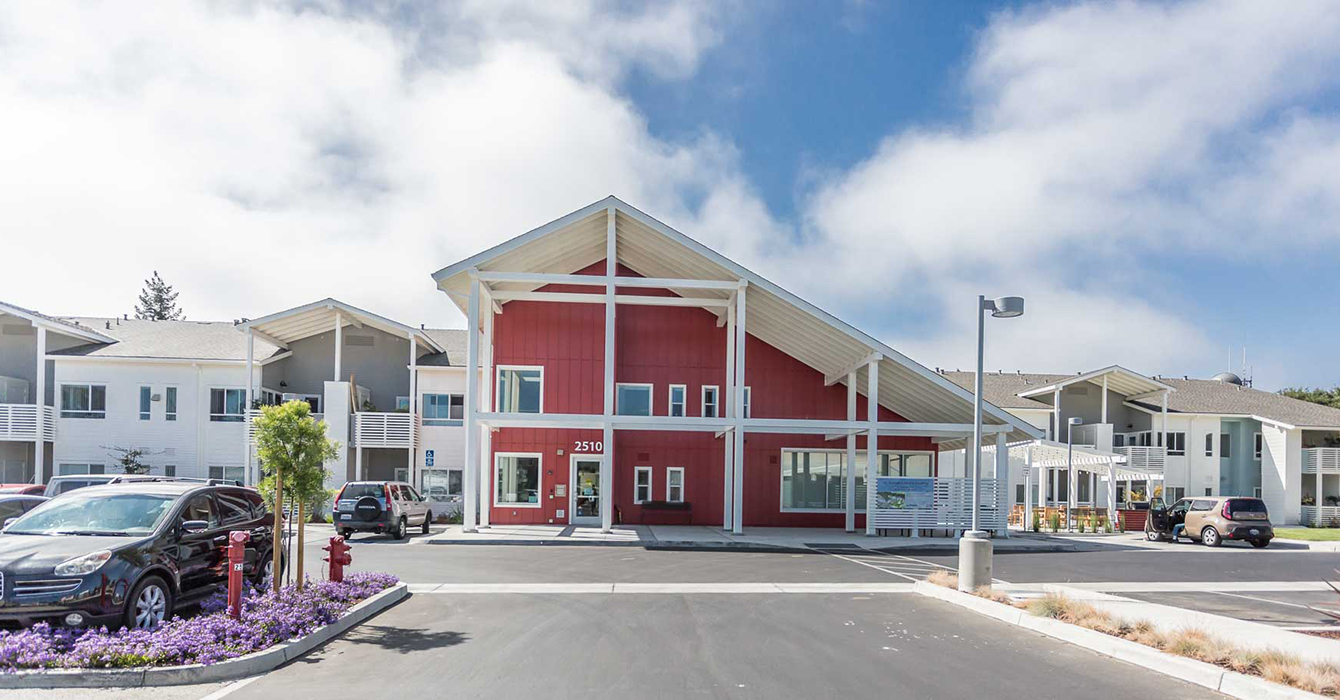
In Seattle’s Ballard neighborhood, a new eight-story apartment building opened last fall on the property of St. Luke’s Episcopal Church.
The 84-unit structure, called St. Luke’s Apartments, was built by BRIDGE Housing, a nonprofit focused on developing affordable housing at scale on the West Coast. It provides homes for families earning 50 to 60% of the area median income and is the first multifamily affordable housing development constructed in the community in over 20 years.
“People love the development and thank us for it all the time,” said the Rev. Canon Britt Olson, vicar at St. Luke’s.
St. Luke’s redevelopment project is part of a growing movement of congregations that are using their property for affordable housing. Faced with financial need, declining membership and aging buildings with deferred maintenance, congregations are considering ways they can use their property to sustain themselves — and how those assets can serve the community.
To better understand the types of housing being constructed on faith-owned land and where they are being built, researchers at Ralph W. Voorhees Center for Civic Engagement at Rutgers University created the Affordable Housing and Shelter on Faith Land Database.
The database is an online, publicly accessible catalog documenting more than 200 congregation-led affordable housing developments and purpose-built shelters on faith-owned land across the United States over the past decade.
Our team documented almost 10,000 units, which provides a baseline number of affordable housing buildings developed by congregations or denominations on their land.
The database was created for faith leaders, congregations, judicatory members and other interested parties who want to learn what types of housing has been built on faith-owned land. Users can search the database by state, project size, cost, religion/denomination, as well as other search queries.

Each entry includes a description of a development and details about the congregation and funding. The website includes a form where users can submit information about projects that aren’t yet included; these additions will improve the database and provide a fuller sense of the realty of affordable housing developments on faith land.
We started building the database with Google searches, using various terms to look for affordable housing developments built on faith land. Then we cross-referenced what we found with information from newspaper articles, denominational websites and the websites of development professionals. We only included developments that were built on land with an existing religious building or that was adjacent to a religious structure.
What did we find? Not surprisingly, many developments were mission-driven, inspired by people’s faith to help house people in need. Most of the developments were built by Christian churches and other organizations, and a handful were built by Jewish synagogues and one was built by a Muslim mosque. Within the Christian tradition, the Catholic Church represented 39% of the development.
A majority of the projects were located on the coasts, with New York and California leading the way. Some states, such as North Dakota and Oklahoma, don’t currently have any faith-based affordable housing projects listed in the database, but this is not to say such projects don’t exist.
The research team analyzed trends and patterns that emerged. One of the biggest findings is that housing is often more than just housing. Affordability requirements are frequently tied to the Area Median Income (AMI) and set for households earning 30 to 60% of the AMI. Congregations have also built housing for vulnerable populations such as seniors, veterans, domestic violence survivors and adults with autism.
In 2025, for example, ArchCare, a healthcare provider of the Roman Catholic Archdiocese of New York, transformed the former convent at Immaculate Conception Church in Tuckahoe into the St. Frances Cabrini Apartments. Reserved for adults with autism, the apartments include 10 supportive housing units along with a common area for events.
In St. Paul, Minnesota, Mosaic Christian Community partnered with the nonprofit organization Settled. The Sacred Settlement Mosaic is a community of six tiny homes (four affordable and two market rate) on property of the Church of the Nazarene.
Imbued with the ethos of radical hospitality, affordable units at Mosaic Christian Community are reserved for people who have experienced chronic homelessness. Residents who occupy the market-rate units live alongside them as “intentional neighbors.” Amenities include a garden, greenhouse and bike storage.
A majority of the projects in the database are large affordable rental buildings or smaller adaptive reuse of historic structures and tiny homes. Many properties were sold or leased; few were donated. This indicates that congregations and judicatory bodies are not giving away their assets but are instead focused on capitalizing on their property so they can ensure congregational vitality and continued mission activity.
A little more than a quarter of the developments are historic properties. Many had been adaptively reused to create smaller housing developments. In some cases, restrictive covenants or deeds ensured the preservation of these structures.
The emphasis on multifamily rental properties means there is little “missing middle” housing — duplexes, triplexes, townhomes and cottage courts (small houses built around a central green space). There also were few affordable homes for people to buy, which means fewer opportunities to build generational wealth.
Financing for these types of developments consisted of multiple sources of funding, including private, public and philanthropic donations. The primary sources of funding for large affordable rental housing came from Low-Income Housing Tax Credits (LIHTC), a federal investor-led housing financing program. Grants and donations were the primary sources for tiny homes built on parking lots and open space.
In Seattle, the members of St. Luke’s were dedicated to a radical devotion to the poor, and they embraced the concept of beloved community, which drove their desire to redevelop the property and existing church buildings.
Before committing to the project, the congregation held a yearlong appreciative inquiry. Members met with neighbors, including local business owners, people who used the property and unhoused individuals. They held one-on-one meetings, small group meetings, and large visioning summits to discuss the idea.
The metaphor for the housing development is Ark of the Covenant, Olson said.
“You carry with you the things that are most important to you. It’s not our buildings, but our values, and our care for the poor,” she said. “We have a theme song: ‘Let us build a house where love can dwell.’ That hymn has meant a lot to us. We sing it every time we meet about our property development.”