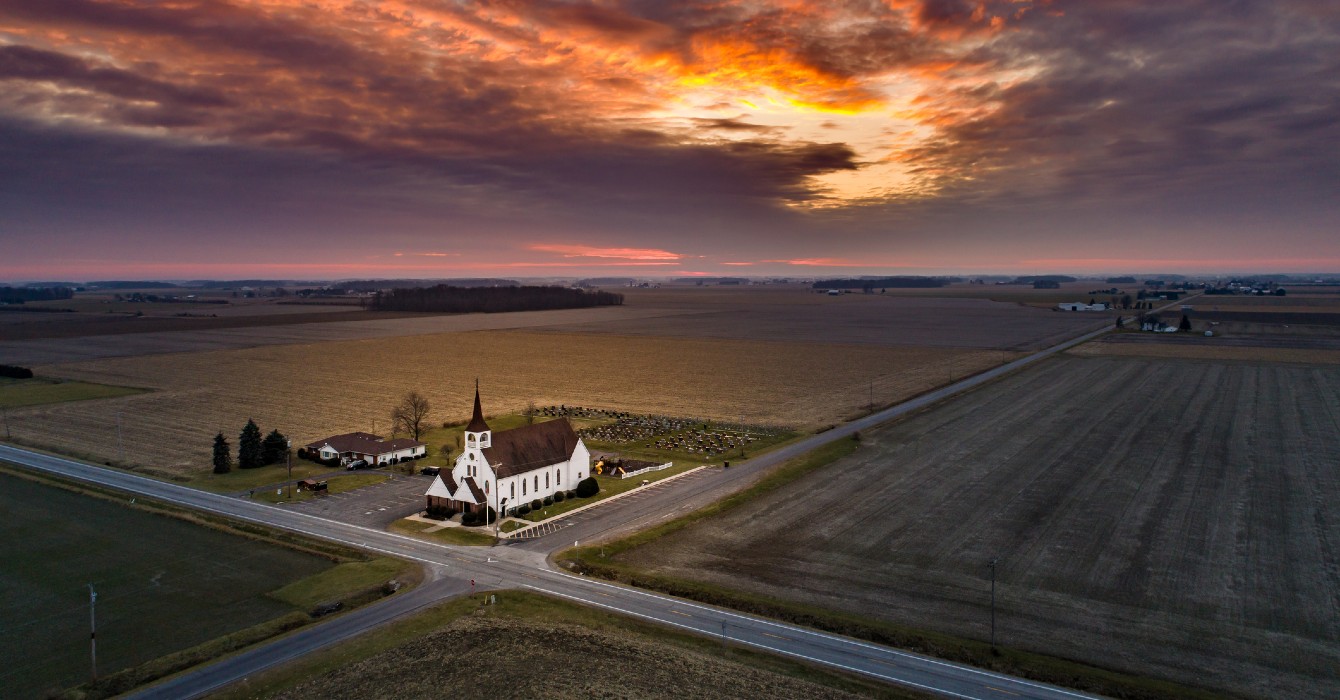
If you ask the Rev. Scotty Ray about the two rural churches he pastors in western Nebraska, the first thing he will tell you is how much he loves the people. The second thing he’ll admit is that they’re old. In one congregation with attendance of 35 on a typical Sunday, seven are in their 90s.
Ray, a participant in the Moses Project, organized a special service honoring these nonagenarians last fall and invited them to select a favorite hymn for the service. One woman chose “I Love to Tell the Story,” which she’d performed as a soloist in that very church’s choir loft 82 years earlier.
The rural church is full of stories of traditions and memories like this one. Sometimes, however, it can seem that the rural church has more stories than people in the pews.
Like many rural congregations, Ray’s numbers are shrinking. So are their budgets, while local community services also dwindle. Rural public schools, hospitals, nursing homes and EMS services are straining to meet resident needs as cuts in federal funding force dollars to stretch even further.
In challenging times, it can be easy for pastors to feel guilty and respond by working harder and planning more activities to try to compel themselves and their congregations into a miracle turnaround. This formula is a recipe for burnout and exhaustion; it’s not a recipe for thriving.
The U.S. Department of Agriculture publishes a report each fall called “Rural America at a Glance.” It highlights social and economic trends in rural areas across the country. Key findings include:
- More people are moving to rural places. Since 2020, rural communities have experienced population growth, although the largest growth is among people older than 65 who have exited the labor force.
- Although people are moving to rural areas, the working-age population is shrinking.
- There’s an increase in counties where 20% or more of the population is 65 or older.
- Rural employment is growing and has nearly recovered to prepandemic rates; however, poverty disproportionately affects rural part-time workers.
- There is a growing eldercare industry, but services have not kept pace.
Rural communities have more people older than 65 and younger than 16 than in between. This increase in the population of older and younger people creates economic difficulties because of the missing middle.
What does this mean for rural pastors and their congregations, and how can a government report help rural pastors avoid burnout and feel a renewed sense of hope?
First, it’s not the pastors’ fault that rural churches are shrinking; there are fewer families living in small places and fewer financial resources to give. There is also more competition outside the church for those families. Youth sports, extracurricular activities and an emphasis on alternate community groups draw the limited number of families away from church.
Rather than stretching themselves too thin, pastors can creatively and gently invite their congregations to reflect on their history and current community needs. This emphasis on traditioned innovation, a way of thinking about the future that relies on the community’s identity in the past, allows congregations to foreground their values and identity and embrace new opportunities while acknowledging demographic realities.
When creating yearlong ministry plans, setting budgets and planning activities, pastors can communicate the data, including the missing middle, with their congregations and leadership team. People 65-plus may be living on a fixed income, and their tithing is based on limited financial resources. It is also impractical to expect service projects that demand more than the congregation can manage.
Finally, have realistic conversations about the gifts, ministries and emphases of the congregation. Pray, partner, be creative, ask the Spirit to provide in unseen ways and take risks, but do so because God is calling, not because the church refuses to acknowledge the demographics or the community’s changing identity and needs.
Renner Lutheran in rural South Dakota also has an aging population. The Rev. Laura Phillips, Moses Project mentor and former Renner pastor, knows this firsthand. Historically, the church had partnered with community organizations to provide food and basic necessities for neighbors in need. The problem? Those donations were collected in heavy boxes, and the aging congregation could no longer transport them.
Church members therefore reached out to the local volunteer fire department to see if they could help. “Sure enough, they were delighted to come!” Phillips said. “Some had never done it before and were thrilled to be invited. It helped the folks at Renner Lutheran tremendously to have strong, able-bodied adults to help carry the heavy food boxes, and it was a great way to connect and build relationships with our community firefighters. It is a beautiful gift to work together in a community like that to be a blessing to one another!”
Ministry is not about budgets or attendance, and flourishing is not measured in numbers alone. Thriving is about relationships and stories, connections, receiving God’s love and grace and sharing with one’s neighbor. Both Ray and Phillips honored their congregations’ stories and traditions and explored new ways to faithfully serve while acknowledging congregational demographics. This can mean that worship and serving one’s neighbor look different than it used to.
God loves small churches and small places. For rural churches to flourish, pastors and congregations will need to adapt and to measure success more than numerically. But the gifts God has given rural churches — community, connection, kindness and care — are abundant.
The refrain of “I Love to Tell the Story” says,
I love to tell the story;
’twill be my theme in glory
to tell the old, old story
of Jesus and his love.
That message never grows old.