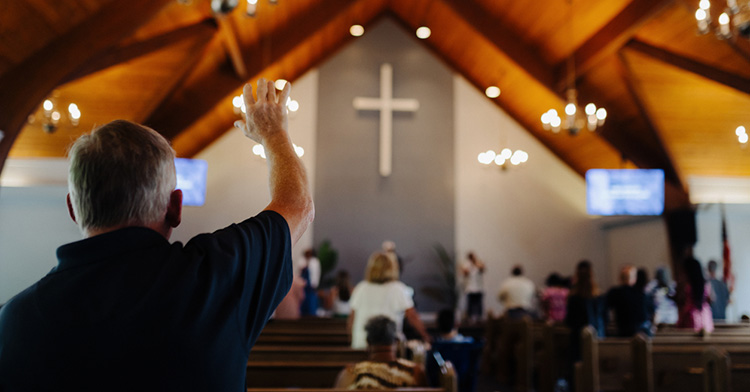
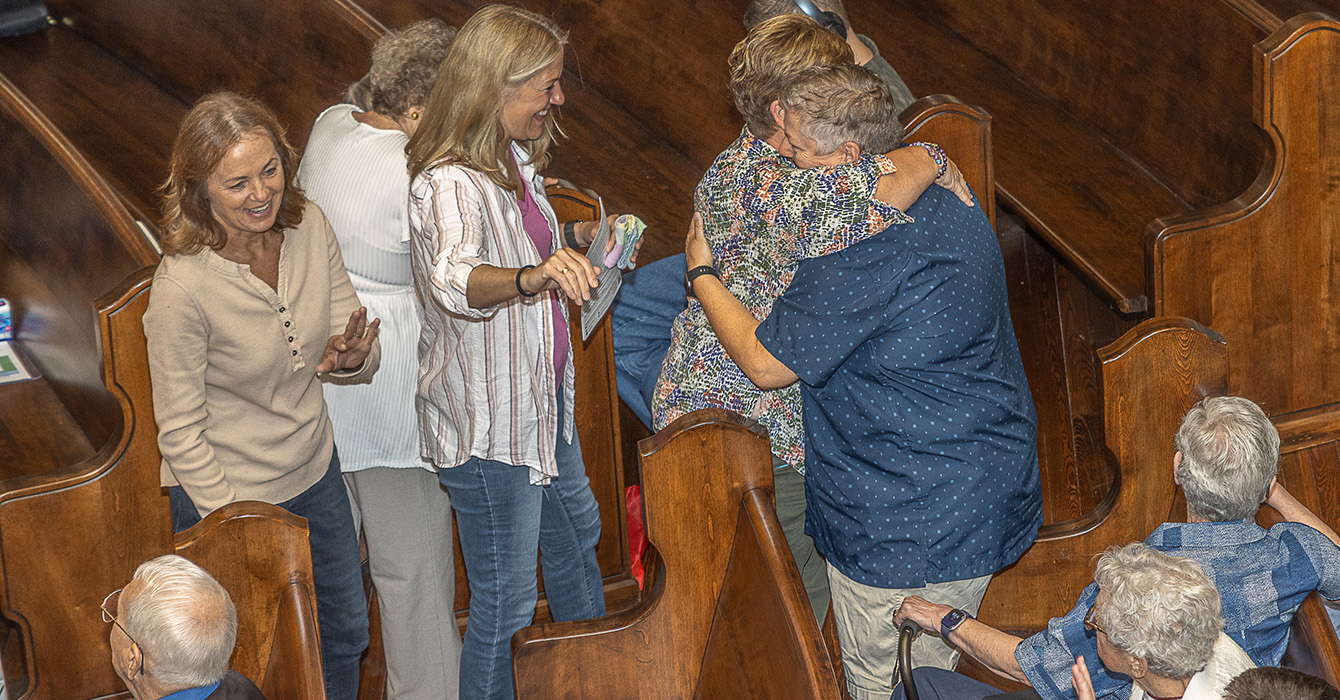

At the beginning of worship, the liturgist at Woodland Christian Church steps to the podium and speaks the first words of the service: “Welcome home!” The Disciples of Christ congregation responds, “Welcome home!” The liturgist then says:
“We believe that no matter who you are or where you are on your life’s journey, you are welcome here. Your name and your story matter to us! We believe that home is wherever our hearts are connected to each other. So welcome home!”
That’s the message that shines through at Lexington, Kentucky’s Woodland Christian. From the church sign at the corner of East High Street and Kentucky Avenue to the tone-setting opening statement in worship, the theme of being home is pervasive. And yet, “home” is a complex concept for this congregation, which experienced four versions of home in a six-year span.

The congregation’s perseverance and openness to the movement of the Holy Spirit not only helped it to stay spiritually grounded in the midst of transition, but allowed it to innovatively deal with major building repairs. That, in turn, led to the creation of 38 units of affordable senior housing for the community. Because of Woodland’s resilience, more people have found a home within the walls of the church.
Woodland’s journey started not long before the pandemic in 2020. The building that the church had called home since 1925 had been in dire need of repair for several years, and the church was looking to hire a new pastor who had a vision for how to address the complex combination of underutilized space, growing building needs and a meager budget.
When the Rev. Christy Jo Harber arrived at Woodland in her first call as a solo pastor, she was undaunted by the work ahead. Harber said the search team was upfront with her about the capital issues.
“Church leaders said that the building had become a huge albatross around their necks,” she said. Despite significant challenges that might scare off other pastors, Harber strongly felt God was at work in this call. After all, her Tennessee grandmother who called her into ministry lived on Woodland Drive.

Biggest challenge
In February 2020, Harber worshipped in the historic sanctuary as part of the interview process, assuming that the biggest challenge ahead of her was how to shepherd the church through a reimagining process. Then the pandemic hit. Harber started her ministry in June 2020, leading her first service via Zoom. While the church was able to worship online, the sanctuary continued to deteriorate.
Under Harber’s leadership, the congregation realized that being out of the sanctuary was the perfect time to truly assess the magnitude of needed repairs. They hired an architectural firm to study the building and determine what would bring the building up to code and how to address the deferred maintenance. The report was sobering: The church needed more than $1 million in baseline repairs, not including addressing ADA compliance and upgrades.
The report received in May 2021 was, in Harber’s words, “worse than anyone thought.” One congregation member, Vicki Vaughn, described the report as “unsettling” and proof that the repairs could no longer be ignored or delayed.
It was clear that the congregation could not return to the sanctuary until the work was done. In July 2021, the church began meeting in “discernment circles” to talk about options moving forward.
“Discernment circles were the times and places where we opened ourselves up to hearing from each other and from God so that we might understand how we were being called to live and move and have our being,” Harber said.
One of the important learnings from the circles was the congregation’s desire to stay in their current location. Not only was the church rooted there, but it had become a pillar in a neighborhood defined by artistic creativity and inclusiveness.
How does your congregation handle decision-making about complex, strategic issues?
The church sits across the street from an idyllic city park that hosts an annual art fair. Woodland was a beacon for people living out their creative expression, and many Lexingtonians who weren’t welcomed at other churches had found a home at Woodland.
‘Strong bones’
While still new to Woodland, Harber understood the importance of honoring the history of the church and its location. “One thing the architect’s report revealed is that we have ‘strong bones,’” she said. “Remaining in that location meant we would be able to increase Woodland’s ministry while preserving a beautiful, historic church which folks had called home for over a century.”
But more than $1 million stood in the way of living out that vision.
While the church was discerning, God’s spirit was swirling. An elder in the church was connected to the owner of a development group.
The elder passed the information on to other church leaders. In November 2021, they had an initial conversation with representatives of Winterwood Inc., a property management firm that specializes in affordable housing.
Guided by the question, “How might we house the Holy?” Woodland and Winterwood began dreaming about how the existing building could be renovated and expanded (the church owned a vacant lot next door) in a way that would secure the church’s future while providing much-needed affordable housing for seniors in Lexington.
What unique contributions does your church make to the larger community?
“Seniors are one of the fastest-growing segments of our local population, and also one of the fastest-growing groups experiencing homelessness and housing affordability challenges,” said Charlie Lanter, the city’s commissioner for housing advocacy and community development.
This proposal would not only help the church, but it would also serve the neighborhood that the church had been part for 100 years.
In February 2022, the church board agreed to begin negotiations with Winterwood to renovate the existing church and add the additional space for an affordable housing facility. Harber said the response of the whole congregation was enthusiastic.

“To be honest, it seemed too good to be true,” said Steven Johnson, a current elder and board member.
But that meant the church would be on the move again. After holding one last worship service in the fellowship hall of its historic building, the church relocated to a recently vacated office space, which would become its home for the next three years. For Harber, this was the third place of worship in her short time at Woodland. “There has been no normal season for me,” she said, noting that she was introduced to her new congregation via a drive-through communion service after a Zoom worship service.
The nomadic church quickly made the space feel like home, decorating with vibrant colors and posting a historical timeline of the church on the walls of the room that was used as the “sanctuary.”
How does your faith community “house the Holy?”
While Winterwood was doing much of the heavy lifting to secure funding and permits, the congregation still wanted to do its part to contribute to the rebirth. Through a “Deep Roots, New Growth” capital campaign, the church raised over $200,000 to revitalize the sanctuary with state-of-the-art lighting, sound and video capabilities, which would allow the space to be used both for worship and for performing art events.
The first gift to the campaign came from Bernice “Queen B” Coleman, 100, a member of Woodland since 1958. Coleman understood the need of renovating the “strong bones” of her church home.
When Harber showed Coleman the architect’s rendering of the project, she said Coleman beamed with pride. “She had the joy of knowing that her beloved church would not only endure but thrive,” Harber said. The agreement between the church and Winterwood was signed on December 18, 2024 — the same day the centenarian died.
In January 2025, ground was officially broken for The Oaks at Woodland, a 38-unit affordable housing facility for seniors. The $13 million project also included renovated community and ministry spaces and a restored historic sanctuary. Funding came from a variety of sources, including low-income housing tax credits from the Kentucky Housing Corporation, loans and grants from the City of Lexington, and a construction loan from a bank.
Unused classrooms and offices in the back of the church were converted into eight apartments, and the new building containing 30 more. The housing units were reserved for seniors aged 55 and older who make less than 60% of the area’s median income.

Anniversary and new beginning
City officials and the local religious community attended the building’s official dedication and grand opening on March 26, 2026; all units were immediately occupied, and hopeful future tenants added their names to a waiting list. And on April 5, Easter Sunday, the Woodland congregation worshipped in the historic sanctuary for the first time in more than six years — and 101 years to the day after the sanctuary’s original dedication in 1925.
The response to The Oaks has been positive. “This project shows just how much can be accomplished with creative, persistent and strong partnerships,” said Hannah LeGris, who represented Woodland’s district as a member of the Lexington-Fayette Urban County Council before going on to serve in the Lexington city government.
“It breathed life into the neighborhood,” said Tom Eblen, Woodland’s current council representative, noting that the project was a living example of Matthew 25:35: “I was a stranger and you welcomed me.”
For Lanter, the project exceeded his expectations. “The housing itself is important, but what stands out to me is the combination of quality, creativity and purpose. Too often people think affordable housing must be a choice between function and beauty, or between development and preservation. This project showed that you can accomplish both.”

Homecoming
The congregation has been overwhelmed by the homecoming. Steven Johnson, the elder and a member of Woodland since 1993, said, “Worshipping in our temporary space reminded us that the church is wherever the faithful are gathered. But being back (in the original sanctuary) is incredible. We come back to a familiar space that has changed, just as we as a congregation have changed.”
Kathryn Johnson, who joined Woodland while they were in their temporary space, said, “It is such a blessing to watch those who have been on this journey since the beginning experience coming home.”
A walk through the renovated facility shows how the past and future meet in ways that honor both. Winterwood tried to preserve as much of the old building as possible, from doors and pews to an original water fountain, while making sure the building was safe, secure and accessible. The seam between the renovated building and the newly constructed addition is marked by three-story-tall glass-enclosed connector, complete with exposed beams and original brick.
That transition is a metaphor for how the old and new meet within The Oaks at Woodland. There are several shared common spaces between the congregation and the residents, including a community room and kitchen. And several apartments are right next door to the church nursery and the youth room.

What elements of your worship space make it feel like home?
The partnership between the church and the residents is a work in progress as both groups learn how to coexist with each other. Harber said that several residents have started attending Sunday morning worship, and the church plans to sponsor classes and workshops open to both church members and residents. People who’ve found a home at The Oaks are already seeing the mutually beneficial relationship with the congregation.
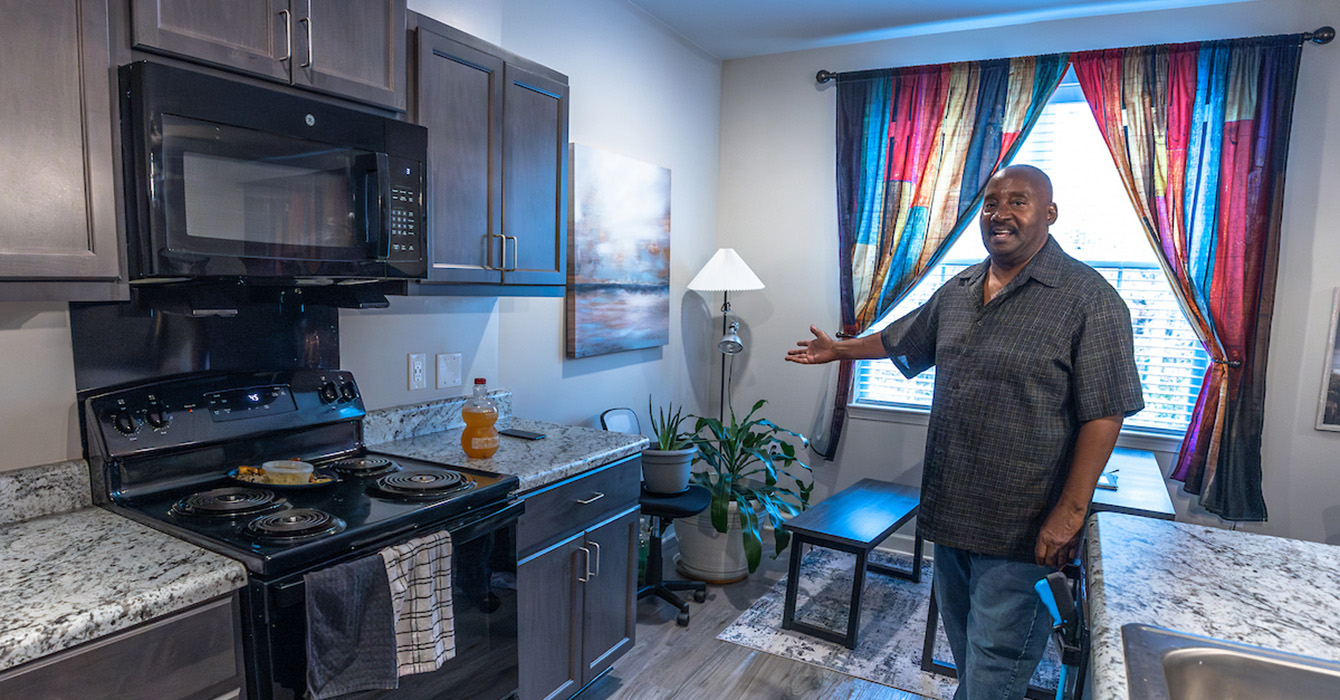
Keith Reid, who joined Woodland in October 2025, had no idea about the project, but ended up being one of its first residents. Now, on Sunday morning, he doesn’t have to go far to spend time with God. When the church service ends, “I don’t have to leave to go home. I’m already there.”

Clarice Taylor, a current resident of The Oaks who used to regularly walk by the church before the project ever began, appreciates the space the congregation gives her. “Interaction with the congregation is optional; people can just be themselves.”
Not long ago, Woodland was worried about short-term capital concerns and long-term survival. Now, the congregation has found a new purpose and vitality in familiar surroundings, and their willingness to step out in faith has extended God’s welcome to others.
“I have a beautiful apartment,” Taylor said. “I get up in the morning, look out my window at the park, and I know I belong here.”
How does your congregation welcome both what is old and what is new?
Questions to consider
- How does your congregation handle decision-making about complex, strategic issues?
- What unique contributions does your church make to the larger community?
- How does your faith community “house the Holy?”
- What elements of your worship space make it feel like home?
- How does your congregation welcome both what is old and what is new?