I’ve heard the Scripture my whole life — at funerals, in hushed hospital rooms, spoken over those nearing the end. I always assumed it was for the sick, the elderly, the dying: “Though I walk through the valley of the shadow of death …”
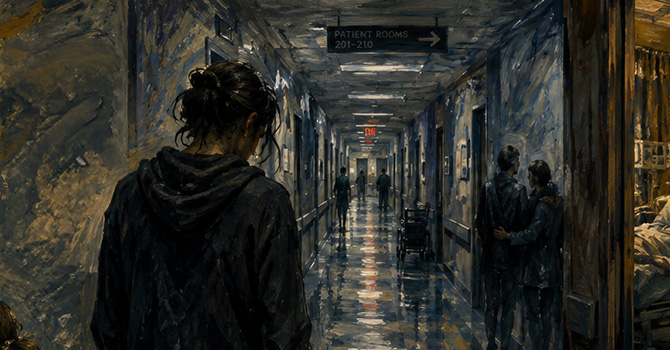
But when I walked the corridors of Providence Alaska Medical Center while my mother hovered close to death, I heard it differently. I heard it for me — for those who walk beside.
Though I walk through the valley of the shadow of death.
I found myself in that shadow, trying to discern how to be. How much to simply be present. How much to push, to fight, to question. How to know if this was her time, or not.
Against all odds, my mother survived and came home. But we have entered what I know is the beginning of the end.
Nothing really prepares you for what it means to care for a parent in this season. I am still figuring it out. But at her bedside, I learned some lessons that I hope can help others. What does it mean to care for someone who is ill or dying?
One thing I realized is how much presence matters. This sounds simple; it is anything but. Loved ones often live far from one another. Our lives are full. Work presses in. But presence matters. Showing up matters. Putting eyes on someone matters.
What surprised me most in the hospital was how few people had visitors. The visitorless rooms felt strikingly empty, even though they were full of equipment. We know loneliness is not just sad — it is deadly. Presence is not a small gift; it is essential care.
My sense of time changed. I have never experienced time like this. Hours stretched endlessly waiting for a doctor. Days blurred together. Weeks passed without clear answers.
When you care for someone, you wait. And alongside that, you shift your expectations. Recovery is not linear. Progress is slow, uneven and often unclear. You enter a different relationship with time — one that requires a patience most of us have not cultivated.
I also learned how much every patient needs an advocate. Even the most capable person cannot navigate the system alone from a hospital bed. There are too many decisions, too many questions, too much at stake.
An advocate asks the next question. Pushes for clarity. Refuses to let things drift. Without one, it is easy for a person to become just another case moving through a system. I saw how care decreases as detachment increases.
As an advocate, I experienced firsthand what American surgeon Atul Gawande meant when he wrote in his book “Being Mortal: Medicine and What Matters in the End”: “Our reverence for independence takes no account of the reality of what happens in life: sooner or later, independence will become impossible.”
This has been true for both my mother and me.
My mother, in her mid-80s, was still living independently in Alaska before this illness. I live in the UK, building a full and meaningful life, fiercely independent in my own right. Geographically, we are about as far apart as two people can be.
That chapter is over now. For both of us, something fundamental has shifted. But what that means isn’t clear.
I cannot move to Alaska permanently — nor would I choose to. I still have a life, a calling, a community that holds me. She can’t move near me at this point in her life And so we are both being asked to live in a new kind of tension: less independent than before, but not fully together either.
What is emerging is something new — interdependence, shaped by distance, love and limits.
In the time she has left, we want to choose quality over quantity. We have told the medical staff again and again: We are seeking quality of life, not simply more time.
But quality is not a fixed idea. It shifts depending on who you are, what you value and how close you feel to death. Sometimes what feels essential becomes clearer — and at other times the decisions and tradeoffs are confusing and frustrating.
We keep returning to the question: What does it look like for her to live well, even now?
Fear gets in the way of answering this question and so many others. Fear is everywhere in this process — fear of loss, of making the wrong decision, of letting go too soon or holding on too long. Fear of death.
And yet, fear clouds judgment. It narrows vision. It makes it harder to listen — to doctors, to loved ones, to God. Naming it has been important, if only to keep it from taking over.
I also saw firsthand that that our systems of care are not built for what families actually need.
The healthcare industry prioritizes treatment and the prolonging of life, often without equal attention to the quality of that life. And the cost is staggering. I was shocked, though not surprised, to learn that a few hours of daily care can run thousands of dollars a month — out of pocket. Nursing homes cost far more.
There is a reckoning coming. It is overdue.
This season is stretching me in ways I did not anticipate. It is asking more of me — practically, emotionally, spiritually.
My father died suddenly. In many ways, that was its own kind of gift. There was no long decline, no prolonged suffering, no undending decisions to make.
This is different. This is the long road.
And while it is harder in many ways, I am beginning to see that there are gifts here too — in the conversations we still get to have, in the care we can offer, in the love that is expressed not in a moment, but over time.
I am trying to walk this road in a way that I will not regret later. To be present. To pay attention. To love well. To advocate and to wait and to resist letting fear overtake me.
“Our ultimate goal,” Gawande writes, “is not a good death but a good life to the very end.”
Though I walk through the valley of the shadow of death, I am learning that accompaniment is its own calling — and, perhaps, its own grace