

Gently waving stalks of rye, trilling wrens, shady hammock-strung thicket and Instagram-ready farm stand make spiritual connection a pretty easy sell on first impression at Plainsong Farm.
The farm doesn’t bill itself as a Garden of Eden, but a living laboratory to nurture, inform and inspire journeys to faith by way of the land, its stewardship and conservation. Farm-based environmental education and Christian discipleship promise to feed the soul, and digging in is a concept both figurative and literal.
On this 12-acre farm in lower Michigan, people of faith and people searching for faith forge a pathway to God through croplands and orchards. At the farm they grow food for people in need, offer short retreats for individuals and groups, and provide Christian formation for young adults. They experiment with ways to create lasting connections between food, sustainability and faith, and open every aspect of farming to exploration and discussion.
Like the early Christians, this small group of the devoted seeks the divine while engaging in everyday earthly struggles. In this case, those struggles include infrastructure inadequacies, budget shortfalls, challenging weather and, well, bugs.
Plainsong Farm is named for the tradition of sung prayer practiced by Benedictine communities.

Traditioned Innovation Award Winner
Leadership Education at Duke Divinity recognizes institutions that act creatively in the face of challenges while remaining faithful to their mission and convictions. Winners received $10,000 to continue their work.

“Our stories are very embodied in the covenant God makes time and again, with the land and with people,” said Emily Ulmer, director of faith-based programs at Plainsong.
“When we go from one climate-controlled space to another, we don’t know our relationship with creation because we don’t have to. We have blinders on about what appears on our table. Being outside and being on the farm gets us out of our comfort zone, and that allows people to ask questions.”
How does your ministry cultivate connections between people, places and God?

Plainsong Farm is in Rockford, Michigan, 20 minutes north of Grand Rapids and firmly at the intersection of farm and garden. A large farm’s regimented wheatfields are across the street, and a modern subdivision is in Plainsong’s backyard. The open and affirming operation, which has a rainbow Pride flag on its website, is in a deeply conservative part of Kent County.
The nonprofit is affiliated with the Episcopal Church and open to all. Its stewards are steeped in Christian reflection and spiritual discovery. To Ulmer, it is a way to live Christianity, not just visit it weekly in church. “How we are learning and questioning and wondering what God is telling us is a part of everyday conversation here. Not just Sunday, but every day. This is a tradition that has everything to do with our everyday life,” she said.
“That’s what I see the farm as. There is not a secular molecule in this galaxy. Everything is infused with the sacred.”
‘Real ministry happens in the garden’
The farm was once the home of the Rev. Nurya Love Parish, an Episcopal priest who partnered with others to turn the property into a place to explore the ideas of food justice, food sovereignty and sustainability.
She found partners in Mike and Bethany Edwardson, a young couple with an enthusiasm for blending farming, food and faith.
“Real ministry happens in the garden just as much as a sanctuary,” Parish told Faith & Leadership in a 2017 interview. “God didn’t put Adam and Eve into a sanctuary. God put Adam and Eve into a garden.”
The Edwardsons started working and dreaming with Parish in 2014, while Mike was pursuing a master’s degree at Grand Rapids Theological Seminary (now Cornerstone Theological Seminary). They had caught the agriculture bug, beginning with a backyard garden and advancing to till and sow on campus, then “other places with land, when we’d say, ‘Let’s grow something here!’”

Mike Edwardson said they were inspired by the writings of the agrarian and environmentalist Wendell Berry and saw gardens as a source of community and a force for good. How, they wondered together, can you grow in a way that fosters a community?
The Edwardsons moved into the yellow three-bedroom farmhouse in 2015 and began working to revive the farm, which had been inactive since the 1980s. There they are raising their three girls amid the gardens, fields, pollinator beds, and remains of a small heirloom orchard. In 2024 Parish stepped down as executive director, and the farm shifted to a shared leadership model.
“I didn’t grow up on a farm. There are no farmers in my family,” Mike Edwardson said. “But I grew up being outdoors and doing things with my hands. When we started, we didn’t know what the heck we were doing. But I am pretty good at figuring it out.”

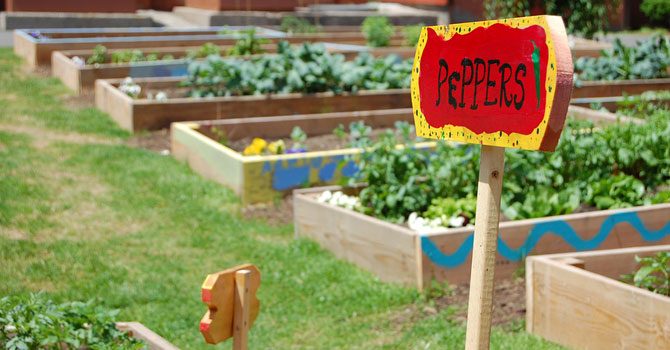
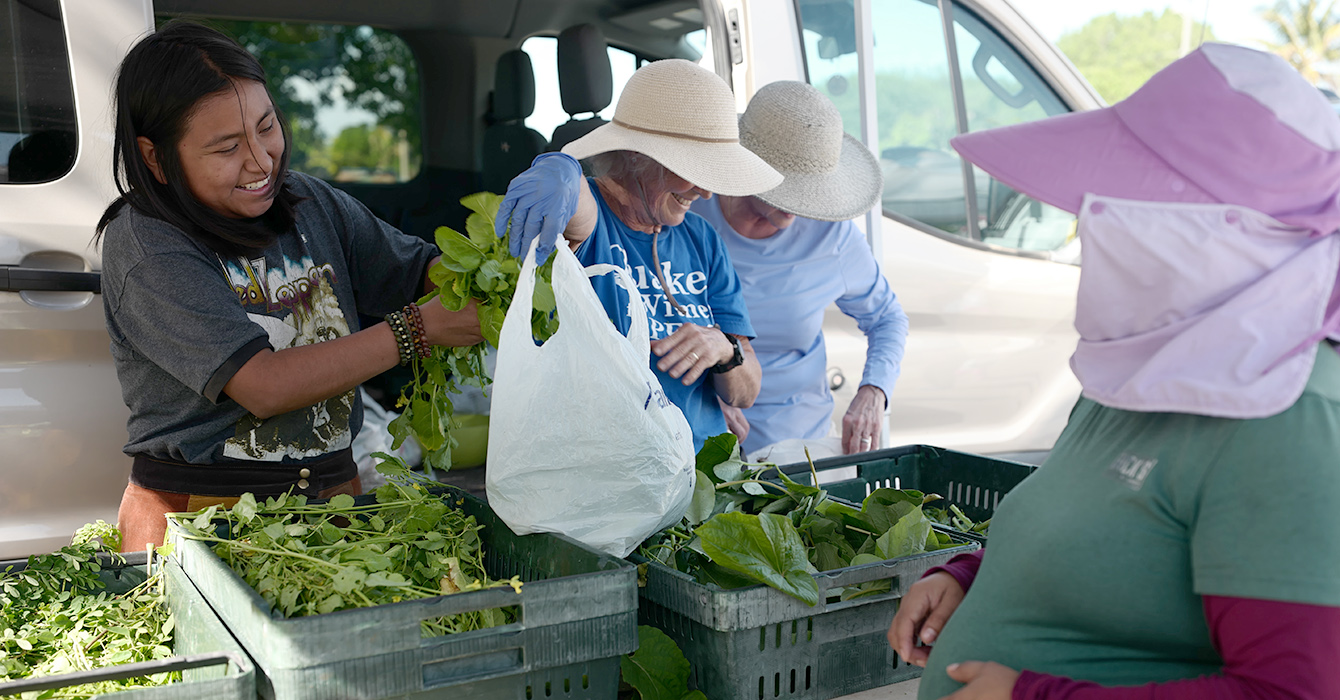
The farm, a picturesque hodgepodge of practicality and whimsy, now produces some 30 types of vegetables, fruits and flowers — from asparagus to zucchini — employing regenerative farming practices. They aim for a no-till, no-spray approach, which protects earthworms and pollinators. The harvested produce is donated to local food bank partners and sold through a small weekly vegetable-share CSA (community supported agriculture) and the on-site pay-what-you-can farm stand.
The property and the offerings are constantly evolving as the team tries new ideas and approaches. Some ideas flop, like trying to grow wheat for communion bread.
“We loved it as a metaphor but learned we’re not as good wheat farmers as vegetable farmers,” Ulmer said.
How do you turn chores into education and meditation?
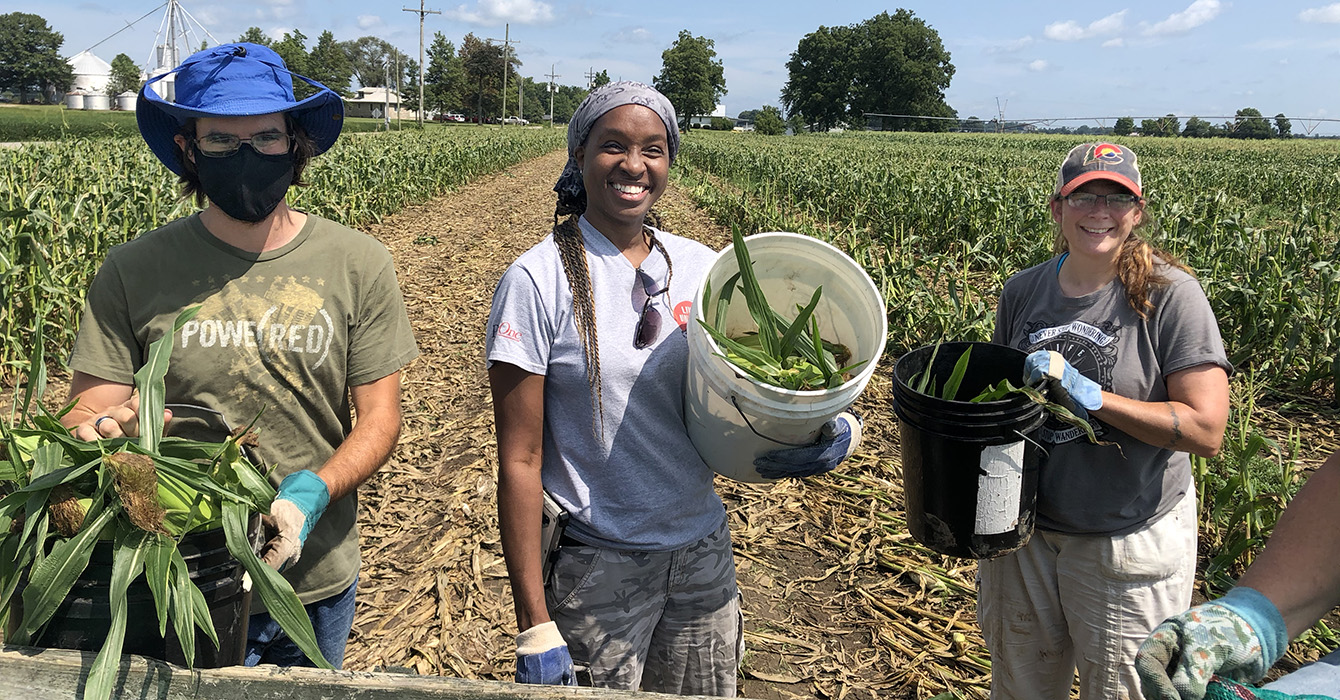
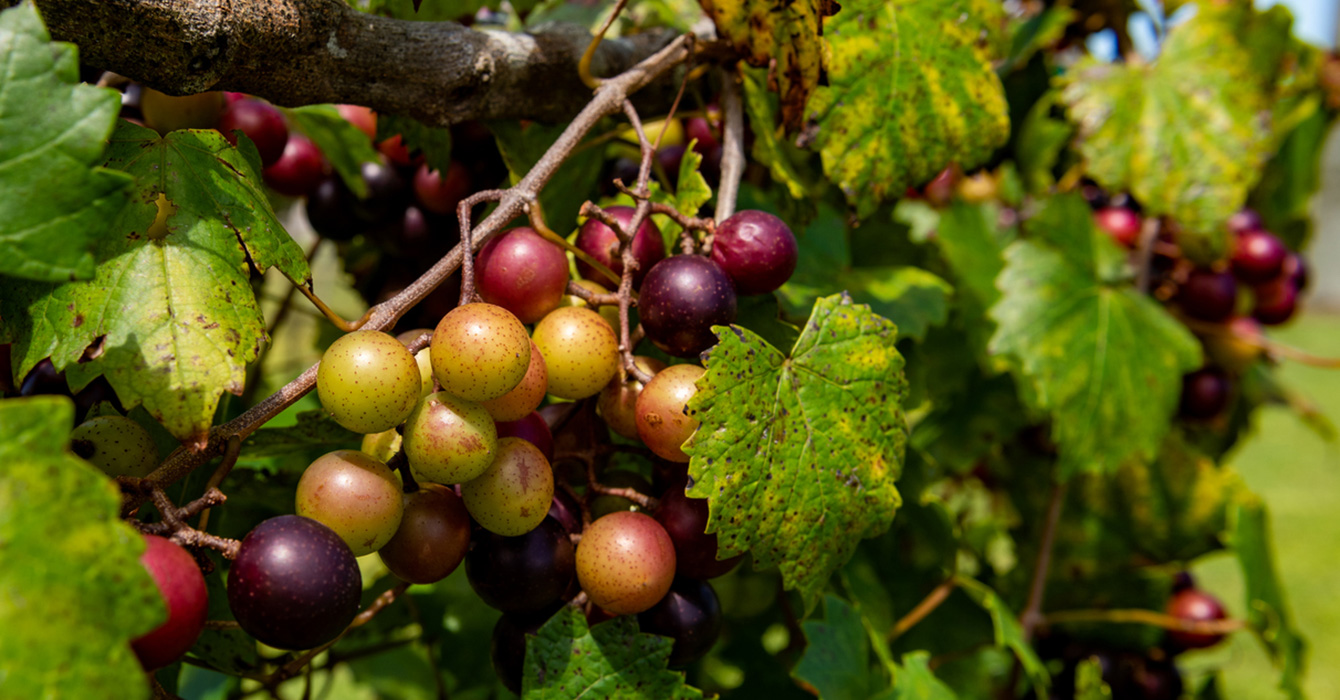
They welcome the public to volunteer on the farm — planting, weeding, harvesting — and strive to make those chores an education and a meditation. Mindful that many visitors may be new to agriculture, they explain their practices, such as why they’re planting chokeberries instead of better-known raspberries (chokeberries foster biodiversity and produce higher-calorie fruit). Digging into the dirt can include digging into thoughts, questions or ideas.

“We say we grow in such a way that takes many hands, and so we need you here,” Ulmer said.
There are half-day retreats for individuals and small groups, where seekers can pace through a grassy labyrinth and children can wallow and create in a shady mud station.
Twice monthly in the summer is Sabbath at the Farm, a short evening worship service that includes Scripture, singing accompanied by resident robins, wrens and the occasional green heron, a multigenerational shared reflection and a potluck.
Gloria Briggs, the eldest of six homeschooled siblings, came to Sabbath at the Farm on a recent June Sunday. She first visited the farm with her siblings and her mom, who brought her brood to Plainsong in search of nature-based activities.
That experience stuck with Briggs, who just received her high school diploma and now drives about 50 minutes to commune in an environment she finds nurturing.
“I feel the most connected to God and spirituality when I’m in nature,” said Briggs, arms hugging a bowl of watermelon chunks. “I think it’s beautiful that you can … all come together to give each other advice and appreciate God together, no matter what religion you are.”
How might your church be different if you believed you needed everyone there?

As the farm manager, farm-based education director and properties manager, Mike Edwardson leans into organic practices — which is just plain hard work. Weeds, for example, are vanquished by people bending, pulling and chopping at the soil rather than by using chemicals.
Plainsong’s leaders see the disconnect many people have with their food — understanding where it came from, what it takes to produce it and the burden it can place on the land’s long-term health. He said volunteering a few hours on the farm isn’t just a lesson in the virtues of low-input farming, but it also fosters an understanding of how narrow profit margins are and shows that production agriculture isn’t always a nod to capitalism, but a means of survival.
“We want to be honest with people,” he said. “This isn’t a simple solution. It’s a lot more complicated than that.”
And they wrestled — and still wrestle — with creating a worship space that isn’t exactly church. The elevator pitch, he said, is elusive.
“You feel like doing something very meaningful and almost visionary at times, but it’s also frustrating because what we do doesn’t fit neatly in a box.”


As pastoral as Plainsong Farm is, the struggles are real. Ulmer said balancing a desire to feed the hungry with practical matters of economy, sustainability and scale is a constant challenge.
The three directors are the only paid staff. (In addition to Ulmer and Edwardson, Katharine Broberg is director of engagement). The rest of the farm’s work is done by volunteers and Farm Fellows. Plainsong’s $290,000 annual budget is covered primarily by the fruits of grant writing, on which Edwardson takes the lead, and produce sales (including the CSA program), field trips and leasing a portion of land to a nonprofit called New City Neighbors.
Ulmer said it’s an ongoing struggle to meet payroll. They contemplate a small capital campaign to shore up infrastructure shortcomings like ramshackle vintage barns, the lack of all-season indoor space and relying on a portable toilet for guests.
“We do what we can with what we can,” Ulmer said, adding about fundraising challenges: “It’s easy to get excited about growing food for neighbors or mentoring young people, but not everyone gets excited about septic systems.”

‘Hope is powerful’
Beyond the structure of the land and buildings, Ulmer describes the community as “concentric circles of imitation.” Farm Fellows commit to a long-term residential service/learning program through the Episcopal Service Corps. They live together in the second farmhouse and participate in a rigorous mix of farmwork, structured discussions, praying and practicing silence.
Those fellows interact with visitors who arrive at Plainsong from many paths. Youth come for service and learning visits. Businesses, such as Ada, Michigan-based Amway, bring groups in to work on the farm. Others come to worship.
The beliefs that people come with are across a spectrum. Some, Ulmer said, are moving away from a more conservative brand of Christianity, while others are taking their first steps in exploring faith. The Plainsong experience is rooted in gentle support. While Scripture is read at events like Sabbath at the Farm, Plainsong strives to be a safe place of exploration.
Nature is both benevolent and taxing. Early June at Plainsong Farm found seedlings stunted by an unseasonably cool and drippy spring. The first rows of tomatoes had failed, and chill dampened Wednesday at the Farm’s attendance. Two weeks later, near-record highs in the upper 90s scorched the Sabbath at the Farm gathering.
What does “gentle support” look like as one is exploring faith?

After she retired as a Presbyterian pastor, Helen Havlik was looking for volunteer opportunities that got her outside and into multigenerational spaces. What she found in Plainsong Farm was more than the outdoors. She calls it a thin space — a Celtic concept that describes places where the line between heaven and earth is narrow.
In addition to her volunteer weeding and hoeing, she is president of Plainsong Farm’s board of directors, which helps find funding and manage practical matters.
Sometimes Havlik wanders the property in prayer. “You can sense the presence of God in those particular places,” she said. “That’s one of the things that drives me there.”
A couple of generations behind her is Erin Taylor, who arrived at Plainsong Farm in the dead of winter, when the farm dips into a mode of rest and planning. A Philadelphia native, she graduated from nearby Calvin College with a degree in biology. She was drawn to work at the intersection of creation care and people.
That yearning, along with a desire to get her hands in the soil to learn regenerative agriculture firsthand, drew her to the farm fellowship. The work, she said, is demanding and gratifying, as is communing with a space filled with acceptance, grace and a sense of belonging.
She recently spent a hot evening with two new fellows reading a weighty article about climate change — an examination of a sweeping global problem that she said could trigger despair, especially if read in isolation.
“But here, I’ve found, and am learning, that hope is powerful,” Taylor said. “It’s really centered in small things that accumulate and take hold of you, and Plainsong Farm is giving me meaningful connections.”
How do you cultivate a space of acceptance, grace and belonging?
Questions to consider
- How does your ministry cultivate connections between people, places and God?
- How do you turn chores into education and meditation?
- How might your church be different if you believed you needed everyone there?
- What does “gentle support” look like as one is exploring faith?
- How do you cultivate a space of acceptance, grace and belonging?